Ha Tien: How a Chinese Family Handed Vietnam Its Southwest Corner
Vietnam's southwestern seaport did not arrive by conquest. A Cantonese exile who had spent a decade as a Siamese captive handed it over in 1708, and kept the right to run it himself.
[Ha Tien: How a Chinese Family Handed Vietnam Its Southwest Corner]
Ha Tien is a ward of An Giang province, 61 square kilometres and about 40,000 people, pressed against the Cambodian border. It was part of Kien Giang province until July 2025, when Kien Giang was folded into An Giang and the town of Ha Tien was downgraded to a ward.
Three hundred years ago it belonged to nobody in particular. A family from Guangdong ran it for over a century. That same family is the reason it is Vietnamese today.
The Khmer name for the place meant "port." Chinese migrants called it Sai Mat. The Gia Dinh thanh thong chi, a gazetteer of southern Vietnam compiled in the early 1800s, records that by the time Mac Cuu arrived the settlement already held "Chinese subjects, Tang people, Khmers and Siamese." It was not empty land.
Mac Cuu was born in Leizhou, Guangdong, in 1655. When the Qing consolidated their hold on China in the 1670s, his family refused to serve the new dynasty. He sailed for Cambodia in 1671, aged sixteen or seventeen. The family surname was originally Mo. He changed the character to avoid sharing it with the Mac clan that had usurped Vietnam's Later Le dynasty and was remembered as a house of traitors.
In Cambodia he talked his way into an Okna post at the royal capital of Oudong, handling commerce. Then he went into business for himself: gambling houses, a cut of the gambling tax, and eventually a silver mine. In 1679 the Cambodian king formally put him in charge of the coastal settlement and let him recruit Chinese migrants to develop it. Some accounts date this to 1681. Local legend said immortals appeared over the river, so he picked characters meaning "river immortal" and the name stuck.
It did not last long. Siamese armies attacked Cambodia in 1687 and 1688. Mac Cuu was carried off to Siam and spent ten years at a port there before escaping. Around 1700 he came back to Mang Kham, the old name for Ha Tien, and started clearing land and building villages again.
In the eighth lunar month of 1708, Mac Cuu sent envoys to Phu Xuan and submitted Ha Tien to Nguyen Phuc Chu, the Nguyen lord who ruled southern Vietnam. Nguyen Phuc Chu appointed him military commander of Ha Tien and gave him the title Cuu Ngoc Hau. Mac Cuu went to pay his respects in person three years later.
The Vietnamese historian Le Van Lan calls the deal mutually profitable. The Nguyen got the territory without spending a single soldier or applying any political pressure. Mac Cuu kept his position as local ruler and his internal autonomy. A man who had spent ten years as a Siamese captive had good reason to want a protector.
That makes 1708 a marker in Vietnam's southward expansion. The country's southwestern outlet to the sea entered the map by transfer.
The legal picture was murky. The land sat in Cambodia's Banteay Meas province. In 1679 a Cambodian king had authorised Mac Cuu to run it; in 1708 Mac Cuu took it with him into a Vietnamese overlordship. And he did not cut ties with Phnom Penh afterwards. The Mac kept paying tribute and taxes to the Cambodian court. Two states were collecting from the same ground.
Each of the three saw something different. In Qing paperwork the Mac were "native officials," a local chief useful for passing messages. The Nguyen issued what the records call a wooden tally granted from afar: recognition without an administrator, with "all affairs left to his own governance." Cambodia simply kept collecting. This was normal for the area. Banteay Meas ran on a two-headed system, with a Khmer governor at Banteay Meas over the Khmers and a Chinese governor at Ha Tien over the Chinese and Vietnamese.
Mac Cuu died in 1735. His son took over in the second lunar month of 1736 with Nguyen approval. Vietnamese sources usually write his name as Mac Thien Tich; the characters behind that spelling are the ones read Mac Thien Tu in Vietnamese.
He pushed the borders out. Rach Gia, Ca Mau, Tran Di in today's Bac Lieu and Tran Giang in today's Can Tho came under Ha Tien, and in 1757 he added five more prefectures on the Cambodian side. At its largest the territory ran from Kompong Som bay, near present-day Sihanoukville, all the way down to the tip of Ca Mau.
In his first year he also founded the Chieu Anh Cac, a literary academy. He recruited scholars, bought books, and opened a school teaching Chinese characters. The Ten Songs of Ha Tien came out of that circle: ten themes, 320 poems in classical Chinese. He published a collection of his own as well. The trading foundations were his father's work. Mac Cuu had sent agents to Japan in 1728 and obtained a shinpai, the Tokugawa shogunate's trading permit. By the son's time the family could run commerce, an army and a school at once.
That is the position from which Mac Thien Tu wrote eight letters to the governor-general of Guangdong and Guangxi. They are still in the Qing archives.
In 1767 the Qianlong emperor decided to invade Burma again. The war had already dragged on for years, and this time Beijing wanted Siamese help intercepting Burmese troops who might flee across the border. The problem was delivery. Li Shiyao, then governor-general, proposed two routes: a local official on Siam's eastern coast, or the Mac at Ha Tien. Ha Tien sat on the sea lane to Siam, and the family had ships and interpreters.
The mission went by sea, hit a storm near the Hon Khoai islands off Ca Mau, and was blown across to Nakhon Si Thammarat on the Malay peninsula. The leader died there. His deputy carried on. In the fourth lunar month of 1768 the party reached Ha Tien and met Mac Thien Tu. Qing documents called the place Cang Khau, "the port."
The envoys raised five matters. The reply answered two: the origins of a country the Qing called Hoa Do, and what exactly had happened to Siam.
Siam first. On 7 April 1767, Burmese armies of the Konbaung dynasty took Ayutthaya after a fourteen-month siege and burned the old Siamese capital to the ground. More than 30,000 refugees crossed into Ha Tien's territory, among them Chieu Thuy of the Ayutthayan royal house. Mac Thien Tu wrote that he had arranged livelihoods for all of them. In the letter he refers to his own domain with a self-deprecating term, the posture of a small player addressing a large one.
As for Hoa Do, he wrote that the country had originally been called Ba Ma, that it had once been five states that later merged, and that one of them was Uong Ngoa. The timing and the context point to Burma, since Burma was what had just destroyed Siam, but the letter never says so outright.
He did two other things besides answering. He sent an interpreter-led party to escort Siam's tribute ship back to Guangdong, and he drew a map of the route from Guangdong to Siam and attached it. The map notes that the passage from Humen out to the Siamese capital runs 148 canh, a canh being a unit of sailing distance; his letter reckons each one at 70 li. The map is now held by the Palace Museum in Beijing.
Some of this survives nowhere else. The 30,000 figure was recorded by the side doing the receiving, and the dispatch itemises actions — troops, ships, cartography — in a way only an official report to a superior power ever does.
One thing the letters leave out is that Chieu Thuy was not simply a refugee. He was a grandson of King Thai Sa, and he came to Ha Tien to ask for help retaking the Siamese throne. Mac Thien Tu took him in, and he sent forces. The first expedition turned back in a typhoon, though the French missionary Corre reported it was beaten off by Siamese troops. In 1769 he sent Tran Dai Luc out again with warships, and that fleet withdrew in a hurry when plague broke out. Relations with Siam's new ruler curdled from there.
That ruler was Taksin. He had raised an army after Ayutthaya fell, driven the Burmese out, declared himself king in 1767 and founded the kingdom of Thonburi. His father was a Teochew migrant from what is now Chenghai district in Shantou.
Taksin moved on Ha Tien in 1771. Mac Thien Tu held the city for more than ten days. One man was doing the work of ten and it still was not enough, the record says. The Siamese brought Western cannon. Mac Thien Tu had already asked the Nguyen at Gia Dinh for reinforcements and been turned down. He abandoned the city and fled to Gia Dinh himself.
Three identities did not save the place. The Qing were far away, Cambodia could barely defend itself, and the overlord who should have sent troops declined.
In 1773 the Nguyen, by then fighting the Tay Son rebellion at home, applied military pressure to secure their southern flank. Taksin pulled out and Mac Thien Tu resumed his post. The Nguyen collapsed in 1777, and he fled to Siam — to Taksin, the man who had taken his city six years earlier. In late 1780, under suspicion in Thonburi, he killed himself.
Four years later Taksin was overthrown, Nguyen Phuc Anh allied with Siam in his own bid for power, and the Mac descendants got Ha Tien back. Nguyen Phuc Anh went on to found the Nguyen dynasty. The post changed hands repeatedly between Siamese and Vietnamese appointees after that. Counting Mac Cuu and his son, seven members of the family held it before the office was abolished in 1832.
What Vietnam remembers is not the letters. It is the 1708 transfer. Vietnamese accounts file Mac Cuu among the men who opened new land, and Binh San, the hill where his tomb stands, was listed as a national historical and cultural site in 1989. His son's legacy is the Chieu Anh Cac, an unusual thing for eighteenth-century southern Vietnam: a working circle of classical Chinese poets.
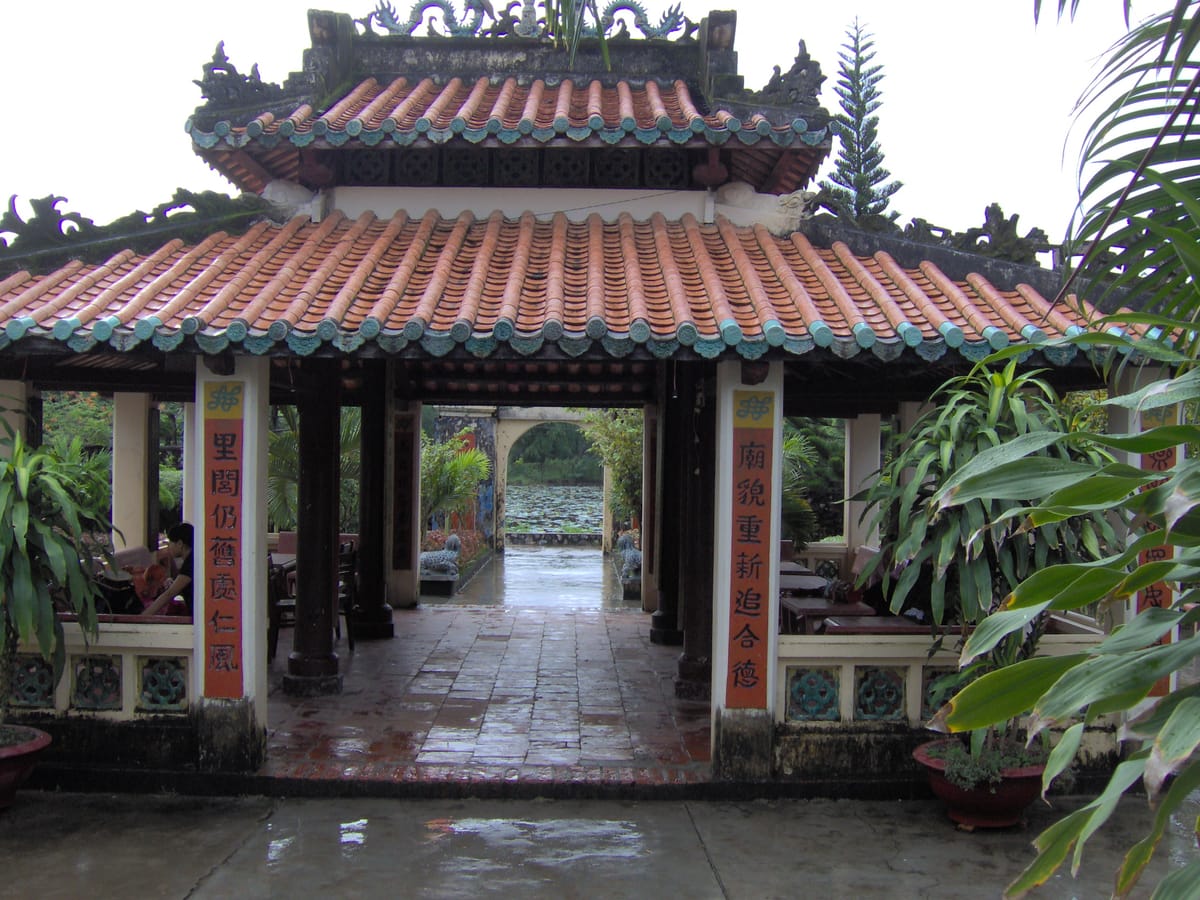
Most of Ha Tien's Chinese were Ming loyalists. Their villages were called Minh Huong communes, and Vietnamese later used Minh Huong as the term for Chinese who came south during the Ming-Qing transition and settled. In a side hall beside Mac Cuu's tomb, the spirit tablets of the Minh Huong and seven-village settlers who followed him are still there. Ha Tien today is a border crossing into Cambodia and the place a lot of people catch the boat to Phu Quoc.