Why Is Vietnamese Women's Day on October 20? It Starts With a Meeting in Hong Kong
Vietnam's second women's day commemorates a 1930 Communist Party resolution passed in Hong Kong. The Party's own chronicle gives that resolution no date, and the only entry for October 20 is a peasant protest.
[Why Is Vietnamese Women's Day on October 20? It Starts With a Meeting in Hong Kong]
In most of the world, Women's Day falls on March 8. It grew out of the labour movements of early twentieth-century North America and Europe, where women fought for labour rights, the vote and equality. The date later became tied to the women's protests of the 1917 Russian Revolution, and the United Nations only recognised it officially in 1977.
Vietnam has a second one, on October 20. Its origin is entirely different. It traces back to a resolution of the Vietnamese Communist Party, and the meeting that passed it was not held in Vietnam at all. It was held in Hong Kong.
In October 1930, the Party was less than a year old. It gathered its Central Committee in Hong Kong for its first plenum, run by Trần Phú, who was elected the Party's first general secretary at that same meeting. The plenum ran for more than two weeks and produced a stack of resolutions, one per subject: workers, peasants, youth, soldiers, anti-imperialism. One of them dealt with women.
That resolution was specific. It said women made up a large share of Indochina's working class and that employers hired them to cut labour costs. It said feudal society treated women as servants and denied them freedom. It told the Party to raise women's own demands in its struggles: no dangerous work for women, maternity leave, an end to marriages arranged like sales. And it told the Party to build a "women's association" to bring more women in. Today's Vietnam Women's Union treats that resolution as its starting point.
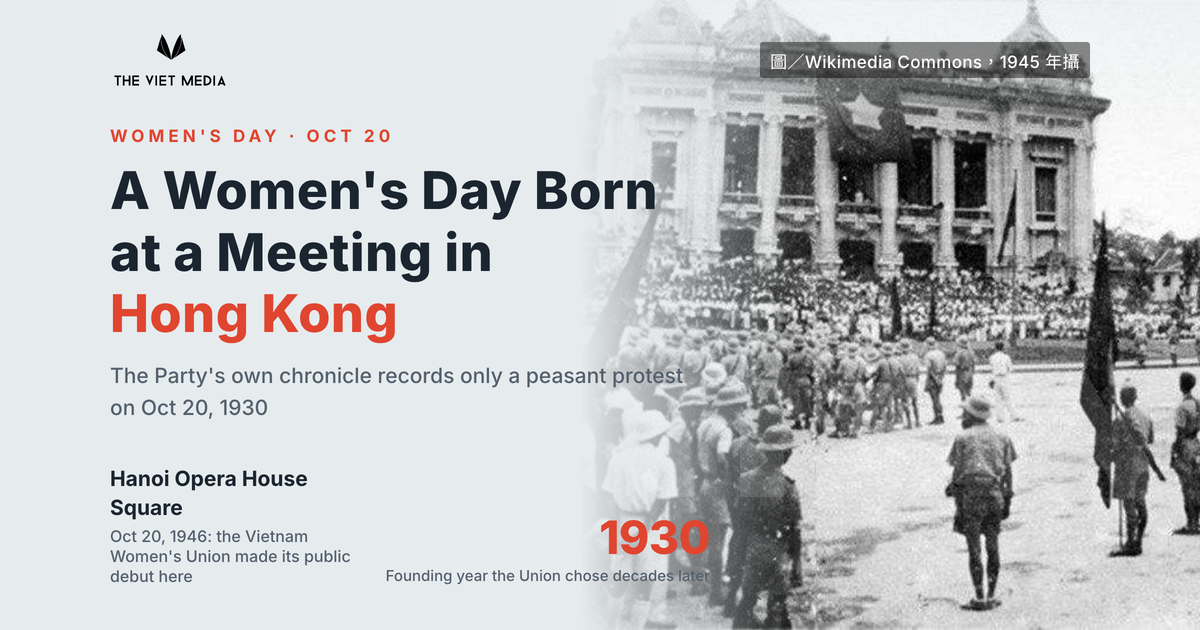
For its first years the organisation could not even use a name in public. It hid behind everyday labels: planting societies, harvest societies, mutual-aid societies. The name changed several times with the political weather; the "Anti-Imperialist Women's Association" that often gets cited came almost a decade later. Only in 1946 did it appear in public under the name it still carries. Early that October the interior minister signed a decree permitting the Vietnam Women's Union to form, and on October 20 the union held its debut ceremony on the square in front of the Hanoi Opera House. Lê Thị Xuyến, a former teacher who had just been elected to the first National Assembly, was named its first acting president.
Yet that is not the day the union counts as its birthday. In 1974 the fourth National Women's Congress set the founding date at October 20, 1930, citing the women's resolution passed in Hong Kong and a set of statutes for a women's federation drawn up at the same time. In 1976, with the war over, the northern union and the southern Women's Liberation Association merged at a unification congress in what is now Ho Chi Minh City, and the date was confirmed again.
But the Party's own historical chronicle, published by its central documents office, records every resolution from that plenum under a bare "October," with no day attached. The women's resolution is no exception. The chronicle has exactly one entry marked October 20, 1930: several thousand peasants in Bình Lục district, in the northern province of Hà Nam, marching in support of the peasant uprisings in the central provinces of Nghệ An and Hà Tĩnh. Nothing in the chronicle links that day to a women's organisation.
So the month comes from the 1930 resolution, and the day happens to match the 1946 debut ceremony. Why that particular day was chosen, the union's handbook and public statements do not say. It took decades more for the date to become a holiday. In 2010 the Party's Central Secretariat issued a notice approving October 20 as Vietnamese Women's Day each year. It is not a day off.
This week the Quảng An flower market in Hanoi has been busy from midnight until the small hours, and at Hồ Thị Kỷ market in Ho Chi Minh City, Đà Lạt roses are selling for twice their usual price. The bouquet handed over in March commemorates a movement. The one handed over tomorrow commemorates a birthday an organisation settled on long after the fact.
The Viet Media Pro: at least four in-depth articles a month, access to every paid article, building into a knowledge base on Vietnam's policy, industries, companies, and people.