Why Is Vietnam's Leading Jeweler Worried About Buying Back Diamonds?
A smuggling case involving staff at PNJ's gem-testing subsidiary prompted customers to sell back jewelry, leaving the retailer with payments to make and goods worth less than their buyback price.
[Why Is Vietnam's Leading Jeweler Worried About Buying Back Diamonds?]
Diamonds sold years ago are returning to PNJ, Vietnam's leading jewelry retailer. Paying customers for them is putting pressure on its cash, while the jewelry coming back may be worth less than the company has agreed to pay.
The wave of buybacks followed a diamond-smuggling case in July involving staff at PNJ's gem-testing subsidiary. Customers who had bought diamonds and jewelry began asking the company to buy them back.
PNJ, or Phú Nhuận Jewelry, still needs money to run its stores, purchase supplies and keep production going. In its first-half financial statements released in early September, the company acknowledged that a sharp increase in buyback demand since July had raised its working-capital needs and strained short-term liquidity.
Subsequent-event disclosures showed that PNJ had completed about VND 5 trillion in buyback transactions between early July and early September, with payments being made over time. A surge in transactions creates payment obligations immediately. Reselling or recycling the goods takes longer, tying up cash in the meantime.
Police accused staff at P-Lab, PNJ's wholly owned gem-testing subsidiary, of participating in smuggling. They allegedly removed diamonds' original grading numbers, engraved P-Lab numbers in their place and issued new certificates.
The case damaged confidence in the parent brand. PNJ acknowledged in its financial statements that the decline in customer trust had disrupted its business plans.
In August, Vietnam's Ministry of Public Security said preliminary findings showed that diamonds sold by the suspects had not entered PNJ's retail system. The company also held diamond import documents. But PNJ still had to pay for goods it had already bought back and find ways to sell or reuse them.
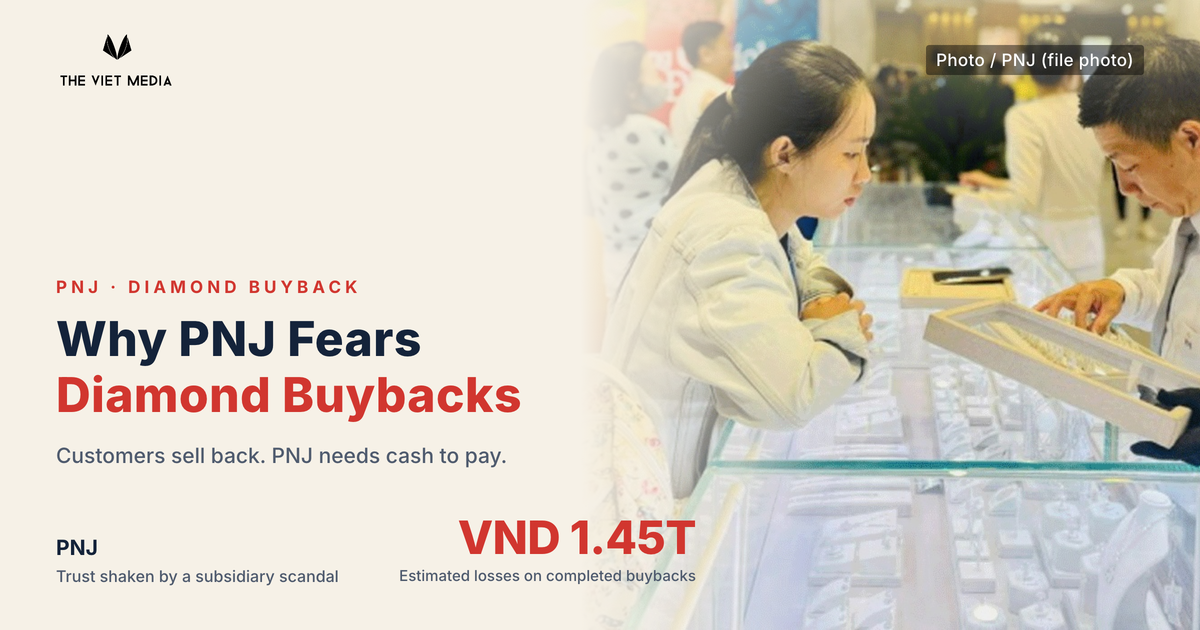
Those buybacks also carry a direct financial cost. PNJ estimated losses of about VND 1.45 trillion on the transactions disclosed above: the value it expected to recover from the goods was lower than the buyback prices it had committed to pay.
Its responses, outlined in the financial statements, included adjusting payment schedules for buybacks and suppliers, converting some returned products into gold and raw materials for reuse, and negotiating with banks to continue loan disbursements.
The exposure extends beyond jewelry already returned. Many diamonds and pieces of jewelry sold in the past remain in customers' hands. Where buyback commitments still apply, a customer's decision to sell can create another payment obligation for PNJ.
According to the company's early-September disclosures, the buyback rate began falling in the first half of August and gradually returned to its average level before the incident. Even so, PNJ's September proposal to revise its annual business plan raised its estimates for future buybacks and exchanges. It also anticipated that product categories with higher loss rates could account for a larger share of returns.
PNJ therefore proposed a large provision to account for potential future buyback losses. It also lowered its revenue and gross-profit forecasts. Including the provision, the revised annual plan projected a full-year after-tax loss of about VND 6.27 trillion.
The cash pressure is visible in how long customers must wait for their money. Under arrangements announced in late September, PNJ pays for returned loose diamonds and diamond jewelry in installments, with the final payment due 120 days after the transaction.
PNJ has also proposed raising capital through a private placement. The proceeds would support its business plan following changes to the buyback policy, working capital and short-term borrowings. An extraordinary shareholders' meeting scheduled for October 21 will discuss the revised annual plan and the placement.