Who Is Actually Working Vietnam's Rare Earths? The Mine Sat Idle for 12 Years, and Every Plant Runs on Imported Feed
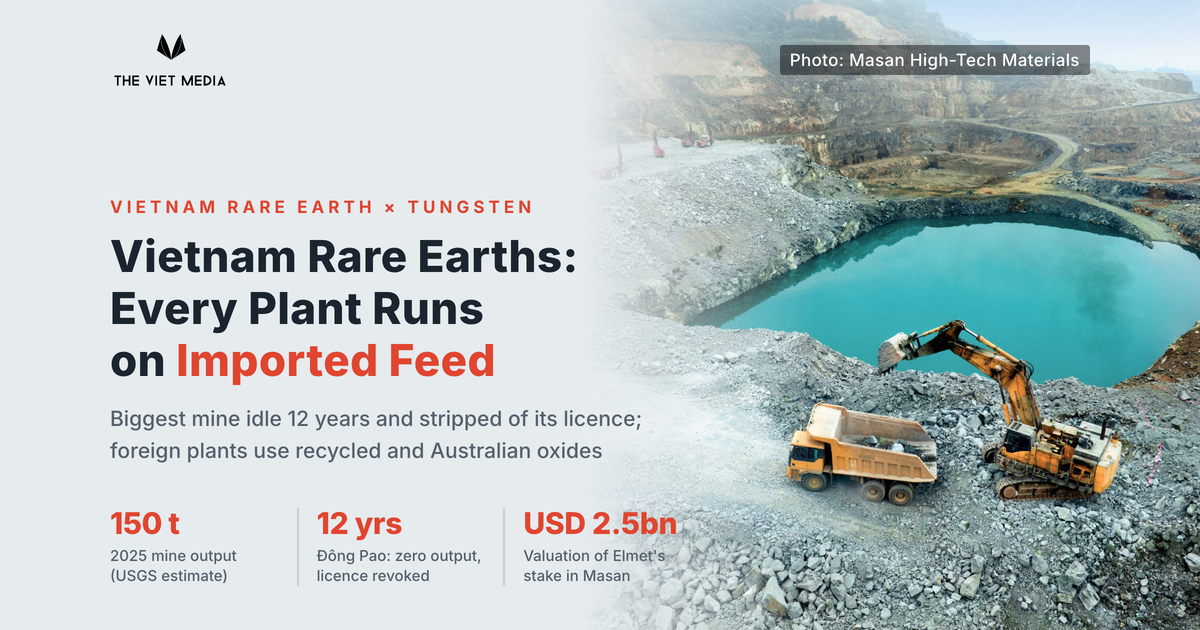
Vietnam's biggest rare earth mine produced nothing in 12 years and lost its licence; every operating plant is foreign-owned and runs on imported or recycled feed; tungsten is Masan's alone; foreign entrants have found exactly three ways in.
[Who Is Actually Working Vietnam's Rare Earths? The Mine Sat Idle for 12 Years, and Every Plant Runs on Imported Feed]
Vietnam's rare earth mines and its rare earth plants live in two different worlds. On the mining side, the country's largest deposit, Đông Pao, is held by a state-owned subsidiary that has produced nothing in 12 years and lost its investment certificate early this year. The only local company with a separation plant, VTRE, saw its chairman jailed for smuggling in 2025. What actually runs are four foreign-owned processing plants, Shin-Etsu, LS, SRE and SGI Vina, and all of them use recycled or imported feed. Tungsten is the exception: one company, Masan, owns both the mine and the refinery. Precious metal recycling comes down to one Japanese refinery, Matsuda Sangyo, while a US-backed joint venture with ERI has not opened yet.
In January the government classified rare earths as a "special strategic mineral" that only state-designated companies may mine. In October it floated a draft that would allow exports in five deep-processed forms. On the corporate side, only Masan is expanding, bringing in foreign shareholders and planning a tungsten scrap recycling plant.
Foreign companies have landed in exactly three ways: wholly owned plants that bring their own feed, offshore feedstock tolled in Vietnam, and offtake or minority stakes with Masan. Every deal that touched Vietnamese mining rights in the past decade has collapsed.