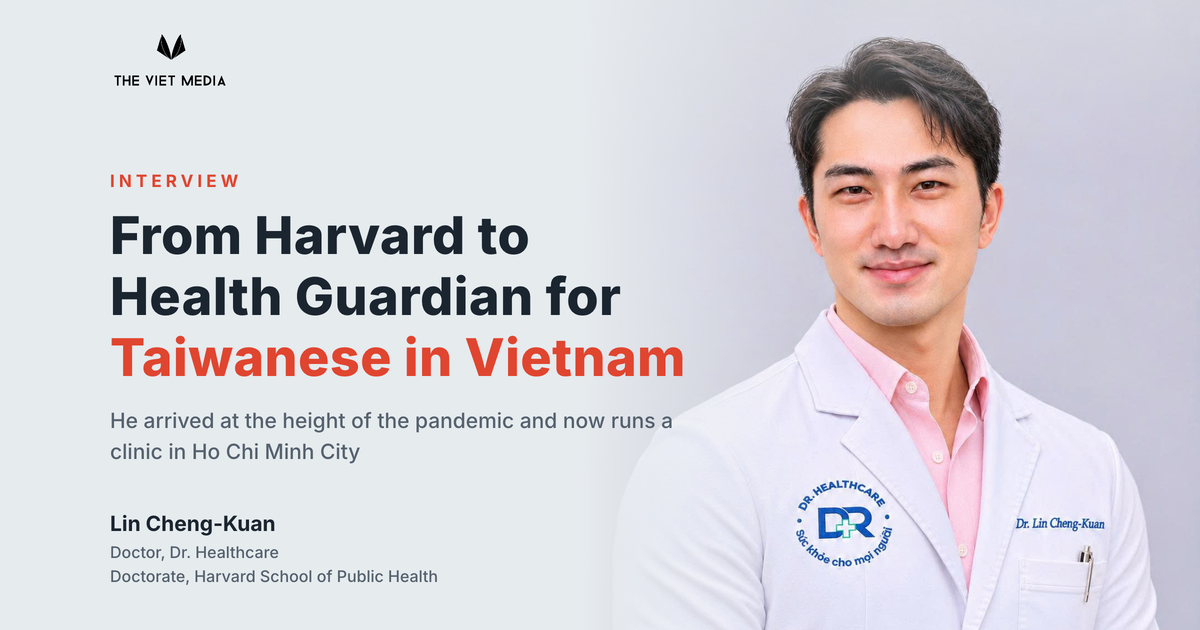
From Harvard Public Health PhD to Health Guardian for Taiwanese in Vietnam: Dr. Lin Cheng-Kuan's Journey
Lin Cheng-Kuan spent years studying the health of migrant workers. Then he moved to Vietnam in the middle of the pandemic and became one.
[From Harvard Public Health PhD to Health Guardian for Taiwanese in Vietnam: Dr. Lin Cheng-Kuan's Journey]
In the summer of 2021, Vietnam was hit by the worst wave of its Covid-19 outbreak. At a hospital in Biên Hòa, Đồng Nai province, Taiwanese doctor Lin Cheng-Kuan pulled on protective gear and walked into the isolation ward. The hospital had switched off the air conditioning for fear it would spread the virus. The room was close to 40°C. His goggles fogged up the moment he stepped inside, so badly he could barely read the patient list in his hand.
From July 9, Ho Chi Minh City and Đồng Nai went into full lockdown, and Lin simply moved into the hospital. In Chinese, the job title for a medical resident literally means "a doctor who lives in the hospital." It is a training-stage title. In Vietnam, Lin ended up living it word for word. "After the lockdown," he joked, "I really became a resident doctor."
Nobody wanted to go into the isolation ward at the time. Lin went in with a sense of purpose. He was in junior high school during the SARS outbreak and grew up hearing stories of older doctors working through it.
"A once-in-a-century pandemic, and I got to be right in the middle of it."
A few months earlier, he had been living a very different life. Lin studied medicine at Kaohsiung Medical University, completed his residency at National Taiwan University Hospital, then earned a doctorate at the Harvard T.H. Chan School of Public Health. He went on to research and teach in the US, at the Environmental Protection Agency and a pharmacy and health sciences university in Massachusetts. Then a senior alumnus from his medical school asked whether he would go to Vietnam as deputy director of a hospital that a Taiwanese group had opened there.
Two things convinced him. The hospital's leadership said it planned to open a medical school once the hospital was running smoothly. "Education is what interests me most," he says. The other reason was his research. Lin studies migrant worker health, a branch of occupational medicine, and he felt that the many Taiwanese living in Vietnam had no doctor they could really trust. After years of studying migrant workers, he was about to become one.
Reality was harder than he expected. He admits that by his second week on the job he wanted to go home. "I was too used to America. I didn't understand how workplaces in Asia work." He had been promised a post in the VIP wing. Instead, the hospital asked him to cover the emergency room first. He didn't refuse. "I was even willing to do free clinics." Then the pandemic hit, and he spent months in the isolation ward. Looking back, he counts it as one of the biggest periods of growth in his career.
He left the hospital in 2023 and spent most of the following year back in the US. Plenty of people urged him to return to Vietnam, and eventually he did. In May 2025, he opened the Dr. Healthcare medical center in Ho Chi Minh City's District 6.
The longer you stay, the more there is to watch. Lin recommends that Taiwanese living in Vietnam long term get their checkups done at Dr. Healthcare rather than back home. Local conditions shape local illness, he says, and doctors in Taiwan may not think to look for diseases that are common in Vietnam.
One example is Helicobacter pylori, a bacterium linked to stomach ulcers and stomach cancer. He advises long-term residents to add a test for it. A meta-analysis of studies across Vietnam put the infection rate among adults at about 58.7%, compared with roughly one in five in a Taiwanese survey. Lin thinks Taiwanese who have lived in Vietnam for years, eating out and sharing meals with locals, may face a higher chance of infection than they would at home. Treatment also has to account for antibiotic resistance, which differs between the two countries, so one approach won't fit both. Parasites, dengue and even lifestyle-related hyperthyroidism are other conditions a checkup in Taiwan can easily miss.
Taiwan's national health insurance does offer some protection. It reimburses medical costs paid abroad for sudden, unexpected emergencies or emergency childbirth. But routine care for chronic conditions, health checkups and dental implants in Vietnam are not covered, and the insurance doesn't pay for checkups or implants in Taiwan either.
In the end, it all comes back to the subject Lin has studied for years. Researchers talk about the "healthy worker effect": migrant workers often turn out healthier than people in their home country, because those who go abroad have already been screened, and those who get injured on the job are often sent home. The ones left to be tracked are the healthiest. Lin sees the same pattern among Taiwanese expats in Vietnam. Parent companies tend to send their most capable and healthiest people overseas, so the numbers look good. That doesn't mean working abroad comes at no cost. "If these people had stayed home, they might be even healthier."
After years of studying migrant workers, Lin is now one of them. He agrees that Taiwanese in Vietnam are migrant workers too, and that the obstacles they face in getting medical care are no different from those foreign migrant workers face in Taiwan. What brought him to Vietnam was that the Taiwanese living here couldn't find a doctor they trusted. When Dr. Healthcare opened last year, he set himself a goal: to become a health guardian for Taiwanese in Vietnam.
This article reflects the interviewee's personal experience and views and is not medical advice. Please consult a qualified doctor.
The Viet Media Pro: at least four in-depth articles a month, access to every paid article, building into a knowledge base on Vietnam's policy, industries, companies, and people.