Dạ Doesn't Just Mean ‘Yes’: Why Vietnamese Speakers Say It Before ‘No’
Vietnamese speakers may begin a negative answer with dạ because the word marks a polite response, not necessarily agreement.
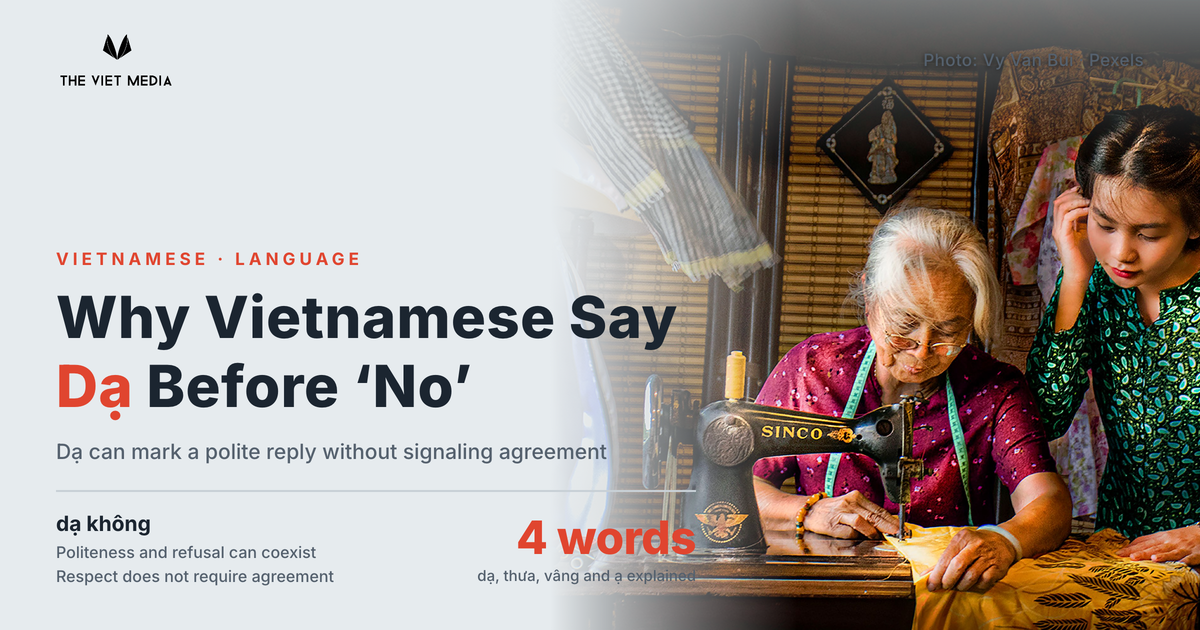
[Dạ Doesn't Just Mean “Yes”: Why Vietnamese Speakers Say It Before “No”]
A Vietnamese writer once recalled seeing a woman on a bicycle pass an acquaintance. He could no longer remember the question she was asked. What stayed with him was the woman's reply. Even after riding past, she turned back and called out: “Dạ, thưa không!”—a respectful way to say “no” or “there isn't.” People nearby praised her manners and told their children to answer the same way.
The reply has three parts. Dạ marks a polite response. Thưa signals that the speaker is addressing someone with deference. Không carries the actual negation. If you learn dạ simply as the Vietnamese word for “yes,” the phrase looks like a contradiction. It is not.
In Vietnamese, dạ can answer someone calling your name or open a sentence politely. In conversation, it may signal “I'm listening” rather than “I agree.” An affirmative answer can begin with dạ, but so can a negative one.
Four small words tend to confuse learners: dạ, thưa, vâng and ạ. Dạ can stand alone as a response or appear at the start of a sentence. Thưa is often used when speaking to an elder, a teacher or an audience; thưa quý vị, for example, means “ladies and gentlemen.”
Vâng is a polite response that usually conveys agreement, acceptance or willingness to comply. Ạ normally appears at the end of a sentence to show respect or warmth toward the listener. All four relate to politeness, but they do different jobs and occupy different positions.
Regional usage adds another layer. When politely saying “yes” or “okay,” speakers in northern Vietnam more often use vâng, while speakers in the south more often use dạ. The two are not interchangeable in every sentence. Dạ can introduce a negative reply, while vâng mainly signals agreement or acceptance. Speakers may also combine them as dạ vâng. None of these differences makes one region more polite than another.
These words matter partly because Vietnamese builds social relationships into everyday forms of address. Speakers use kinship terms such as anh for an older male, chị for an older female, em for a younger person and cô for a woman of an aunt's generation—even when no one is related. The choice depends on age, relationship and attitude. Dạ or thưa can then adjust the tone of the opening.
English speakers can use I and you without recalculating them for each person. Vietnamese speakers often have to decide how both sides of the conversation relate before choosing a form of address. Someone asking an older man for directions might address him as anh and begin the question with dạ. The first word defines the relationship; the second makes the approach polite.
The expression gọi dạ, bảo vâng—roughly, “when called, answer dạ; when instructed, answer vâng”—describes someone who treats elders respectfully. It can also imply that the person is obedient and easy to guide. Vietnamese folk verse likewise places dạ and vâng alongside telling family members when one arrives or leaves, presenting them as part of a child's upbringing.
The same expectations appear in modern school rules. A code of conduct issued by Vietnam's Ministry of Education and Training in 2019 says students should be kính trọng, lễ phép—respectful and polite—toward teachers, parents and relatives. It does not prescribe dạ or thưa specifically. The rule addresses courtesy more broadly.
Vietnamese media have recently returned to a familiar question: are dạ and thưa disappearing from everyday speech? Some young people now reply with ok, được (“okay”), biết rồi (“I know”), or a short text message. One report recorded a mother reminding her son to come home early. Still looking at his phone, he answered: “Biết rồi mà, lát con về.”—“I know. I'll be home later.” The sentence contained neither dạ nor thưa.
Scenes like this do not prove that an entire generation has abandoned polite speech. The reported experiences point in opposite directions. Some people skip dạ and thưa in family messages because the relationship feels close. Others begin using dạ more often after entering the workplace and find that older colleagues seem more comfortable when they do.
Polite particles are only one measure of respect. Listening without interrupting, apologizing after a mistake and acting honestly at work matter too. A person can use dạ and thưa perfectly while still treating others badly.
Nor do these words prevent disagreement. A younger speaker can say, “Dạ, con không đồng ý với quan điểm này.”—“I don't agree with this view.” A student can tell a teacher, “Thưa cô, em có một cách nhìn khác.”—“Teacher, I see it differently.” The opening preserves respect; the rest of the sentence still rejects the other person's position.
Vietnam has debated before whether politeness should mean obedience. At an education conference in 2021, a proposal called for schools to stop using the slogan Tiên học lễ, hậu học văn—“First learn propriety, then learn knowledge.” The proposal did not reject teaching courtesy. It questioned the way ngoan, or “well-behaved,” can be narrowed to mean easy to manage and always obedient, turning propriety into a one-way demand.
The fact that dạ can come before a refusal makes the distinction clear. Respecting the person you are speaking to and accepting that person's opinion are not the same thing.
Foreign learners do not need to memorize an elaborate rulebook. A few common situations cover much of daily life. To ask a stranger for directions, one source gives: “Dạ, anh cho hỏi đường đến Bệnh viện Mắt.”—“Excuse me, could you tell me how to get to the Eye Hospital?” Here, anh addresses a somewhat older man. The form of address should change with the listener.
When an elder calls or asks a question, dạ is a safe way to begin the reply—even when the answer is no. In a formal address, thưa quý vị works for “ladies and gentlemen.” Ạ often goes at the end of a sentence to show respect. None of these words needs to appear in every line. Their use depends on the listener, the relationship and the setting.
Dạ has no single English equivalent. Sometimes it means “yes” or “I'm listening.” At the start of a question, it may feel closer to “excuse me.” Once you understand its social function, hearing dạ before a negative answer no longer sounds contradictory.
The Viet Media Pro: at least four in-depth articles a month, access to every paid article, building into a knowledge base on Vietnam's policy, industries, companies, and people.