Vietnam's Vegetarian Market: Buddhism, Royal Cuisine, and a Billion-Dollar Cultural Advantage
When people think of Vietnamese food, they picture pho and grilled pork. But roughly one in ten Vietnamese eat vegetarian, and signs reading "Cơm Chay" line the streets of every major city. The forces behind this go far beyond religion.
[Vietnam's Vegetarian Market: Buddhism, Royal Cuisine, and a Billion-Dollar Cultural Advantage]
When people think of Vietnamese food, pho and bun cha come to mind. Walk the streets of Ho Chi Minh City or Hanoi, though, and you'll spot something that doesn't fit the image: vegetarian restaurants everywhere. Signs reading "Cơm Chay" hang above everything from sidewalk stalls to air-conditioned dining rooms.
About 10% of Vietnam's population eats vegetarian, according to data cited by Saigon Giai Phong, one of the country's major newspapers. That's a striking number for Southeast Asia.
But what makes Vietnam's vegetarian market truly unusual is the cultural infrastructure behind it: a three-layer structure built on Buddhist faith, royal culinary tradition, and a generational shift in consumer behavior.
▍ The First and Fifteenth: Vietnam's Built-In Vegetarian Cycle
The foundation is Buddhism.
Vietnam's Government Committee for Religious Affairs estimates the country has about 14 million Buddhists, or 13.3% of the population, making it the largest religious group. The 2019 census counted only 4.6 million (4.78%), because it only tallied formally registered adherents. The higher figure includes people who consider themselves Buddhist without formal affiliation.
Regardless of which number is more accurate, one thing is clear: on the first and fifteenth of every lunar month (mùng một and rằm), a huge number of Vietnamese go vegetarian. They call it ăn chay. It doesn't matter whether they're formally Buddhist. The practice runs through folk belief and family tradition, from grandmothers to young office workers.
From a market perspective, this "intermittent vegetarianism" creates a unique demand structure. These consumers aren't full-time vegetarians, but they eat vegetarian on a predictable monthly schedule. For suppliers, that's a scalable, recurring demand base, not a niche propped up by a small group of committed vegans.
▍ Hue: Where Royalty Made Vegetarian Food Elegant
If Buddhism solved the problem of getting people to eat vegetarian, Hue's royal cuisine solved a different one: making vegetarian food something people actually wanted to eat.
National Geographic has called Hue "the vegetarian food capital of Vietnam." The former imperial capital has over 300 Buddhist temples, with roots stretching back to the 16th century when the Nguyen lords moved south. In 1839, Emperor Minh Mang ordered the construction of Giac Hoang Temple inside the citadel walls. His successor ranked it among the capital's twenty finest sights.
The Nguyen emperors were devout Buddhists who strictly avoided meat on holy days. But here's the catch: each imperial meal demanded around 50 dishes. When you need to serve 50 distinct courses under a plant-only constraint, your chefs have no choice but to push vegetarian cooking to extraordinary levels of refinement.
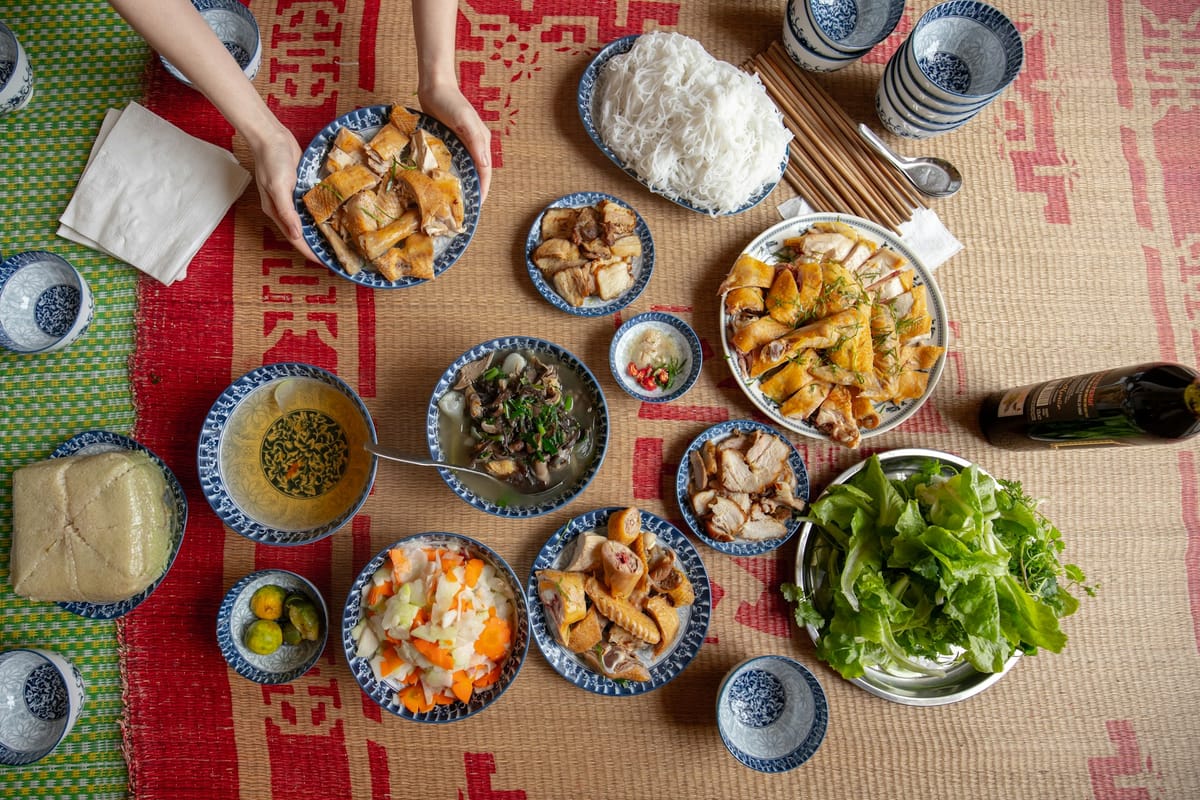
Mai Thi Tra, a 90-year-old Hue culinary artisan, recalls her mother preparing vegetarian feasts for Emperor Bao Dai. They would mash cooked mung beans and cassava into the shapes of shrimp, fish, and pork ribs, then fry, braise, and steam them. Imported lotus seeds, shiitake mushrooms, and enoki from China rounded out the elaborate spread.
These techniques eventually traveled from the palace to the streets. In the early 20th century, some of Emperor Thanh Thai's concubines and daughters of high-ranking officials became Buddhist nuns, carrying the refined culinary skills of the court into temple kitchens. From there, the techniques spread to ordinary restaurants. A century later, Hue's street-level vegetarian food still carries that DNA of ambition.
▍ From Faith to Lifestyle
Traditional Vietnamese vegetarian consumers ate plant-based food for religious reasons. In recent years, a new wave of consumers has joined them for entirely different motivations.
A February 2024 Rakuten Insight survey found that about 86% of Vietnamese respondents had tried plant-based food alternatives. Kantar data shows two-thirds of Vietnamese Gen Z and millennials actively incorporate plant-based protein into their diets, with over 80% of urban consumers regularly buying plant-based meat and dairy substitutes.
Vietnamese state broadcaster VTV reported that vegetarianism in Vietnam has "transcended food itself" (đã vượt ra ngoài câu chuyện ẩm thực). Young consumers are walking into vegetarian restaurants looking for calm and a sense of lifestyle, not just a meal.
But supply still has gaps. Traditional vegetarian restaurants (Cơm Chay) are dense in major cities, but modern plant-based alternatives haven't caught up in distribution. The same Rakuten Insight survey found that 39% of non-consumers said the reason was simply that these products weren't available near where they live. The market's ceiling is still a long way off.
▍ A Market Growing at Double Digits
This cultural base is translating into real market size.
Euromonitor International, as cited by VTV, estimates Vietnam's vegetarian food market at roughly USD 1 billion, growing 10-15% annually. IMARC Group projects the country's vegan food market will grow at a CAGR of about 10.10% from 2025 to 2033.
The gap between the two numbers is a matter of definition, not disagreement. Euromonitor uses the broader Vietnamese term "thực phẩm chay," which covers restaurant dining and traditional vegetarian food. IMARC's "vegan food" counts only packaged plant-based products. One measures the whole ecosystem; the other measures a subset.
Either way, the direction is the same: double-digit annual growth.
▍ Supply Side: From Temple Canteens to Michelin Picks
The market's growth is attracting a new wave of vegetarian brands that are reshaping what Vietnamese vegetarian food looks and feels like.
The 2025 Michelin Guide Vietnam listed 181 restaurants in total. Three vegetarian spots earned Bib Gourmand recognition:
➤ Chay Garden (District 3) — a colonial-era house with a garden courtyard, serving affordable Vietnamese vegetarian fare
➤ Vi Que Kitchen (District 1) — fully vegan, blending flavors from across Vietnam into modern dishes
➤ Hum Garden (Thu Duc City) — organic and locally sourced ingredients in a residential neighborhood setting
The most telling newcomer is Tales by Chapter, which opened in early 2025 in District 1 as Saigon's first zero-waste, plant-based fine dining restaurant. Chef Truong Quang Dung studied sustainable food production at Cambridge. His menu, called "ZERO," uses every part of every ingredient: corn kernels go into dishes while the cobs fuel the kitchen fire; carrot tops become dipping sauce; beetroot appears in five different forms. The restaurant serves one seating per night, with ingredients shipped three times a week from its own organic farm in Da Lat.
These restaurants point to a structural shift. Vietnamese vegetarian food is moving from budget temple-side buffets to designed, chef-driven, internationally recognized dining experiences.
▍ The Buddhist Moat
In late October and early November 2025, Ho Chi Minh City hosted its second Vegetarian Food Festival (Le hoi Am thuc Chay). Over five days, it drew more than 200,000 visitors across 150-plus booths from over 120 businesses. The event set a Vietnam record: 200 lotus-themed vegetarian dishes. Organizers explicitly branded HCMC as "Thu phu am thuc chay," the vegetarian capital.
Five days. 200,000 people. This is mass-market consumer behavior, not a niche interest.
Western plant-based meat companies have spent billions of dollars in marketing trying to convince people that skipping meat is normal. In Vietnam, Buddhist culture accomplished that for free over centuries. On the first and fifteenth of every lunar month, large numbers of Vietnamese walk into vegetarian restaurants without anyone having to persuade them.
That's the deepest moat around Vietnam's vegetarian market: not eating meat has never been strange here.
▍ Challenges: From "Big Enough" to "Good Enough"
Cultural roots don't equal a mature market. Vietnam's vegetarian sector still faces structural issues.
First, nutrition awareness lags behind enthusiasm. VTV reported that many young consumers equate "vegetarian" with "healthy" while ignoring protein and micronutrient balance. Over-reliance on processed vegetarian products can mean more additives, not fewer.
Second, supply is geographically uneven. The Rakuten Insight survey found 39% of non-consumers cited lack of availability near their homes. Big cities are seeing an explosion of options, but smaller cities and rural areas remain underserved.
Third, the market data itself is messy. Different research firms define "vegetarian market" in very different ways, and the numbers from Euromonitor and IMARC can differ by a factor of ten. For businesses and investors looking to enter, understanding what each number actually measures matters more than the number itself.
These challenges won't change the market's direction. But they'll determine how fast and how steadily it gets there.
The Viet Media Monthly
A curated monthly digest of the most important political, economic, tech, and industry developments in Vietnam.
Designed for reading on desktop or tablet — no algorithm, no noise. Just the stories that matter.
Delivered before the 10th of each month. Cancel anytime.