Why Do Vietnamese Restaurants Charge for Wet Wipes? The Answer Is on the Floor, Not the Table
Wholesale cost is under 1,000 VND, menu price is 2,000 to 5,000. A supplier calls it the most profitable item in the house. But what makes the rule stick at street level is a different calculation about free tissue ending up on the floor.
[Why Do Vietnamese Restaurants Charge for Wet Wipes? The Answer Is on the Floor, Not the Table]
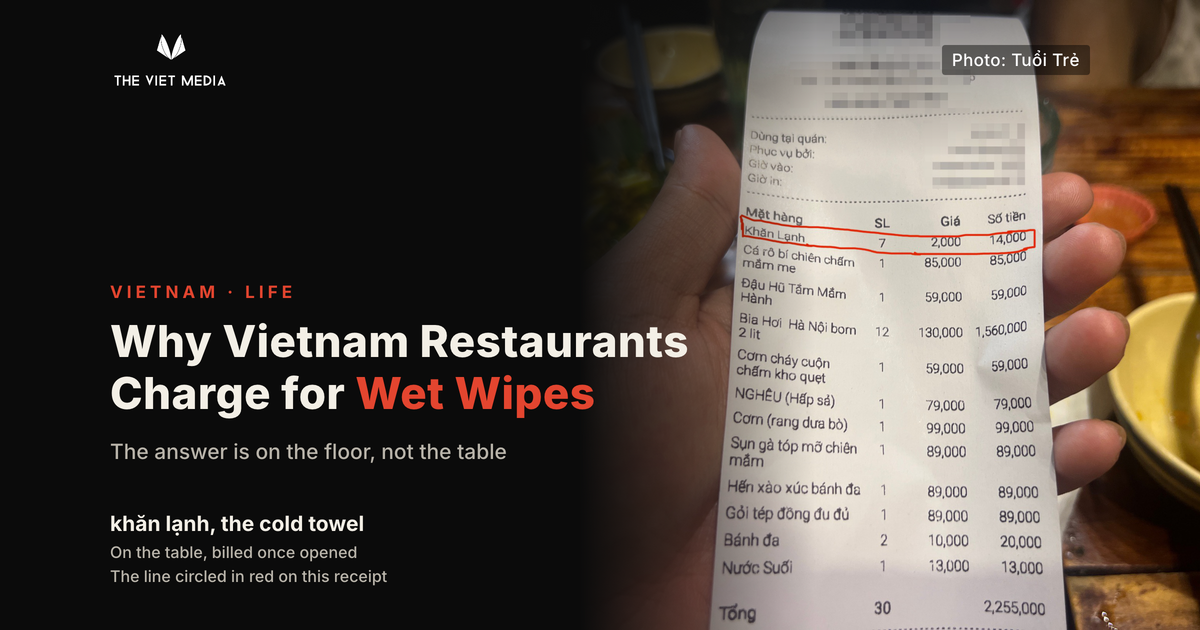
First-time visitors to Vietnam usually notice it on the first bill. A bowl of phở, a glass of iced tea, and then a line that needs translating: khăn lạnh, a few thousand dong. Ask the server and it turns out to be the wet wipe you tore open without thinking. Almost everywhere else, a napkin comes with the meal. In Vietnam it is a line item. Why?
Sit down at almost any restaurant in Vietnam and the table is already set with individually wrapped wet wipes. Khăn lạnh literally means "cold towel," because they are chilled before they come out. That counts as a service, and it is not free. The rule, in principle, is simple: open one and it goes on the bill, leave it sealed and it does not. Each one costs 2,000 to 5,000 VND. Many beer-and-grill joints go further and do not stock dry napkins at all, so once your hands are greasy, a wet wipe is the only option, and you pay for every one you tear open. One forum user in Hanoi complained that even plain packaged wipes, not chilled, were billed, and that staff came by after the meal to count how many had been opened.
The first reason is money, and the suppliers say so themselves. A Hanoi company that prints custom packaging for restaurant wipes published a sales pitch to food-and-beverage owners under the headline "The real profit is not in the food, it is in the wet towels." Its stated wholesale price runs from 400 to 900 VND per wipe depending on quality. Its suggested retail price starts at two or three thousand for small eateries and climbs to 10,000 at karaoke bars and large restaurants. Same wipe, very different willingness to pay. The same pitch tells owners to place the wipes right next to the bowls and chopsticks so customers open them without thinking, and notes that hardly anyone complains when the charge shows up on the bill.
The margin is not the only attraction. Wipes need no preparation, no extra staff, and unlike ingredients they do not spoil. The wrapper carries the restaurant's name and logo, and every customer handles one. A rough calculation shows the scale: a restaurant that sells 300 wipes a day at 1,500 VND profit each clears 13.5 million VND a month. For an industry known for thin net margins, that is not small change.
The second reason is how cheap restaurants in Vietnam set prices. Wipes are just one line in a long habit of itemising. A broken-rice shop in the Bình Thạnh area of Ho Chi Minh City charges 30,000 VND a plate and another 5,000 for parking. Some phở shops have stopped putting out free tea, and bill iced tea by the glass and bottled water by the bottle. Peanuts and iced tea that appear on the table while you wait for your food will appear on the bill too, unless you ask first. When a group spends several hundred thousand or several million dong on a meal, a few thousand more per head barely registers, and it goes down far more easily than a higher menu price would. Customers are not all happy about it. Some say they would rather see the broken rice priced at 35,000 than 30,000 plus 5,000 for parking. Others say that once a restaurant pulls this on them, they do not come back no matter how good the food is.
The third reason is on the floor. Put a full box of pull-out tissue on the table of a Vietnamese street eatery and by the end of the meal the floor is often covered in a layer of crumpled paper, even with a waste basket sitting right under the table. A reader letter to a newspaper ran with exactly that photo, captioned as a common sight in many restaurants. A supplier pitching to Hanoi bia hơi beer halls ran the numbers a different way: with free tissue, each customer uses 8 to 12 sheets, the paper ends up scattered across the floor and sometimes down the drain, and staff spend several minutes sweeping before the next table can sit down. With single-pack wipes, it is one per customer, half a minute to clear, and the item can go on the bill. Charging here works as rationing. Customers use less, and what the restaurant saves is the staff's sweeping time.
Vietnamese consumers who defend the charge make the same argument. Itemised pricing keeps the menu price as low as possible, they say, and billing for wipes cuts waste and litter. Some go further and argue free tissue should not be on the table at all, because too many people drop it on the ground when they are done. One forum user's version: wherever there is a free tissue box, the floor looks like a dump, and the moment the restaurant starts charging, nobody grabs a handful. But waste only explains why a street eatery charges at all. How much it charges is a different question. A karaoke bar getting 10,000 VND for the same wipe comes back to the first reason: customers there will pay it.
Per-piece billing predates the disposable wipe. Twenty years ago, many small restaurants in Ho Chi Minh City were still handing out reusable chilled cloth towels, and some suppliers were tiny workshops operating out of apartments, washing thousands of towels a day. The towels went into an old washing machine with detergent and bleach, came out without being sun-dried or sterilised, and were folded and packed straight away. Wholesale was 300 to 500 VND a towel. Restaurants chilled them and sold them for 1,000 to 2,000. A dermatologist warned at the time that wiping your face with one was a known route for cold sores. The towel on the table has since been replaced by a sealed disposable wipe. The way it is billed has not changed.
Some restaurants have also used the rule to pad bills. A receipt from a restaurant in District 3 of Ho Chi Minh City once circulated on Facebook showing a party of nine charged for 60 wet wipes, alongside close to a hundred cans of beer, and nobody online could make the numbers add up for one table. Vietnamese diners argue about all of this among themselves, and the flashpoint is usually that nobody said anything up front. A wipe sitting on the table looks free, and many people only find out otherwise when the bill arrives. Restaurants that print the price on the menu, mention it when the wipes come out, and leave unopened ones off the bill get far fewer arguments over a few thousand dong.
The Viet Media Pro: at least four in-depth articles a month, access to every paid article, building into a knowledge base on Vietnam's policy, industries, companies, and people.