Why Are Vietnamese Restaurants Called Phở 10, Phở 24, and Bánh mì 362? Three Sources of the Numbers
Phở 10, Bánh mì 25, Bún mắm 444, Bánh mì 362. The numbers on Vietnamese shop signs are mostly house numbers, sometimes years, sometimes lucky digits. They are easy to remember, easy to find, and easy to copy.
[Why Are Vietnamese Restaurants Called Phở 10, Phở 24, and Bánh mì 362? Three Sources of the Numbers]
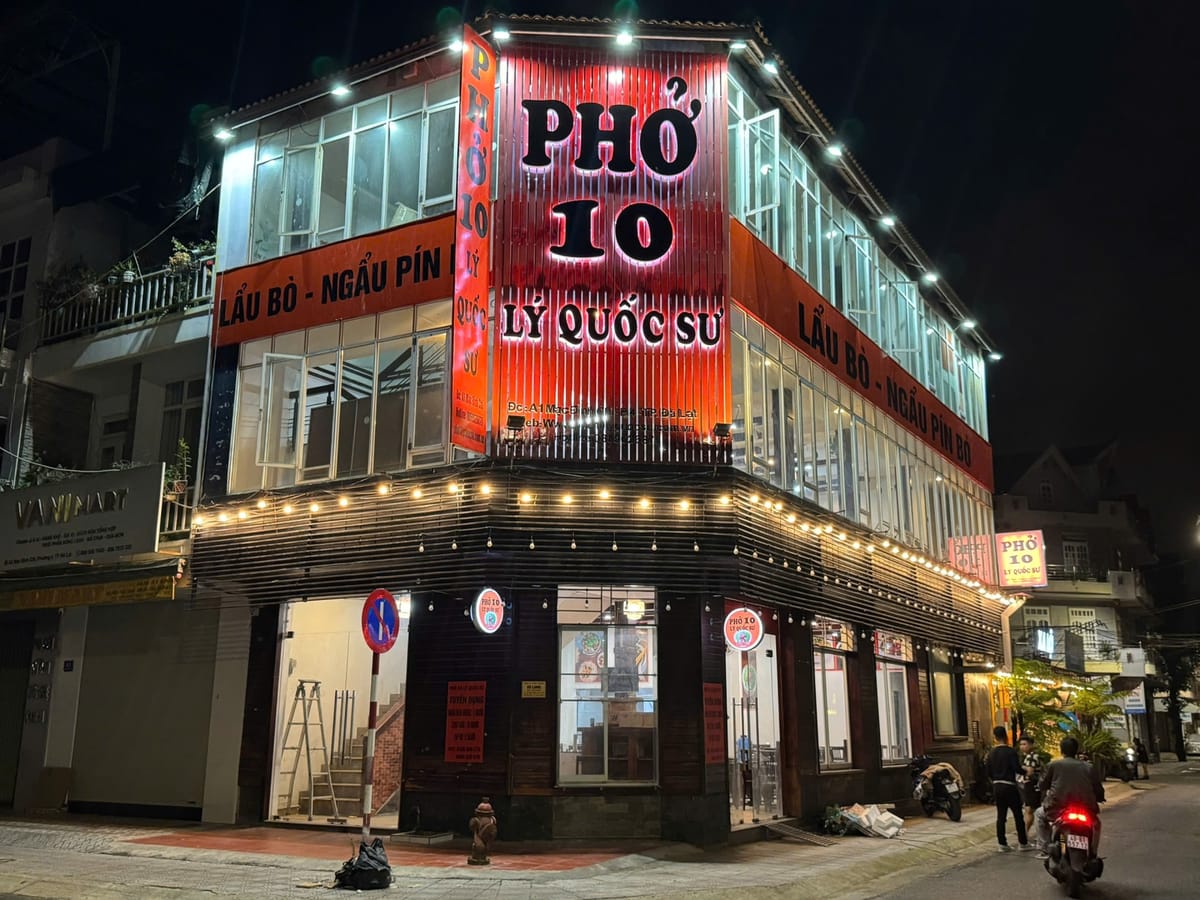
Walk through Hanoi's Old Quarter and the first thing you notice on the signs is often a number: Phở 10 Lý Quốc Sư, Bánh mì 25, Tuyết bún chả 34. In Ho Chi Minh City it is Bánh xèo 46A, Bún mắm 444, Bánh mì 362. The chains do it too. Phở 24 and Phở 2000 both put a number on the sign. When the 2026 Michelin Guide picked five bún chả (grilled pork with noodles) spots in Hanoi, one of them was Tuyết bún chả 34, and the 34 is simply its house number on Hàng Than Street. Another, Bún chả Đắc Kim, sits at 1 Hàng Mành Street, and Hanoians just call it Bún chả Hàng Mành.
The numbers come from three places: house numbers, years, and digits that sound lucky. At least among street-food shops, the house number is the most common source, and the easiest for someone else to borrow.
Naming a shop after its address grows out of an old street-food habit. A 2016 essay on Hanoi pho shop names put it bluntly: pho began as food for laborers in the French colonial period, and vendors named their stalls after whatever was easiest to recognize. A short owner became Phở Tư Lùn (Short Tư), a one-eyed one Phở Bình Chột, a heavy one Phở Vượng Béo. An address works the same way. Bún chả Đắc Kim opened at 1 Hàng Mành around 1966, and customers gradually stopped using the shop's name and started calling it "the bún chả on Hàng Mành," because the address was easier to remember and easier to find. Phở 10 Lý Quốc Sư skipped the middle step. When Phạm Ngọc Lân and his wife opened at 10 Lý Quốc Sư in 2005, the address was the name, and when they later opened two more branches in Hanoi, those branches kept the original house number too.
Moving does not change the name either. Bún mắm 444, a fermented-fish noodle shop in Ho Chi Minh City's Bình Thạnh District, now sits at 375 Lê Quang Định Street. A reporter asked the owner in 2022 why a shop at number 375 was called 444, and whether it was a lucky number. She said the shop had simply started at number 444 and moved years ago. She began with a street cart, had been at it for 26 years by 2022, and charges 75,000 to 85,000 VND a bowl.
A house number can even travel abroad. Bánh mì 362 started as a cart that founder Nguyễn Đăng Khoa's grandmother set up in 1980 at 362 Bạch Đằng Street in Bình Thạnh. The house at 362 was where he was born and grew up, he said in an interview, and the number means a great deal to the family. He opened his first shop in South Korea in September 2019 with a Korean partner who had been a regular since the cart days. By 2025 the brand had 30 shops in South Korea and only six in Ho Chi Minh City, and the signs in Korea still carry that Bình Thạnh house number.
A second group of numbers records a year. The first Phở 2000 opened in 1999 on Võ Thị Sáu Street in Ho Chi Minh City; the owners chose the name because they wanted a marker for the turn of the century. The business took off quickly and a branch opened next to Bến Thành Market. In November 2000, US President Bill Clinton walked into that Bến Thành branch and ordered a bowl of chicken pho, when the brand was barely a year old. The photo from that day is still on the wall.
Vietnamese emigrants took the year idea further. Pho 79 in Garden Grove, California opened in 1982; the 79 marks 1979, the year most of the family arrived in the United States, and in 2019 the restaurant won the James Beard Foundation's America's Classics award. Pho 75 in the Washington area points to 1975, the year the war ended. UCLA Vietnamese literature professor Chuc Bui has explained that Pho 54 refers to the 1954 partition of the country and Pho 45 to the famine in northern Vietnam in 1945. A server at Pho 54 said that when customers ask, staff sometimes just say it is a lucky number that is easy to remember.
Phở 24 belongs to neither group. The 24 is a brand number designed from day one. Lý Quí Trung opened the first shop in Ho Chi Minh City's District 1 in June 2003; the 24 stands for the 24 spices in the broth, and for 24 hours in a day.
The same 79 that marks a refugee's arrival year in California is the god of wealth back in Vietnam. The number 68 is read as Lộc Phát: in Sino-Vietnamese, the readings Vietnamese uses for Chinese-derived words, 6 is "lục," close to "lộc" (fortune), and 8 is "bát," close to "phát" (prosper). Both 68 and 86 show up constantly in bank account numbers, license plates, and phone numbers. The numbers 39 and 79 are called the small and the big god of wealth, and there are two stories about why. One traces them to the number tables passed around in lô đề, the underground lottery, where 37 and 77 stand for the sky god, 38 and 78 for the earth god, 39 and 79 for the god of wealth, and 40 and 80 for the kitchen god. The other reads them as homophones, the way 68 is read. Shop names follow. Vietnamese guides on naming a shop list "68 Shop," "Thiên Ân 99 Bakery," and "Hưng Thịnh Phát 88" as examples of picking a name with auspicious digits. There is a market price for this belief. In 2023 the license plate 51K-888.88 was bid up past 32 billion VND at auction; the winner never paid, and when the plate was re-auctioned in October it sold for 15.265 billion VND.
The trouble with house numbers is that anyone can stand on the same street and use the same number. Around 1 Hàng Mành there are now four shops with nearly identical "Bún chả Hàng Mành" signs, and in 2015 Đắc Kim went as far as hanging a bilingual sign at its door announcing that the "Bún chả số 1 Hàng Mành" next door was a fake. The neighbor, a former Đắc Kim employee, said all five houses in that row carry the number 1, so the name was simply easy for tourists to remember. Phở 10 Lý Quốc Sư has the same problem: plenty of shops in Hanoi hang a "Phở Lý Quốc Sư" sign, and the original has had to post a notice at the door explaining that it runs only three locations in the city.
The law is not much help. Vietnam's Intellectual Property Law treats numerals, letters, and signs that indicate a geographic origin as non-distinctive, so they cannot be registered as trademarks on their own unless they are already so widely used that everyone recognizes them. Phở 10 Lý Quốc Sư's application was refused twice and only approved in 2016 as a four-color logo protected as a whole, with neither "10" nor "Lý Quốc Sư" protected separately. The most famous case, Phở Thìn 13 Lò Đúc, is more awkward still. Nguyễn Trọng Thìn opened at 13 Lò Đúc Street in 1979 and put the house number next to his own name, but the words "Phở Thìn" had already been registered in 2003 by another Phở Thìn, founded in 1955 beside Hoàn Kiếm Lake. His own application was still pending in 2023, and there has been no news of approval since.
A house number is a way of finding a shop left over from the street-cart era. A year is a moment the owner wanted to keep. The digits 68 and 79 are a wish for good business. All three are easy to remember, and none of them belongs to anyone. The next time you see a number on a shop sign in Vietnam, it is most likely the house number the shop opened at. Look up at the door plate and it will usually match.
—
📢 A quick word from our sponsor
Heading to Vietnam and dreading the SIM card counter at the airport? I use Saily eSIM instead — buy it online before you fly, scan the QR code in the app, and your data connects automatically the moment you land.
Saily also lets you switch your virtual location in the app — traffic routes through a NordVPN server, so it works much like a VPN, though it doesn't encrypt data on the device — and it blocks malicious sites, ads, and trackers. Vietnam plans start at US$3.99 for 1GB/7 days, with 3GB/30 days at US$7.99 and 10GB/30 days at US$17.99. Unlimited plans are available too.
👉 Get your Saily eSIM → and use code Special10 for an extra 10% off