Vietnam's Q1 2026 GDP Grew 7.83% — but Who's Really Driving It?
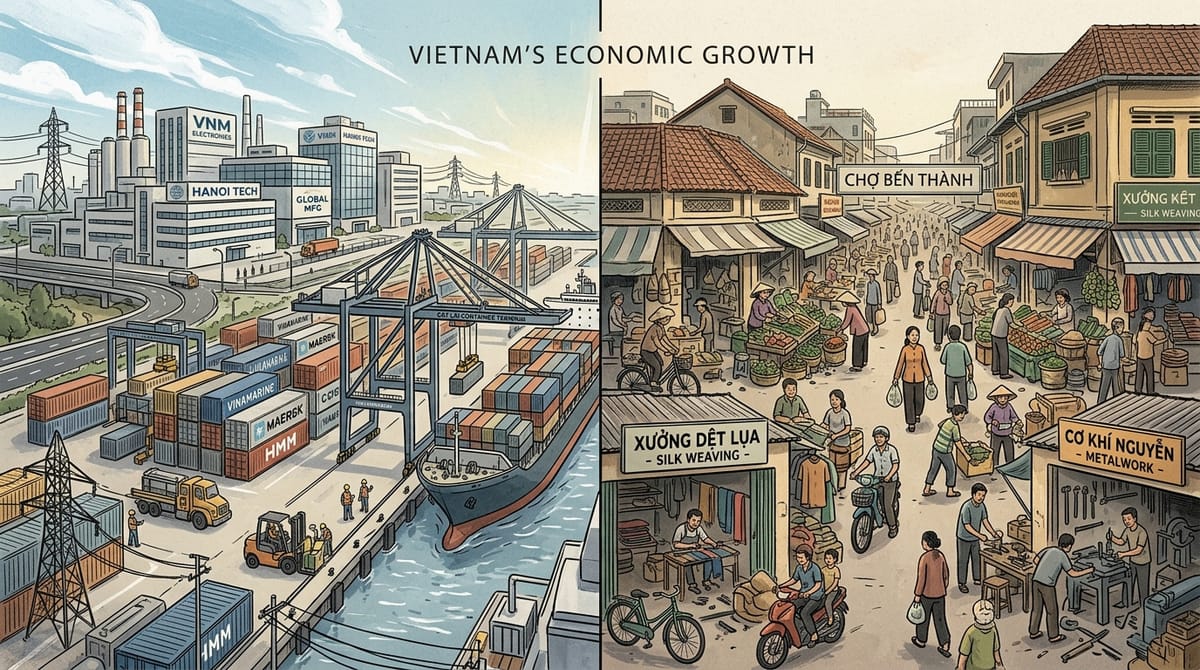
Vietnam's Q1 GDP growth looks impressive at 7.83%, but dig deeper and a structural imbalance emerges — foreign firms dominate exports while domestic companies fall behind.
[Vietnam's Q1 2026 GDP Grew 7.83% — but Who's Really Driving It?]
Vietnam's General Statistics Office announced on April 4 that the economy expanded 7.83% year-on-year in the first quarter of 2026, up from 7.07% in Q1 2025.
The headline number looks strong. But context matters.
Growth actually slowed from 8.46% in Q4 2025, and it falls well short of the government's full-year target of at least 10%.
At this pace, Hanoi has a lot of ground to make up.
▍ Where the Growth Came From
Services contributed just over half of the quarter's growth, expanding 8.18%.
Industry and construction accounted for 44%, growing 8.92%.
Agriculture, forestry and fisheries chipped in less than 6%.
The standout was manufacturing, which grew 9.73% and alone contributed a third of total GDP growth.
Electronic component output surged more than 30%.
The overall industrial production index rose 9%, its strongest first-quarter showing in five years.
▍ Exports Are Booming — but Look at Who's Exporting
Total trade reached nearly $250 billion in Q1, up 23% year-on-year.
Exports hit $122.9 billion, up about 19%.
Here's the catch: 80% of those exports came from foreign-invested enterprises.
Foreign firms shipped $98.5 billion worth of goods, up 33%.
Vietnamese domestic companies exported just $24.5 billion — less than a fifth of the total — and that figure actually fell 17% from a year earlier.
For every five dollars Vietnam exports, four come from foreign firms.
Domestic companies contribute just one.
The quarter also saw a $3.6 billion trade deficit, reversing last year's surplus.
Imports jumped 27%, with foreign firms ramping up purchases of machinery and components by more than 45%.
Much of this reflects capacity expansion — the factories are still being built.
▍ FDI Keeps Flowing In
Foreign investors remain bullish on Vietnam.
Registered FDI reached $15.2 billion in Q1, up nearly 43%.
Among the 904 newly approved projects, registered capital totaled over $10.2 billion — 2.4 times the level a year ago.
Actual disbursements hit $5.4 billion, up 9% and the highest Q1 figure in five years.
The money is heavily concentrated: Singapore accounted for over half, South Korea for 36%, and the two countries together made up nearly 90% of the total.
Nearly 70% of new FDI went into manufacturing, and more than 80% of disbursed capital ended up on factory floors.
▍ Consumption Is Recovering, but Inflation Is Catching Up
Domestic spending picked up.
Retail sales and consumer services grew nearly 11% year-on-year, and final consumption expenditure rose over 8%.
The Lunar New Year holidays helped, and international arrivals hit 6.76 million — a record for any first quarter, up more than 10%.
But inflation is accelerating.
The average CPI increase for Q1 was 3.5%, and by March it had climbed to 4.65%, the highest monthly reading in nearly three years.
Rising oil prices, costlier construction materials and higher food prices are all pushing up the cost of living.
The government's full-year CPI target is 4.5% — and March already brushed against that ceiling.
▍ Risks Ahead
The first risk is US tariffs.
After the Supreme Court struck down the IEEPA tariff framework, the effective tariff rate on Vietnamese goods entering the US now stands at roughly 16% under Section 122.
But the US Trade Representative launched a new Section 301 investigation in March, targeting Vietnam and 14 other countries over "structural excess capacity in manufacturing."
Goods caught being transshipped to dodge duties face an additional 40% penalty.
The US trade deficit with Vietnam keeps widening — it reached $145.7 billion in 2025, up more than $20 billion from the year before.
The bigger that gap gets, the more political attention Vietnam draws.
The second risk is energy costs.
The statistics office warned at its press conference that Middle East tensions could push oil and raw material prices higher in Q2, adding pressure to supply chains.
Vietnam's manufacturing sector is heavily reliant on imported inputs, and that pressure is already building.
▍ The Engine Is Shifting Gears
Vietnam's Q1 data tells a story of real growth with a structural catch: most of the gains are accruing to foreign capital.
Domestic enterprise exports fell nearly 20%.
More than 57,000 new firms were registered in the quarter — up nearly 60% — but over 30,000 businesses also exited the market each month.
Entrepreneurial energy is there, but so is the squeeze.
A 7.83% growth rate is solid by any standard, but it's a long way from the 10% Hanoi is aiming for.
The bigger question is whether growth that relies so heavily on foreign manufacturing can hold up when tariff risks are rising and domestic firms are losing ground.
The next few quarters will show whether 7.83% was a strong start — or a number that flatters to deceive.
The Viet Media Monthly
A curated monthly digest of the most important political, economic, tech, and industry developments in Vietnam.
Designed for reading on desktop or tablet — no algorithm, no noise. Just the stories that matter.
Delivered before the 10th of each month. Cancel anytime.