Vietnam's First Cross-Region High-Speed Rail Breaks Ground — VinSpeed's Under-a-Year Blitz
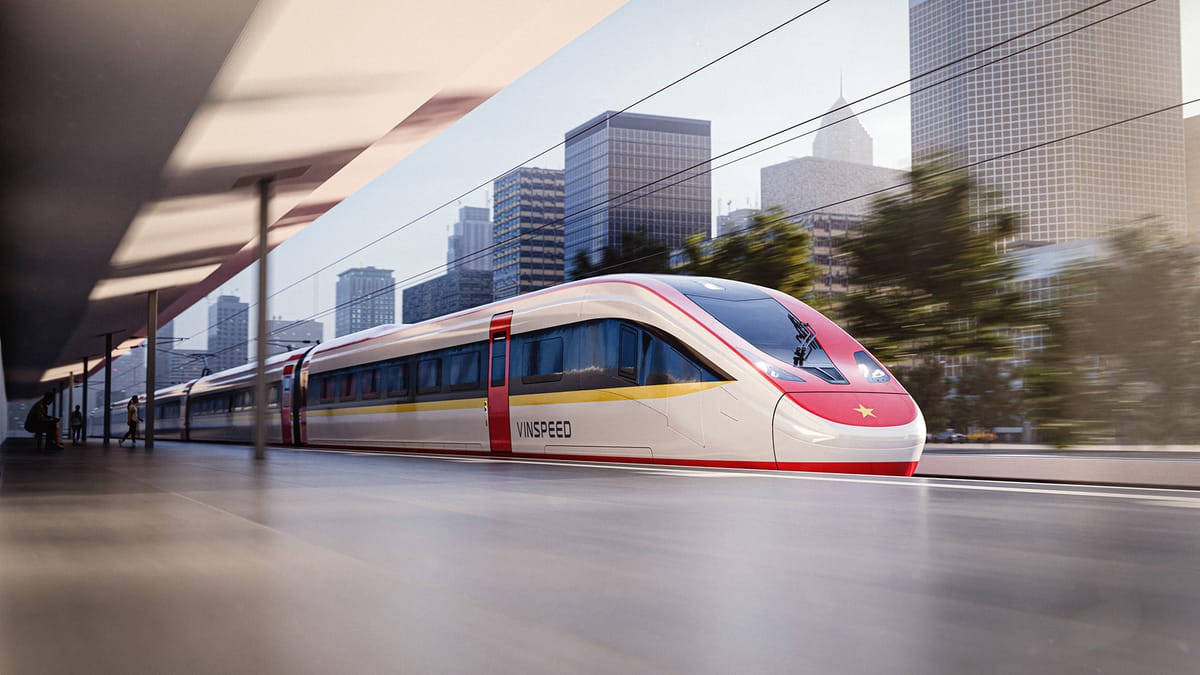
VinSpeed broke ground on Vietnam's first cross-region high-speed rail — 120 km, $5.6 billion, 2028 operation. The real story isn't the speed. It's where the stations are.
[Vietnam's First Cross-Region High-Speed Rail Breaks Ground — VinSpeed's Under-a-Year Blitz]
On the morning of April 12, 2026, at the Hạ Long Xanh station construction site near Halong Bay, Vietnam's new Prime Minister Lê Minh Hưng pressed the groundbreaking button.
This marked the start of Vietnam's first cross-region high-speed rail — a roughly 120 km line linking Hanoi with Quang Ninh.
VinSpeed had already broken ground on its first line four months earlier (the Bến Thành–Cần Giờ line inside Ho Chi Minh City). This is the first time the company is crossing provincial borders.
The guest list said a lot about the stakes.
Quang Ninh People's Committee Chairman Bùi Văn Khắng pledged to coordinate across ministries on land clearance.
Michael Peter, global CEO of Germany's Siemens Mobility, flew in and noted that his company's trains collectively cover around one million kilometers per day — roughly three times the Earth-to-Moon distance.
But the most interesting thing about this line isn't the speed record.
It isn't the international partners either.
It's where the stations sit.
The starting station is inside the Vietnam National Exposition Center in Hanoi's Đông Anh district — a building anchoring Vinhomes Global Gate Hanoi, a 385-hectare Vingroup urban development.
The terminal station sits inside Globe Hạ Long Forest Park, part of Vinhomes Global Gate Hạ Long — another Vingroup mega-project spanning 4,110 hectares, with roughly $18 billion in total investment.
Vietnam's first cross-region high-speed rail, from one end to the other, never leaves Vingroup's own real-estate portfolio.
▍ The Specs: What Kind of Project Is This
Start with the numbers.
The line runs about 120 km across four localities — Hanoi, Bac Ninh, Hai Phong, and Quang Ninh — with a top design speed of 350 km/h.
Double-track standard gauge, fully electrified, total investment around $5.6 billion, not including land clearance.
Rolling stock and core systems come from Germany's Siemens Mobility, with technology transfer to VinSpeed built into the contract.
Five stations in total, with three intermediate stops spread across Bac Ninh, Hai Phong, and Quang Ninh.
Commercial operation is targeted for 2028.
When it runs, the trip from Hanoi to Quang Ninh drops from over two hours to roughly 23 minutes.
▍ Who Is VinSpeed? A Rail Company Less Than a Year Old
VinSpeed was only founded in May 2025. It's the high-speed rail investment and development subsidiary of the Vingroup conglomerate.
Vietnam's richest man, Phạm Nhật Vượng, personally transferred his own Vingroup shares into VinSpeed — a visible signal that this is a bet he's placing himself.
The timeline is tight.
Founded in May 2025. First groundbreaking in December 2025 — the Bến Thành–Cần Giờ high-speed line in Ho Chi Minh City, same specs as the Hanoi–Halong line, also targeting 2028.
From founding to first groundbreaking: seven months.
From founding to second groundbreaking: under eleven months.
That pace is rare in global rail history.
Still, breaking ground isn't the same as cutting the ribbon. The real test is 2028.
▍ Why VinSpeed? What Happened in 2025
To understand this line, you first need to understand what it isn't.
VinSpeed's original target wasn't Hanoi–Halong at all.
It was after something much bigger — the North–South high-speed rail, a roughly $67 billion project that Vietnam's National Assembly approved in November 2024, targeting completion by 2035.
In mid-May 2025, VinSpeed dropped a proposal on the government that jolted the market: put up 20% of the cost itself, and borrow the remaining 80% from the state as an interest-free loan over 35 years.
Ten days later, another conglomerate entered the ring. THACO (Trường Hải Group, owned by billionaire Trần Bá Dương) submitted a rival bid.
THACO's terms were more conventional. Same 20% equity, but the other 80% would come from domestic and foreign lenders, with the government only guaranteeing the loans and subsidizing interest — not a direct zero-rate loan from state coffers.
THACO also proposed a phased build, starting with the highest-demand segments.
Overnight, the North–South rail became a public contest between two of Vietnam's biggest conglomerates.
VinSpeed's proposal drew open skepticism.
The South China Morning Post quoted public-policy adviser Rich McClellan calling the terms "unprecedented."
Vietnamese economist Đỗ Thiện Anh Tuấn warned of moral hazard: "If companies know they are using public funds and are shielded from interest rate risk, they may lose incentives to control costs."
The argument dragged on through the second half of 2025.
On December 25, 2025, Vingroup formally withdrew from the North–South bidding.
The statement was soft-edged — a "proactive and responsible decision" to redirect resources to "already approved projects."
Which approved projects?
Vingroup named seven: a 9,000-hectare Olympic-standard sports complex in Hanoi, the Bến Thành–Cần Giờ line in HCMC, the 120 km Hanoi–Halong high-speed rail, a VinMetal 2 steel plant, two wind farms in Hà Tĩnh province, an LNG plant in Hai Phong, and urban development in HCMC's Cần Giờ ward.
Seven projects. Four of them tie directly back to Vingroup's real-estate portfolio.
The strategic trimming didn't stop in late 2025.
In early April 2026, Vingroup asked the government to let it exit the Hai Phong LNG plant too — a project the group itself had only broken ground on in September 2025, billed as Vietnam's largest LNG facility.
The reason: the Iran war had pushed LNG prices sharply higher, and the multi-billion-dollar annual import bill would eventually strain Vietnam's foreign exchange reserves.
Vingroup proposed replacing the LNG plant with renewable energy and battery storage.
If the LNG project does get dropped, the only remaining non-real-estate items on that December 2025 list are the VinMetal 2 steel plant and the two wind farms.
Vingroup's resources are tilting more and more toward urban development and its own private rail system.
▍ The Real Story: Rail Meets Property, in a Closed Loop
Let's bring the focus back to where the two end stations actually sit.
The Cổ Loa terminus isn't some random spot on the Hanoi outskirts. It's the centerpiece of Vinhomes Global Gate Hanoi — the Vietnam National Exposition Center.
The whole Vingroup development covers 385 hectares.
The Hạ Long terminus is inside Globe Hạ Long Forest Park, part of Vinhomes Global Gate Hạ Long — one of Vingroup's largest urban projects ever: 4,110 hectares, around $18 billion in total investment, a planned population of roughly 244,000.
Together, the two endpoint developments cover more than 4,000 hectares — about the combined footprint of four Da'an districts in Taipei.
Seen as a business model, VinSpeed's line is effectively the spinal cord connecting two Vingroup mega-cities, doubling as their public-facing gateway.
Hanoi visitors land in Halong in 23 minutes. Walking out of the terminus, they enter Vingroup's own shops, hotels, and residential zones.
The 244,000 residents planned at Vinhomes Global Gate Hạ Long are, on their own, a built-in ridership base.
This model isn't new globally.
Japan's JR East, Hong Kong's MTR, and Singapore's mass transit all use some version of "rail plus property" — using the land-value uplift around stations to subsidize thin rail operating margins.
The difference: JR East and MTR are century-old state or quasi-state institutions. VinSpeed is a private-conglomerate subsidiary less than a year old.
For Vingroup, the $5.6 billion rail investment doesn't have to stand on ticket revenue.
On the Halong side alone, if the $18 billion urban development appreciates by roughly 30% thanks to the new rail line, the uplift alone covers the entire rail construction cost. (This is a rough back-of-envelope test, not a financial model.)
The three middle stations — Gia Bình, Ninh Xá, and Yên Tử — sit outside this closed loop.
None of them belong to Vinhomes developments today. How land prices move around them once the line opens will be a separate and telling indicator.
▍ VinSpeed's Cadence: From Moonshot to Closed Loop
Between May 2025 and April 2026, VinSpeed quietly completed a strategic pivot.
It started aiming at the national moonshot — the North–South high-speed rail, a project that only worked with state loans.
When that path was closed off, VinSpeed didn't walk away. It took the same team, the same Siemens contract, and the same 350 km/h double-track specifications, and split them into two smaller, fully self-directed lines: HCMC's Bến Thành–Cần Giờ and Hanoi–Halong.
The common thread: both lines have endpoints that Vingroup can monetize on its own.
Bến Thành is central Ho Chi Minh City; Cần Giờ is a Vingroup-developed coastal city under construction. In the north, Cổ Loa and Hạ Long both sit inside Vinhomes Global Gate projects.
By pivoting from moonshot to closed loop, VinSpeed can now use its own capital and Siemens's technology to put two lines into construction within a two-year window.
That pace is an outlier in any rail market.
The reason isn't some secret technology. It's that VinSpeed doesn't have to wrestle the National Assembly on timetables, wait for ODA loans, or bend to public-transit policy priorities.
It only needs to negotiate with itself — converting Vingroup's real-estate needs into VinSpeed's rail orders.
▍ How to Read This Line
2028 is the year to watch.
That's when VinSpeed expects both of its lines to open — while Vietnam's actual national North–South high-speed rail, scheduled to break ground in December 2026, will still be mid-build.
If VinSpeed hits its target, Vietnam will see something unusual: private rail running before state rail, with both built to the same 350 km/h standard.
Several questions remain open.
What will tickets cost?
A 23-minute Hanoi-to-Halong run could be priced like a flight (premium positioning) or like an intercity coach (mass-transit pricing). That single choice decides whether this line is a tourist route or a commuter spine — and whether the three middle stations see meaningful use.
Will Vinhomes Global Gate Hạ Long actually reach its planned 244,000 residents?
That number underpins the long-term ridership base.
How will land prices move around the three middle stations?
This will be the dividing line between "pure commercial HSR" and "property-play HSR."
Where will VinSpeed's next line run?
If it's again "one Vinhomes to another Vinhomes," the model is confirmed.
After 2028, when Vietnam designs its real North–South high-speed rail, will it adopt Siemens-compatible German specs — or go with Japanese Shinkansen or Chinese CRRC systems?
That decision will determine whether VinSpeed's lines can eventually plug into the national mainline.
The groundbreaking ceremony on April 12 hadn't even wrapped up, and these questions were already on the table.
Vietnam's first cross-region high-speed rail will be a milestone in the country's infrastructure history. It's also a less-than-a-year-old company leveraging the expected appreciation of its own real estate to prove it can move faster than the state.
Whether that's a victory of execution speed or a validation of a business model — we won't know for another ten years.