The Plastic Stool, Not the Chain Store, Is Where Vietnam's Coffee Scene Actually Lives
Vietnam has about 500,000 coffee shops, and all major chains combined still account for less than 1% of the market. Chains and street vendors aren't really competing — they sell completely different things.
[The Plastic Stool, Not the Chain Store, Is Where Vietnam's Coffee Scene Actually Lives]
01 | Start With the Scale: Chains Account for Less Than 1%
According to a 2024 report from Vietnamese market research firm Mibrand, the country has roughly 500,000 coffee shops — counting everything from plastic-stool sidewalk stalls to polished chain outlets. The figure is still being widely cited in 2025.
Half a million is a lot. Vietnam's population is about 100 million, which works out to one coffee shop for every 200 people. And the number is still growing fast. According to data compiled by Japanese consultancy B-Company, the country had around 317,000 coffee and tea shops at the end of 2023; by 2025 that had ballooned past 500,000.
Chains have been expanding aggressively, too. B-Company's figures show that total outlets from major chain brands grew from 816 in 2019 to 2,067 in 2025 — more than doubling in six years. The fastest growth is not in Ho Chi Minh City or Hanoi, but in other cities and provinces, as chains push into tier-two and tier-three markets.
Put the numbers side by side, though, and the gap is striking:
➤ Total market: ~500,000 outlets
➤ Major chain outlets combined: ~2,067
➤ Chain share: under 1%
In other words, 99% of Vietnam's coffee shops are not part of any chain.
02 | The Chain Wars Are Real — But They're Not Fighting for the Sidewalk Customer
The chain segment has been busy.
Highlands Coffee is the largest homegrown chain. Its parent company Jollibee Foods Corporation (the Philippine fast-food group that bought into Highlands in 2012) reported in Q3 2025 that Highlands operates 928 outlets in Vietnam, including company-owned and franchised stores, with EBITDA up year-on-year. Jollibee holds 60% of Highlands through a holding company; day-to-day operations are still run by founder David Thai. In a March 2026 disclosure to the Philippine Stock Exchange, Jollibee said the Highlands board is evaluating a Vietnam IPO targeted for Q1 2027.
Other major chains have taken different paths:
➤ Milano Coffee runs a low-cost franchise model and had surpassed 2,500 outlets by the end of 2025.
➤ Starbucks plays in the mid-to-high price tier and just hit 150 stores in January 2026.
➤ Phuc Long and Katinat run a "coffee + tea + space" hybrid format, using fruit teas and matcha fusions to court Gen Z.
But chains don't always win. The Coffee House is the cautionary tale — VnExpress reported in August 2024 that TCH closed all its outlets in Can Tho and Da Nang, and its national footprint shrank substantially from the prior year. CEO Ngo Nguyen Kha framed the closures as "adapting to changing conditions and ensuring stable operations across the system." Chains can mis-step and have to retreat.
So who are these chains actually competing for?
A 2024 nationwide consumer survey cited by B-Company found that nearly 40% of coffee-shop customers go primarily to work. The most frequent visitors are middle-income office workers and students.
The real product chains sell is a space — "I want somewhere with Wi-Fi and air-conditioning where I can plug in for three hours." Highlands, Katinat and Starbucks are all chasing the same crowd.
The plastic-stool stalls and small shopfronts in side alleys sell something else entirely.
03 | Why the Sidewalk Cup Won't Be Replaced
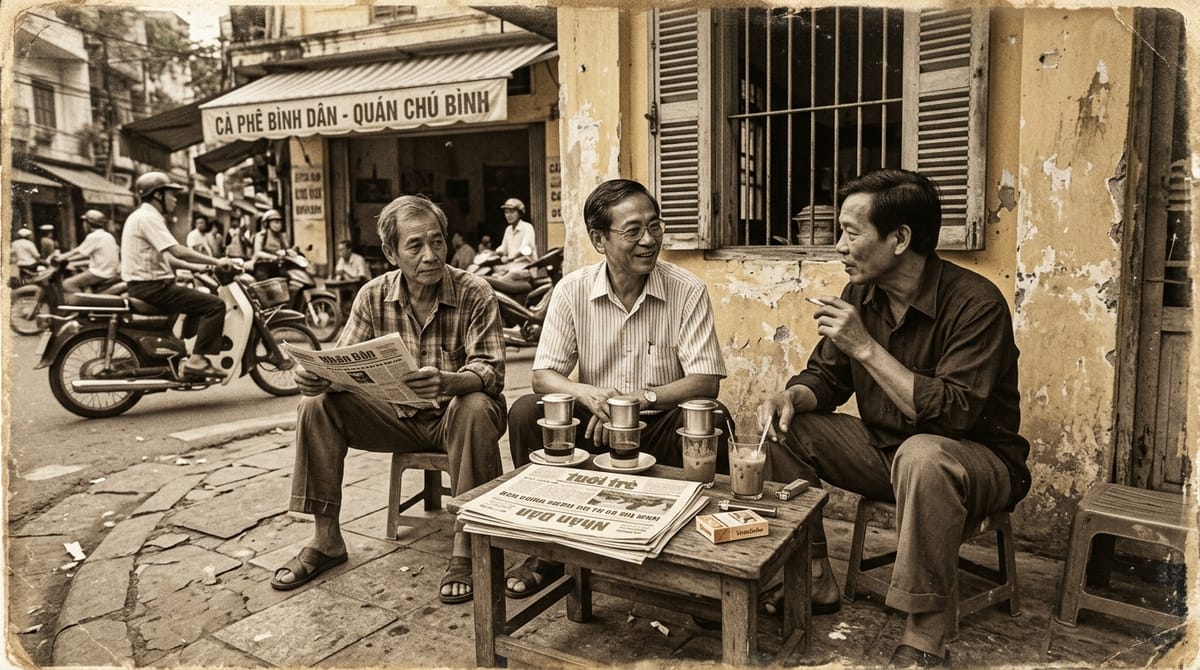
A plastic stool, a phin filter, a glass of cà phê sữa đá for under a dollar, and five minutes watching the coffee drip down — that's enough time to chat with the vendor, talk to the person next to you, scroll your phone, or read the paper. This isn't just selling coffee; it's part of the city's public space. Chains can't move into this scene, and wouldn't want to.
Vietnam's homegrown specialty coffee movement isn't trying to copy Starbucks either.
XLIII Coffee (formerly 43 Factory Coffee Roaster) opened a new location in Ho Chi Minh City's Thảo Điền district in 2025, built around traditional Vietnamese design elements like redwood daybeds, carved lattice screens, and dragon-headed chairs. XLIII's whole business is built on traceability and precision roasting — direct producer relationships, single-origin roasting, detailed batch information. It looks more like a serious roastery than a chain café, and it's playing a completely different game.
La Viet Coffee got there earlier. Founder Trần Nhật Quang, a former university lecturer, opened a shop in Đà Lạt in 2015. He works directly with local farmers and focuses on small-batch Arabica from preserved Bourbon and Typica varietals. La Viet's value proposition isn't a brand at scale — it's the idea that Vietnam itself can produce great Arabica.
The bean economics also work in the street vendors' favor. Domestic Robusta procurement prices hit a record high during the 2024/25 harvest, with sharp year-on-year gains. Even after pulling back from the peak by Q2 2026, prices remain elevated. But a roadside stall selling a glass for under a dollar still survives, because beans aren't the main cost. The cost is space, labor, a few hundred dollars in stools and folding tables. No big-format rent, no head-office overhead. Margins are thin, but the cash-flow structure is solid.
One last observation: the flow isn't only "foreign chains entering Vietnam." Trung Nguyên Legend has been pushing the other direction for years — directly owned and franchised outlets in the United States, China, Taiwan, Canada, France and Japan. A significant share of homegrown Vietnamese chains' expansion energy is heading outward, which is a completely different story from foreign chains coming in.
—
This article is a market observation based on public data. Figures reflect each source's publication date. It does not constitute investment, franchise or business advice.
The Viet Media Monthly
A curated monthly digest of the most important political, economic, tech, and industry developments in Vietnam.
Designed for reading on desktop or tablet — no algorithm, no noise. Just the stories that matter.
Delivered before the 10th of each month. Cancel anytime.