Hanoi's Empty Storefronts: Rents Have Dropped Up to 37% From 2025 Peaks and Still No One Is Renting
More than 30 empty storefronts on one stretch of Hanoi's Kim Mã street. Rents in some wards down 37% from 2025 peaks. And landlords still can't find tenants. The reason is structural, not seasonal.
[Hanoi's Empty Storefronts: Rents Have Dropped Up to 37% From 2025 Peaks and Still No One Is Renting]
01 | More Than 30 Empty Stores on One Stretch of Kim Mã
Walk down Kim Mã, Chùa Bộc or Phố Huế — three of Hanoi's most coveted retail streets — and what stands out are not shopfronts but "for rent" signs. On some stretches under a kilometer long, dozens of stores have been sitting empty since before this year's Lunar New Year. On Kim Mã – Nguyễn Thái Học alone, more than 30 shops are shuttered or up for lease.
If this were just a soft economy, landlords would cut rents and find tenants. This time, they have cut rents to the floor and still cannot.
Asking rents for street-front retail in many central Hanoi districts are down 20–30% from 2025, according to Batdongsan.com. At the ward (phường) level, the drops from 2025 peaks are even sharper: 37% in Cát Linh, 32% in Kim Mã.
By contrast, online search interest for Hanoi private homes is down just 22% over the same period — also Batdongsan data. The residential market has cooled. The street-front retail category has been gutted. The market is not marking everything down; it is repricing one specific asset class.
02 | Five Forces Pressing at Once
Hoàng Tùng, founder of the Pizza Home chain, frames what is happening on Hanoi's streets as five forces all pushing in the same direction at the same time.
➤ First: consumer spending is weakening. A 40 sqm menswear shop on the alley entrance of Thái Hà Street closed last month. The original rent was VND 35 million a month (about USD 1,330). The landlord offered to drop it to VND 33 million to keep the tenant. It wasn't enough. "There were months when sales didn't even cover the rent," the owner said. He cleared his inventory and moved everything online.
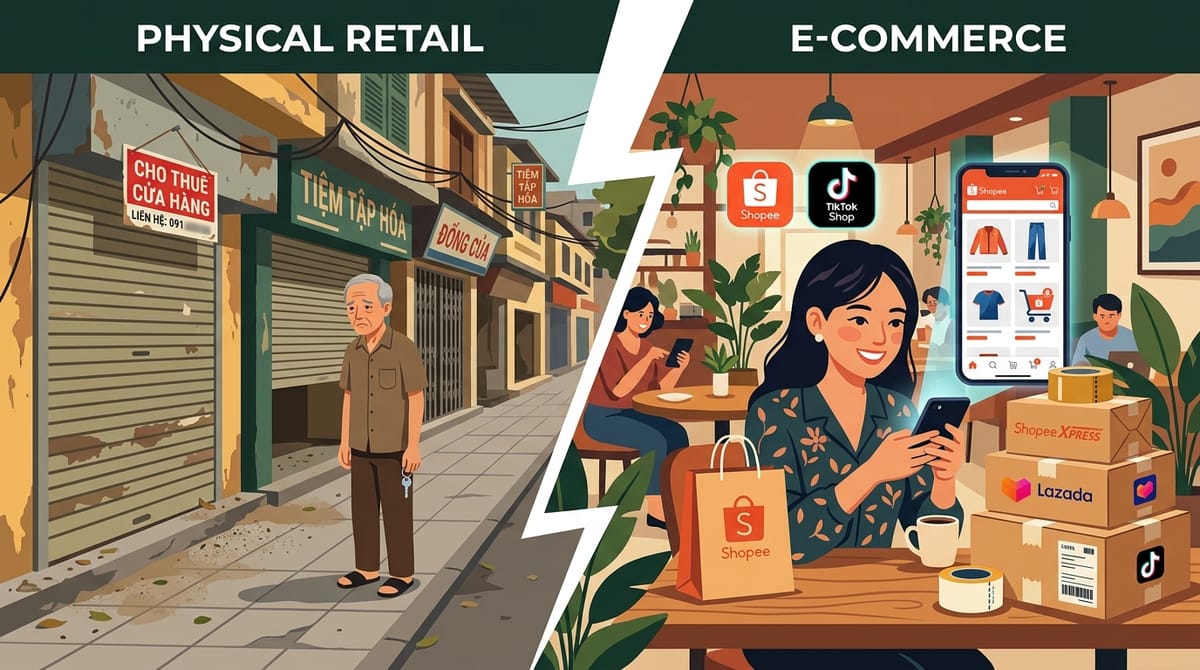
➤ Second: consumption is moving online, fast. A cosmetics shop on Chùa Bộc moved 200 meters off the main street into an alley barely wide enough for two motorbikes to pass. Rent at the new spot is less than half what it was. Foot traffic at the old location had collapsed over the previous year, a staff member told reporters. Customers now browse on social media and order delivery.
The macro numbers tell the same story. According to Metric.vn, GMV across Vietnam's four major e-commerce platforms — Shopee, Lazada, Tiki and TikTok Shop — grew nearly 35% in 2025. Shopee and TikTok Shop together now account for roughly 8% of Vietnam's overall retail goods market (per the General Statistics Office), up from 6.5% in 2024. In Q1 2026, the four platforms posted another 46.6% year-on-year jump.
➤ Third: rents are sticky. CBRE Vietnam's head of retail services, Mai Võ, is blunt: the lack of tenants on prime streets "is not a short-term phenomenon. It is the result of a strong structural shift." Brands once paid premium rents to be seen on central streets — but with e-commerce and integrated shopping malls reshaping consumer habits, the productivity of street-front space no longer justifies the rent. Hoàng Nguyệt Minh, general director of Cushman & Wakefield Vietnam, adds that years of rent inflation have eroded the competitiveness of old townhouses, many of which have deteriorated and can no longer be retrofitted to modern brand standards.
Landlords, meanwhile, are not cutting fast enough. A 2025 first-half F&B report from iPOS.vn and Nestlé Vietnam echoes the squeeze: 45.3% of F&B businesses raised prices in the first half, and 13.7% pointed directly to rent as the reason. When landlords don't budge, operators pass the cost to consumers. When consumers can't absorb it, they stop showing up.
➤ Fourth: tax and compliance pressure is closing in from another direction. Citing a recent VCCI survey of household businesses, Hoàng Tùng notes that most hộ kinh doanh (sole-proprietor merchants) are either making razor-thin margins or missing their own expectations — while compliance burden goes up. Electronic invoicing and digital payment requirements, rolling out in stages this year, are pulling previously "off-the-books" revenue back onto the ledger: every transaction now leaves a trail, closing the grey zone where small operators used to shave their tax bill. Dr. Nguyễn Ngọc Tú of Hanoi University of Business and Technology suggests a 3–5 year tax holiday for household businesses to ease the transition, arguing they need time to learn bookkeeping and digital payments. In the short term, tighter cash flow shows up first in unpaid rent.
➤ Fifth: Hanoi's largest sidewalk enforcement campaign in years. On November 11, 2025, the city's Steering Committee 197 (Hanoi's cross-agency body for street and sidewalk order) issued Plan No. 06, piloting strict enforcement in Hoàn Kiếm, Cửa Nam and Ba Đình wards: stop sidewalk encroachment, tear down unauthorized awnings. On December 13, Hanoi police expanded the operation citywide, deploying officers across all 126 wards and communes — backed by AI cameras.
For retailers, that one move erased a "hidden floor area" that never appeared on any lease. Tables on the sidewalk, scooters parked under awnings, goods spilling into the street — that was free extra retail space. Now that space is gone, and street-front shops have lost square meters they never paid rent for in the first place.
03 | This Isn't Just Hanoi. Vietnam's Physical Retail Is Being Reshuffled
The iPOS + Nestlé F&B report carries one staggering number: as of June 30, 2025, the country's F&B outlet count was 7.1% lower than in 2024 — meaning more than 50,000 outlets had vanished in six months. The report calls this the "second great shakeout" of Vietnam's F&B market. The first was in the first half of 2024.
What makes it worse: the shakeout didn't grow the industry. First-half 2025 F&B revenue was essentially flat versus the same period in 2024 — despite expectations at the end of 2024 that the sector would grow about 10% across the full year. 50,000 fewer outlets, revenue unchanged: surviving operators carry heavier load, but the pie itself didn't grow.
Back on Hanoi's streets, the 30+ empty shops on Kim Mã are this equation in concrete form. Thu Huyền, who runs a Korean BBQ chain, told reporters she just closed her Lê Duẩn Street branch after two years: "The location ate up too much cost, and it was inside a planning zone so customers couldn't easily get to it." The same exit logic is playing out on every prime street in Hanoi.
Pizza Home's own survival strategy points in the same direction. For its delivery-first, dine-in-light format, rent and related store costs stay around 18% of revenue. For a dine-in-heavy format, that ratio can climb to 35%. That 17-point gap is the dividing line between who survives this shakeout and who doesn't.
04 | CBRE: Not Short-Term, Structural
CBRE's Mai Võ saying "this is not a short-term phenomenon, this is a structural shift" is the most important framing of this story.
Hoàng Tùng put it even more bluntly at the end of his interview: "The market is forcefully repricing itself. From here on, only operators who are genuinely efficient, who sell across multiple channels and who control costs can survive."
For the past decade, Hanoi's prime retail was governed by an implicit equation: a prime storefront equals stable cash flow. Rents went up every year. Brands queued for spots. Vacancies got filled in a month or two. Each of the five forces above has now pulled out one of the legs holding that equation up. The "location premium" asset class is being marked down first.
When landlords are willing to cut 13–37% and still can't hold a tenant, the market is signaling something specific: the old rent levels were built on the assumption that brands would pay big money to be seen on prime streets — and that assumption has now been broken by e-commerce and integrated shopping malls.
—
This article is a trend analysis based on public reporting and does not constitute investment, real estate or business advice.
The Viet Media Monthly
A curated monthly digest of the most important political, economic, tech, and industry developments in Vietnam.
Designed for reading on desktop or tablet — no algorithm, no noise. Just the stories that matter.
Delivered before the 10th of each month. Cancel anytime.