Le Minh Hung: Vietnam's New Prime Minister, From Central Bank Governor to Head of Government
Le Minh Hung, Vietnam's youngest-ever central bank governor, was unanimously elected prime minister. Here's what his background, cabinet, and political constraints mean for the country's economic direction.
[Le Minh Hung: Vietnam's New Prime Minister, From Central Bank Governor to Head of Government]
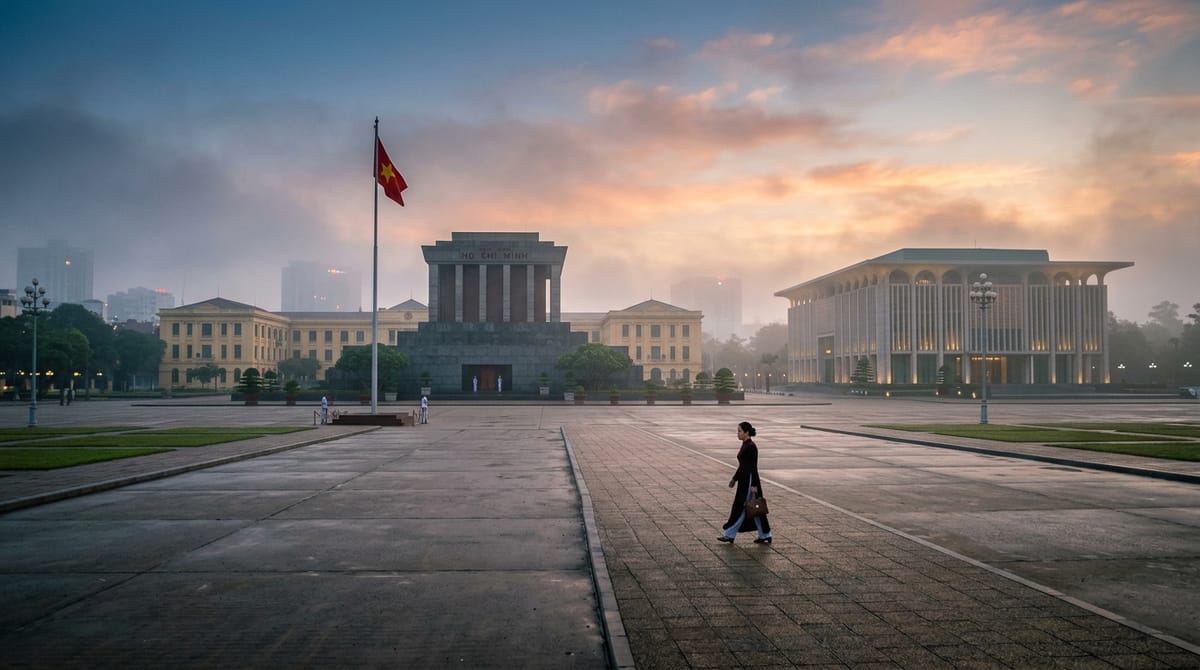
On April 7, 2026, all 495 lawmakers present at Vietnam's 16th National Assembly cast their votes for the same man. Le Minh Hung was sworn in as the country's ninth prime minister, taking office for a five-year term.
He pledged "absolute loyalty to the Fatherland, the people, and the Constitution," then laid out a governing plan anchored by a bold target: double-digit economic growth.
But who is Le Minh Hung? What shaped him? And what kind of political environment is he stepping into?
▍ A Banker's Son From Central Vietnam
Le Minh Hung was born in December 1970 in Huong Son district, Ha Tinh province, in central Vietnam. His father, Colonel General Le Minh Huong, served as Vietnam's Minister of Public Security from 1996 to 2002.
Hung studied French at Vietnam National University, then went to Japan for a master's degree in economics and public policy at Saitama University. That Japanese education set him apart from many Vietnamese officials who trained in the Soviet Union or China.
In 1993, at 23, he joined the State Bank of Vietnam, starting in the international relations department handling IMF affairs. He worked his way up through various positions before becoming deputy governor in 2011.
▍ The Youngest Central Bank Governor in History
In April 2016, Hung was approved by the National Assembly with over 80 percent of the vote to lead the State Bank. At 46, he became the youngest governor in the bank's history and the youngest cabinet-level official of the 2016-2021 term.
He held the post for four years. His main achievements included controlling inflation, restructuring underperforming banks, lowering interest rates, and directing credit toward productive sectors. By the time he left in 2020, non-performing loans in Vietnam's banking system had been brought below 3 percent.
For a developing country's central bank, keeping bad loans at that level requires sustained regulatory pressure and structural reform. That track record would prove essential to his later rise.
▍ From Technocrat to Party Insider
In October 2020, Hung left the central bank and moved to the party apparatus as chief of the Party Central Committee's Office. It was a pivotal shift from government to party work.
After nearly four years in that role, he took over as head of the Central Organization Commission in May 2024. The commission is the Communist Party's personnel hub, controlling appointments and evaluations of officials nationwide. In that position, he helped drive the 2025 political restructuring that introduced a two-tier local government system.
In January 2026, he was elected to the 14th Politburo. In March, he won a National Assembly seat in Hai Phong with 99.87 percent of the vote. On April 7, he became prime minister.
From a junior specialist at the central bank to the head of government — a 33-year climb.
▍ The Governing Plan: Three Breakthroughs and 12 Priority Tasks
Hung has outlined three strategic breakthroughs, with institutional reform at the top. He compared institutions to "roads" for the economy — if the roads are blocked, traffic can't move. He said 2026 must be the year to clear longstanding institutional bottlenecks.
On the economic front, the National Assembly has approved a GDP growth target of at least 10 percent for 2026. For context, Vietnam's GDP grew 8.02 percent in 2025, pushing the economy to $514 billion and 32nd place globally. First-quarter 2026 growth came in at 7.83 percent — solid, but still short of the double-digit goal.
Other targets include per capita GDP of $5,400 to $5,500, a consumer price index of about 4.5 percent, and labor productivity gains of 8.5 percent.
Hung has laid out 12 priority tasks, including:
➤ Raising state budget revenue by 10 percent and cutting regular expenditure by more than 10 percent
➤ Securing energy supplies, particularly oil and gas
➤ Stabilizing real estate, corporate bond, and financial markets
➤ Attracting more FDI with technology transfer requirements
➤ Developing capital markets and upgrading the stock exchange's status
➤ Promoting e-commerce and cashless payments to boost domestic consumption
➤ Targeting 25 million international tourists with pilot long-term visa exemptions
➤ Restructuring industry and agriculture
Total social investment is projected at about 40 percent of GDP, up 33 percent from the previous term. Public investment would account for 20 percent, with the rest coming from private and foreign sources.
▍ The New Cabinet
Hung's government includes six deputy prime ministers and 17 ministers, with a streamlined structure of 14 ministries and three ministerial-level agencies.
Among the six deputy PMs, a few stand out:
➤ Phan Van Giang, a four-star general who also serves as minister of national defense — the only person holding both roles
➤ Nguyen Van Thang, who holds a doctorate in finance and monetary theory and previously ran VietinBank before serving as minister of transport and then minister of finance. His financial background mirrors Hung's, signaling this government's emphasis on economic governance
➤ Pham Thi Thanh Tra, a holdover deputy PM who previously served as minister of home affairs
The new State Bank governor is Pham Duc An, taking over the institution where Hung began his career.
▍ A Prime Minister Under a Powerful Party Chief
To understand Hung's position, you have to look at the broader power structure.
In Vietnam's political system, the party general secretary is the top leader. General Secretary To Lam, who also serves as president, had his reappointment confirmed on the same day. Former Prime Minister Pham Minh Chinh was excluded from the new Central Committee entirely.
Political analyst Nguyen Anh Tuan described the new arrangement as "a very strong general secretary paired with a very weak prime minister," predicting that "government power will gradually narrow, while the party apparatus will grow stronger."
Observers also note that Hung lacks the local governance experience of his predecessors. His entire career has been in central institutions — he has never led a province or city. That is unusual for a Vietnamese prime minister.
Still, his central banking background and economic expertise align well with Vietnam's current policy direction: sustaining high growth amid global uncertainty while pushing forward financial market reform and institutional modernization.
Whether he can carve out meaningful governing space under a dominant party chief will be the defining question of his tenure.
The Viet Media Monthly
A curated monthly digest of the most important political, economic, tech, and industry developments in Vietnam.
Designed for reading on desktop or tablet — no algorithm, no noise. Just the stories that matter.
Delivered before the 10th of each month. Cancel anytime.