Phu My Hung: How a Taiwanese Major Built a City on a Saigon Swamp
A retired Taiwanese major with an electrical engineering degree from Columbia took KMT money to Vietnam in 1989. His three ventures — Tan Thuan EPZ, Hiep Phuoc power plant, and Phu My Hung — are all still standing. He didn't live to see it.
[Phu My Hung: How a Taiwanese Major Built a City on a Saigon Swamp]
Drive south from central Ho Chi Minh City, cross Nguyen Van Linh Boulevard, and you arrive in Phu My Hung.
Locals still call the city Saigon.
The official name became Ho Chi Minh City after reunification in 1975, but fifty years on, the new name has never really replaced the old one in daily speech.
The 433-hectare core of Phu My Hung sits inside the 2,600-hectare South Saigon master plan.
In 2008, Vietnam's Ministry of Construction and the HCMC government officially designated it a "model urban area."
What makes Phu My Hung unusual, though, isn't the planning.
It's the people who live there.
In Tan Phong ward, 3,184 of the registered residents are foreigners — over half the population.
In Tan Phu ward, another 2,988 foreigners account for roughly thirty percent.
It isn't just who lives there.
In March 2026, HCMC approved 24 new residential projects where foreigners are allowed to buy property, and 19 of those 24 are in Phu My Hung, clustered in Tan My and Tan Hung wards.
In practice, the city government handed nearly 80 percent of that batch of foreign purchase quotas to a single developer.
▍ A Swamp, Thirty Years Ago
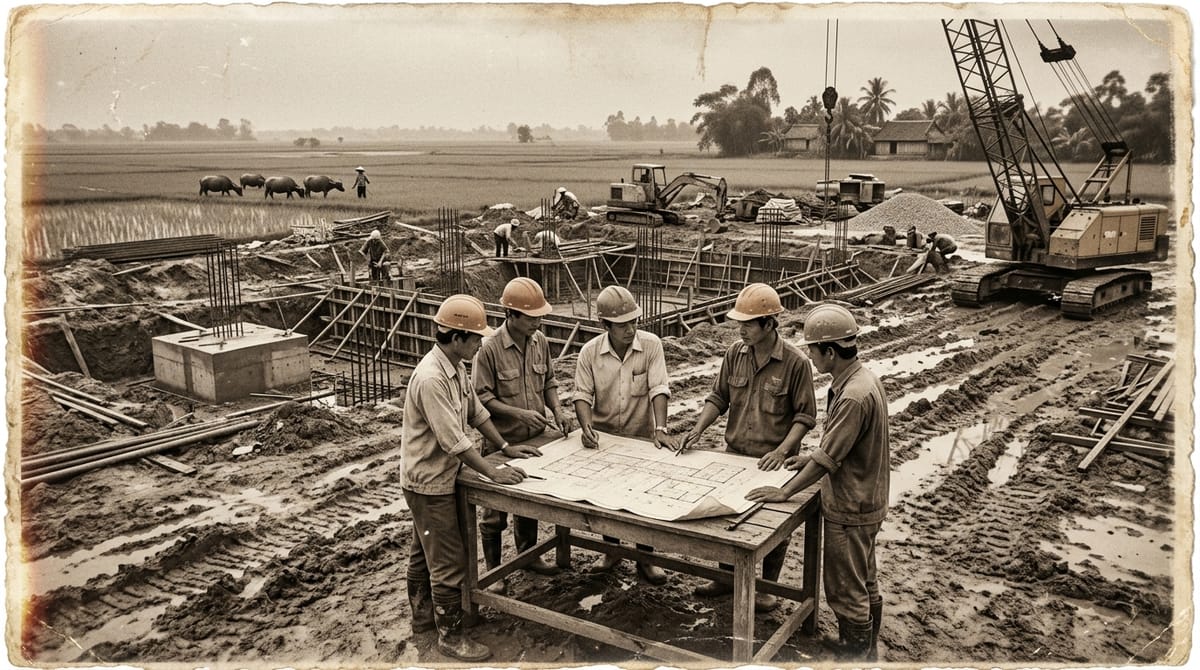
In the early 1990s, this land was part of Nha Be district on the outskirts of Ho Chi Minh City — marshland and low-yield rice paddies, close to worthless.
The man who turned it into Phu My Hung was a Taiwanese army veteran named Lawrence Ting.
▍ From Major to Developer
Ting was born in 1939 in Qingdao, Shandong.
His family fled to Taiwan during the Chinese civil war, and he grew up in Taichung.
His background wasn't exactly ordinary.
His grandfather had headed the Qingdao Chamber of Commerce, and his older brother Ting Shan-hsi became a film director in Taiwan.
But Ting himself took the military route.
He graduated from the 30th class of the Republic of China Military Academy and was sent to Fort Benning in the U.S. for infantry, airborne, and ranger training.
In 1964, he won one of just two national defense scholarships and went to Columbia University to study electrical engineering.
In 1972, he retired from the army as a major and joined Taiwan's Hua Hsia Engineering & Plastics Group.
His wife, Fei Tsung-ching, came from a Taiwanese political family.
Her father Fei Hua had served as Taiwan's Minister of Finance; her mother Chang Hsin-yi was a great-great-granddaughter of the Qing dynasty statesman Zeng Guofan.
▍ The KMT's Vietnam Trilogy
The turning point came in 1989.
Taiwan's President Lee Teng-hui was pushing public and private actors to expand overseas.
The Kuomintang's Central Finance Committee chairman Hsu Li-teh put the deal together, and the KMT's Central Investment Holding Corporation seeded a new entity called Central Trading & Development Corporation (CT&D).
The initial cap table: KMT 75 percent, the Ting family 10 percent, Taiko Group chairman Chien Peng-lun 10 percent, Wan Hai Lines chairman Chen Ching-chih 5 percent.
The three private investors were all hand-picked by the party.
CT&D opened three fronts in Vietnam at once: an export processing zone, a power plant, and urban development.
The first was Tan Thuan Export Processing Zone.
CT&D secured the investment license in September 1991 and broke ground in February 1992 — the first export processing zone in Vietnam.
It was a joint venture with state-owned IPC, covering 300 hectares.
By mid-2024, Tan Thuan had attracted over 250 investors from 22 countries, with roughly USD 2.4 billion in total investment.
The second was the Hiep Phuoc Power Plant, the only fully owned project among CT&D's three ventures.
The third was Phu My Hung.
In May 1993, CT&D and the HCMC People's Committee — represented on the Vietnamese side by the Tan Thuan Industrial Promotion Company — jointly founded Phu My Hung Development Company.
The three projects combined covered 1,000 hectares and about NT$30 billion in cumulative investment.
That same year, Ting received the Ho Chi Minh City Medal of Honor.
He would later receive Certificates of Merit from the Vietnamese Prime Minister in 1997 and 2001.
▍ The Party Money Pulls Out. He Doesn't.
But Phu My Hung had barely begun when the KMT decided to withdraw.
In 1994, KMT investment chief Liu Tai-ying pulled the plug — and announced it unilaterally through the media.
For Ting, this was a crisis.
Phu My Hung Development had existed for barely a year, and losing your majority shareholder at that point could have killed the whole project.
Ting stayed.
He convinced the three private shareholders to buy out more of the KMT stake, each ending up with about 30 percent; the KMT retained 10.
In 1998, the KMT sold its final 10 percent and exited entirely.
By that point, Tan Thuan had turned a profit, but Phu My Hung and Hiep Phuoc were still losing money.
▍ Building a City on a Swamp
What Ting now had to do was turn a paper plan into an actual city.
The main artery was Nguyen Van Linh Boulevard — 17.8 kilometers long, 120 meters wide at its broadest, ten lanes, spanning ten bridges, for a total investment of around USD 100 million.
This road opened up the route from central HCMC south into Phu My Hung.
The South Saigon master plan itself was led by Skidmore, Owings & Merrill (SOM), with Koetter Kim & Associates and Japanese architect Kenzo Tange's firm as consultants.
The work drew international recognition.
Phu My Hung won a Progressive Architecture Citation in 1995 and an AIA Urban Design Honor Award in 1997.
In 2013, Harvard Business School senior lecturer John Macomber turned it into a teaching case (HBS Case 213-098) on how private capital can build sustainable cities.
Phu My Hung's development strategy ran opposite to the Vietnamese norm: build the schools, hospitals, parks, and shopping centers first, then put up housing.
Most developers did the reverse — homes first, amenities whenever.
▍ A District That Doesn't Feel Vietnamese
Today Phu My Hung has more than ten international schools.
One of them, the Lawrence Ting School (Trường Đinh Thiện Lý), opened in 2008 as a non-profit middle and high school, and marked its 15th anniversary in 2023 with a new campus.
And the residents aren't only Vietnamese.
According to Korean consulate estimates, about 20,000 Koreans live in Phu My Hung's Hung Gia ward and around the Sky Garden complex.
Across all of Ho Chi Minh City, the Korean population is close to 90,000; roughly 11,000 are officially registered in District 7, where Phu My Hung sits.
▍ The Tragedy
The story took a sharp turn in 2004.
CT&D's three private shareholders had long disagreed on how to run the company.
In 2004, Chen Ching-chih filed lawsuits against Ting in both Vietnam and Taiwan, alleging misuse of company funds.
The Taipei District Prosecutor's Office opened an investigation, and Ting was barred from leaving Taiwan.
On September 23, prosecutors raided CT&D's office.
That same evening, Ting fell from a building on Ren'ai Road in Taipei.
He was 65, and left behind a suicide note.
His wife Fei Tsung-ching told the press that Ting had "taken his own life to prove his innocence."
The note, as quoted by Taiwanese media, read: "This is a case fully exploiting the power of the judiciary for political persecution, masterminded by the brothers Chen Chao-heng and Chen Ching-chih."
Three years later, in 2007, Vietnamese President Nguyen Minh Triet posthumously awarded Ting the Order of Friendship.
▍ What He Left Behind
After Ting's death, his sons Ting Kuang-chin and Ting Kuang-hung took over the operation of Phu My Hung.
The institutions bearing his name survived.
The Lawrence S. Ting Foundation has given out roughly 125,000 scholarships over 20 years, totaling about 160 billion VND.
In 2025 alone, it distributed close to 8.8 billion VND in new awards.
The other legacy is the Lawrence Ting Charity Walk.
The 21st edition, held in January 2026, raised 2.3 billion VND on the day; across 21 years, nearly 250,000 participants have raised over 53 billion VND combined.
▍ What Comes Next
The company itself has not slowed down.
Phu My Hung's after-tax profit in 2025 was close to 3 trillion VND, up roughly 40 percent year on year and a three-year high.
The expansion has moved beyond South Saigon.
In October 2025, Phu My Hung broke ground on Harmonie in what was then Binh Duong Province — a 2-hectare project with close to 1,500 units, scheduled for delivery in 2028.
(Binh Duong was absorbed into the expanded Ho Chi Minh City administrative area in July 2025.)
Bigger still is Hong Hac City to the north — roughly 200 hectares in Bac Ninh Province, total investment of about USD 1.1 billion, developed in partnership with Japan's Nomura Real Estate, which launched sales in June 2025.
This is Phu My Hung's first venture outside South Saigon, and its first push into northern Vietnam.
▍ The Harvest He Didn't Live to See
From the founding of CT&D in 1989 to today, the story spans 37 years.
From swampland to roughly NT$30 billion in investment.
From KMT party capital to three private shareholders stepping in.
From a retired major who studied electrical engineering at Columbia, to a district packed with Korean residents, international schools, and foreign families.
Lawrence Ting didn't live to see the harvest.
But what he planted has grown into its own.
The Viet Media Monthly
A curated monthly digest of the most important political, economic, tech, and industry developments in Vietnam.
Designed for reading on desktop or tablet — no algorithm, no noise. Just the stories that matter.
Delivered before the 10th of each month. Cancel anytime.