Vietnam Was One of the World's Leanest Countries. That's Changing Fast.
Vietnam still has one of the world's lowest obesity rates, but the speed of change is alarming — and the country isn't ready for it.
[Vietnam Was One of the World's Leanest Countries. That's Changing Fast.]
Vietnamese people are thin. That's the common perception, and the data backs it up — Vietnam has one of the lowest adult obesity rates in the world.
But that number is moving in the wrong direction, quickly.
About 19.5% of Vietnam's population is now overweight or obese, according to the WHO. That's roughly 20 million people. The rate itself isn't alarming compared to global averages. The speed is. Vietnam's overweight and obesity rate has grown by about 38%, the fastest in Southeast Asia, where other countries are seeing increases of 10% to 20%. Over the past two decades, the rate has increased sevenfold.
▍ More Than Half of HCMC's Kids Are Overweight
The numbers are worst among children.
The overweight and obesity rate for Vietnamese kids aged 5 to 19 doubled from 8.5% in 2010 to 19% in 2020. Urban areas are hit hardest at 26.8%, compared to 18.3% in rural regions.
In Ho Chi Minh City, more than 50% of young people are now overweight or obese. In Hanoi, the figure tops 41%. In Vietnam's two biggest cities, nearly half of all children weigh more than they should.
▍ From Pho to Fried Chicken
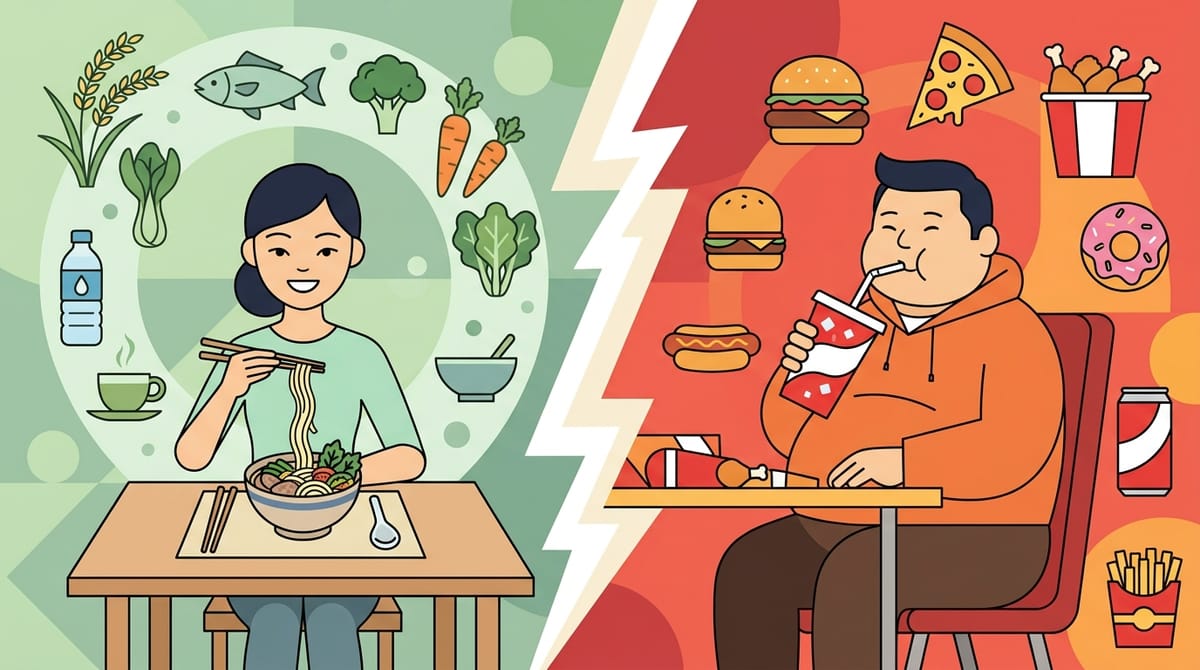
Vietnam's traditional diet — rice, pho, vegetables, fish — is low in fat and modest in portion size. That's been the foundation of the country's historically low obesity rate.
Economic growth is reshaping what people eat.
Vietnam's fast food market hit USD 4.7 billion in 2025 and is projected to reach USD 6.6 billion by 2034. The country now has over 1,000 fast food outlets. The top three chains alone account for most of them: Lotteria with 222 stores, Jollibee with 213, and KFC with 172. Store counts grew 12% in 2025, and chains are now expanding beyond Hanoi and HCMC into smaller cities.
Then there's sugar. Vietnamese people drank four times more sugary beverages in 2023 than in 2009. The average person now consumes nearly 70 liters of sugary drinks a year.
▍ Obese but Unaware
In 2025, Danish pharmaceutical company Novo Nordisk and local researchers published the ACTION-Vietnam study. They surveyed 1,000 people classified as obese and 200 healthcare professionals. The findings were uncomfortable.
Among the 1,000 people already diagnosed as obese, only 56% recognized themselves as such. Another 30% thought they were just "a little overweight." And 58% believed losing weight was a personal matter that didn't require medical help.
Doctors had their own issues. Forty percent were reluctant to bring up weight with patients, worried about making them uncomfortable. Nearly 50% of obese patients said they felt embarrassed when asked about their weight.
The result is a communication gap. Doctors don't want to say it. Patients don't want to hear it. Weight keeps going up.
▍ The Sugar Tax That Doesn't Start Until 2027
Vietnam's National Assembly passed a revised excise tax law in 2025 that includes sugary drinks. But the timeline is slow: the tax rate is 0% in 2026, rises to 8% in 2027, and reaches 10% in 2028. It applies to drinks with more than 5 grams of sugar per 100 ml. Milk, pure fruit juice, and coconut water are exempt.
The Ministry of Finance estimates the tax will bring in about VND 2.4 trillion (USD 94 million) annually and reduce sugary drink consumption by roughly 20%.
The beverage industry association (VBA) pushed back, arguing that obesity has complex causes and a single tax won't fix it. The Vietnam Chamber of Commerce and Industry (VCCI) suggested lowering VAT on sugary drinks in 2026 to give the industry a buffer period.
Thailand, the Philippines, and Malaysia have taxed sugary drinks for years. Vietnam is one of the last in the region to act.
▍ A Country That Isn't Ready
The World Obesity Federation rates Vietnam's preparedness for dealing with obesity as low.
There's a reason for that. For decades, Vietnam's public health priority was malnutrition, not overconsumption. When a country spends generations making sure people have enough to eat, shifting to address the opposite problem takes time — in both policy and mindset.
But the clock is ticking. At the current pace, Vietnam will have nearly 2 million overweight or obese children aged 5 to 19 by 2030.
It took 20 years of economic growth for Vietnamese people to eat better. It took the same 20 years to turn one of the world's leanest countries into the one gaining weight the fastest. Eating well and eating right are not the same thing — and the gap is wider than most people think.
The Viet Media Monthly
A curated monthly digest of the most important political, economic, tech, and industry developments in Vietnam.
Designed for reading on desktop or tablet — no algorithm, no noise. Just the stories that matter.
Delivered before the 10th of each month. Cancel anytime.