Vietnam's Nuclear Power Revival: A Plant 17 Years in the Making
On March 25, 2026, Vietnam's prime minister signed a nuclear power deal in Moscow. The plant was first approved 17 years ago.
[Vietnam's Nuclear Power Revival: A Plant 17 Years in the Making]
On March 25, 2026, Vietnamese Prime Minister Phạm Minh Chính met Vladimir Putin in Moscow and signed a construction agreement for the Ninh Thuan 1 nuclear power plant. The project was first approved 17 years ago.
Taiwan recently confirmed plans to restart its own nuclear plants, triggering heated public debate. Few people noticed that Vietnam made a similar move around the same time.
▍ Where Vietnam Gets Its Power
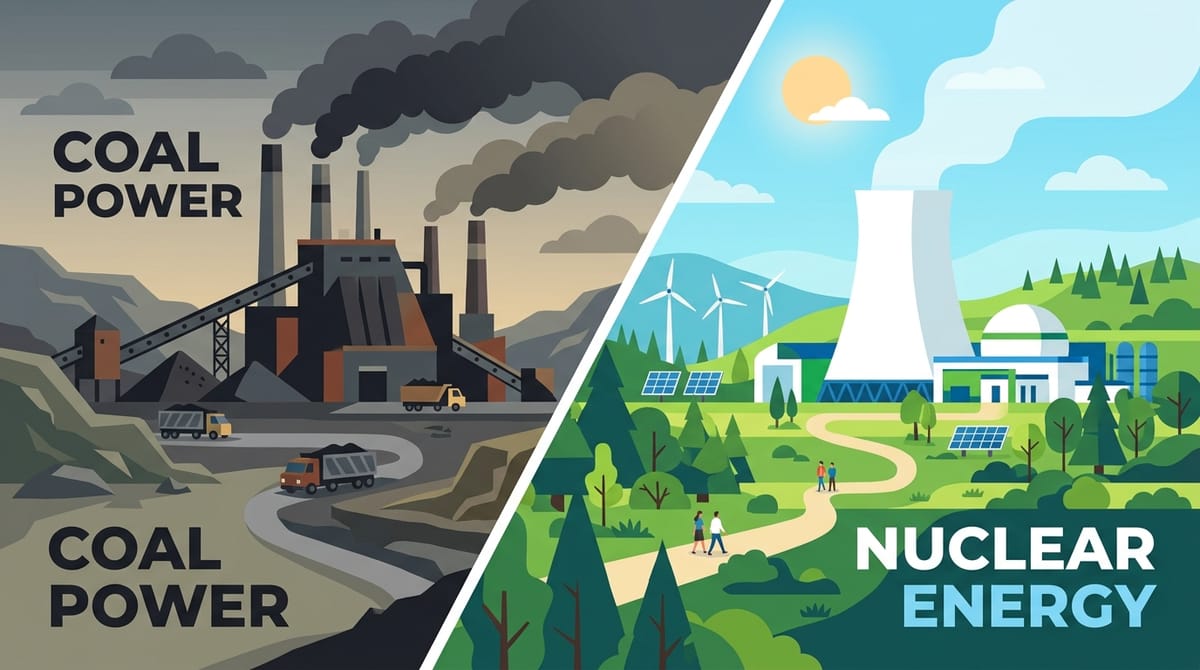
Coal generates over half of Vietnam's electricity.
In 2025, coal-fired plants accounted for 54% of total output. Hydropower contributed about 23%, and wind and solar together made up roughly 13%. Natural gas and a small amount of imported electricity covered the rest.
Vietnam relies heavily on coal, but it doesn't produce enough domestically. In 2024, the country imported 44 million tons of thermal coal, a 30% jump from the previous year.
Hydropower seems like a cleaner option, but it has one serious vulnerability: drought.
Northern Vietnam was hit by a severe drought in the summer of 2023. Reservoirs ran dry. Eleven hydropower plants went offline, including Son La, the country's largest. The daily power shortfall forced even industrial zones into rolling blackouts. Factories halted production. Malls cut air conditioning. People endured 35-degree heat without power. The World Bank put the economic damage at roughly USD 1.4 billion.
Solar capacity has grown quickly, but the grid hasn't kept pace. Many solar farms sit in the central and southern parts of the country, far from the northern industrial zones that need the power most. A new high-voltage transmission line completed in 2024 doubled capacity from central to northern Vietnam. That helped, but the broader grid bottleneck persists.
▍ Growing Appetite
Vietnam's electricity consumption is growing close to 10% a year. Industrial users make up more than half of total demand and are expanding the fastest. Semiconductor fabs, data centers, and electronics assembly plants all consume enormous amounts of power.
The government wants high-tech products to account for 45% of manufacturing output by 2030. That target means nothing if the grid can't deliver.
Under current plans, total installed generation capacity needs to double within five years. But coal can't grow much further given decarbonization pressure and rising import costs. Large-scale hydropower has limited room left. And renewables are held back by the grid.
That leaves nuclear.
▍ A 17-Year Timeline
Vietnam's nuclear ambitions go back to 2009, when the National Assembly approved two plants in the south-central province of Ninh Thuan. Combined planned capacity exceeded 4,000 MW. Ninh Thuan 1 was assigned to Russia's Rosatom. Ninh Thuan 2 went to Japan. Both intergovernmental agreements were signed in 2010.
Then came Fukushima in 2011. Anti-nuclear sentiment surged globally. Domestic opposition grew in Vietnam too, and government budgets were tight. The plans stalled.
In November 2016, the National Assembly voted to shelve the entire program. Budget pressures and safety concerns were the stated reasons. Both projects sat idle for eight years.
In November 2024, the National Assembly reversed course and voted to restart the Ninh Thuan program. Vietnam's power demand had become too urgent to wait.
Japan was the first to fall away. In December 2025, Japan's ambassador to Vietnam announced the country's withdrawal from Ninh Thuan 2. Vietnam wanted the plant built within five years. Japan said that was impossible. The timeline was only part of it. After Fukushima shut down all 33 of Japan's reactors, only 12 have come back online. The country's nuclear workforce has eroded over the past decade, and Japanese firms simply don't have enough skilled workers to take on a major project overseas.
Russia, responsible for Ninh Thuan 1, stayed.
On March 25, 2026, Phạm Minh Chính flew to Moscow and signed the deal. Rosatom will build two reactors with a combined capacity of 2,400 MW. Putin called it a "breakthrough decision" and accepted an invitation to visit Vietnam later this year.
▍ Why Russia Stayed
Ninh Thuan 1 has been Russia's project since 2009. After the eight-year freeze and Japan's exit from Ninh Thuan 2, Rosatom remained on Ninh Thuan 1. The reasons are straightforward.
Money comes first. Under the original 2010 agreement, Russia offered to finance at least 85% of the project. The new deal's financial terms are still being finalized, but the precedent matters. Capital is the single biggest barrier to building a nuclear plant, and that kind of financing is hard to match.
Then there's fuel. Russia supplies the nuclear fuel and takes back spent fuel for the lifetime of the plant. Vietnam doesn't need to build its own spent fuel facilities, saving both money and political headaches.
And people. Russia has trained about 300 Vietnamese nuclear specialists since 2009. Rosatom knows the Ninh Thuan site better than anyone, having studied its geology and environment for 17 years.
Vietnam and Russia also have decades of cooperation in energy and defense. Rosatom was the obvious partner.
Ninh Thuan 2 still has no confirmed builder. South Korea is widely seen as the front-runner, having recently completed the Barakah nuclear plant in the UAE, one of the few large-scale nuclear projects delivered roughly on time. Vietnam and South Korea signed a nuclear cooperation framework in 2025.
Westinghouse signed a memorandum with PetroVietnam, but the US is focused on small modular reactors that aren't commercially available yet.
▍ The Math
Vietnam's nuclear restart comes down to arithmetic.
Electricity demand grows close to 10% a year. Coal provides more than half the power supply, mostly from imports. Hydropower depends on rain, and 2023 proved what happens when it doesn't come. The grid isn't ready for large-scale renewables.
When the Middle East conflict erupted, oil and gas prices spiked. Countries across Asia scrambled for more coal, pushing those prices up too. Vietnam zeroed out fuel import taxes and halved environmental levies earlier this month because the energy bill had become unsustainable.
A stable, baseload power source that doesn't rely on imported fuel isn't optional for Vietnam anymore.
Ninh Thuan 1 won't start generating power until the early 2030s at the earliest. Until then, coal remains Vietnam's primary source of electricity.
The Viet Media Monthly
A curated monthly digest of the most important political, economic, tech, and industry developments in Vietnam.
Designed for reading on desktop or tablet — no algorithm, no noise. Just the stories that matter.
Delivered before the 10th of each month. Cancel anytime.