Vietnam's Minimum Wage Rises Again, but Average Pay Is Already Nearly Double the Floor
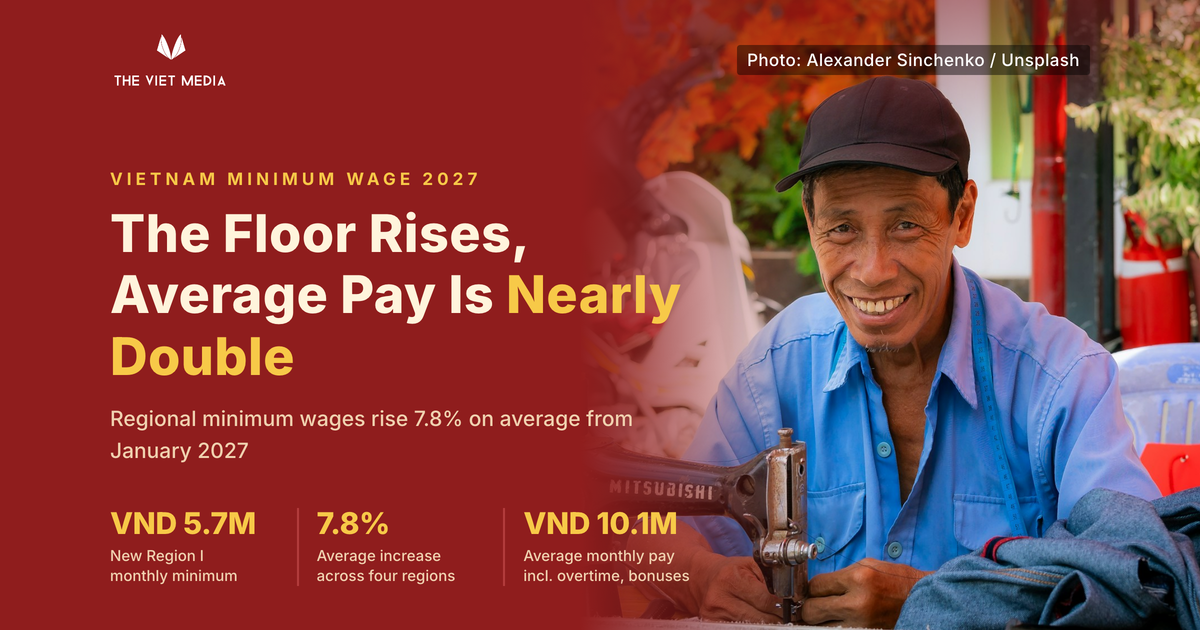
Vietnam will raise regional minimum wages by an average of 7.8% from January 2027, the second straight increase above 7%. Average pay for wage earners is already close to twice the new top rate.
[Vietnam's Minimum Wage Rises Again, but Average Pay Is Already Nearly Double the Floor]
Vietnam will raise its minimum wage by an average of 7.8% across its four wage regions from January 1, 2027. The government issued Decree 399/2026 in early November. The last increase was 7.2%, so this is the second year in a row that the rise has topped 7%.
The minimum wage is a legal floor, not what most people earn. In Region I, the highest-paying zone, the new monthly minimum is VND 5.7 million, about USD 220 at the November 3 exchange rate. Average monthly income for Vietnam's wage earners, including overtime and bonuses, is already close to twice that. The workers who gain directly are those paid near the floor. The employers who have to raise pay are the ones that hire many of them.
Here are the old and new rates (USD figures are approximate, based on the new monthly rate):
➤ Region I: VND 5.31 million to 5.7 million a month (about USD 220); VND 25,500 to 27,400 an hour
➤ Region II: VND 4.73 million to 5.08 million (about USD 197); VND 22,700 to 24,400 an hour
➤ Region III: VND 4.14 million to 4.45 million (about USD 173); VND 20,000 to 21,400 an hour
➤ Region IV: VND 3.7 million to 4.04 million (about USD 157); VND 17,800 to 19,400 an hour
Region I gets the largest increase in cash terms but the smallest in percentage terms, at 7.3%. Region IV, the lowest-paid zone, gets the biggest percentage rise: 9.2%.
How far is the floor from typical pay? Vietnam's statistics office says wage earners made an average of VND 10.1 million a month in the first nine months of this year, about USD 392. That figure includes overtime, bonuses and job allowances, not just base pay. It is also a national average, which high earners can pull up. It shows the overall level of pay. It does not mean every low-wage worker earns more than the minimum.
The 7.8% figure came out of two rounds of talks at the National Wage Council. At the first meeting in June, the Vietnam General Confederation of Labour, the national trade union body, proposed average increases of 8.5% to 9.8%. It said that range would roughly cover workers' basic living needs, citing economic growth, inflation, labour productivity and business conditions.
The Vietnam Chamber of Commerce and Industry (VCCI), which represents employers, pushed back. It said many businesses were struggling, a January start was a little rushed, and companies needed time to adjust. It wanted the increase delayed to July and worried that a large rise would push up costs. Before the second meeting, VCCI was arguing for about 5%.
In mid-July, the council agreed to recommend a 7.8% average increase starting January 1, and the government adopted the proposal unchanged. A union representative said the union had hoped for more, but council members were broadly satisfied with the outcome. A VCCI representative said businesses might struggle to absorb the cost, while stressing that the council had reached consensus. The Ministry of Home Affairs, which drafted the decree, estimates that even after inflation this year and next, the new rates will still sit slightly above workers' minimum living standard at the end of 2027.
For manufacturers in industrial parks, the most relevant part of the decree is how wage regions are assigned. The rule of thumb is the employer's place of operation. A company with branches in different regions pays each branch the rate for its location. If an industrial park, export processing zone or high-tech park straddles more than one wage region, every employer inside it must pay the highest of those rates.
The decree also covers areas affected by Vietnam's administrative restructuring. Until the government issues new rules, areas that were renamed or split keep their previous rate. Areas formed by merging places with different rates take the highest one. The full list of which locality belongs to which region is in the decree's appendix.
Workers paid by the week, by the day, by piece or on a contract basis must also earn at least the new minimum once their pay is converted to a monthly or hourly figure. Employers must review labour contracts, collective agreements and internal pay rules, and may not cut existing pay entitlements such as overtime.
*Wage region assignments follow the decree's appendix. Please consult a professional adviser for your specific situation. This article is not legal advice.
The Viet Media Pro: at least four in-depth articles a month, access to every paid article, building into a knowledge base on Vietnam's policy, industries, companies, and people.