Why Do Vietnamese People Put Their Gods on the Floor?
Vietnamese shops and homes keep their Earth God and God of Wealth altars on the ground floor, facing the door. The reason is both spiritual and practical.
[Why Do Vietnamese People Put Their Gods on the Floor?]
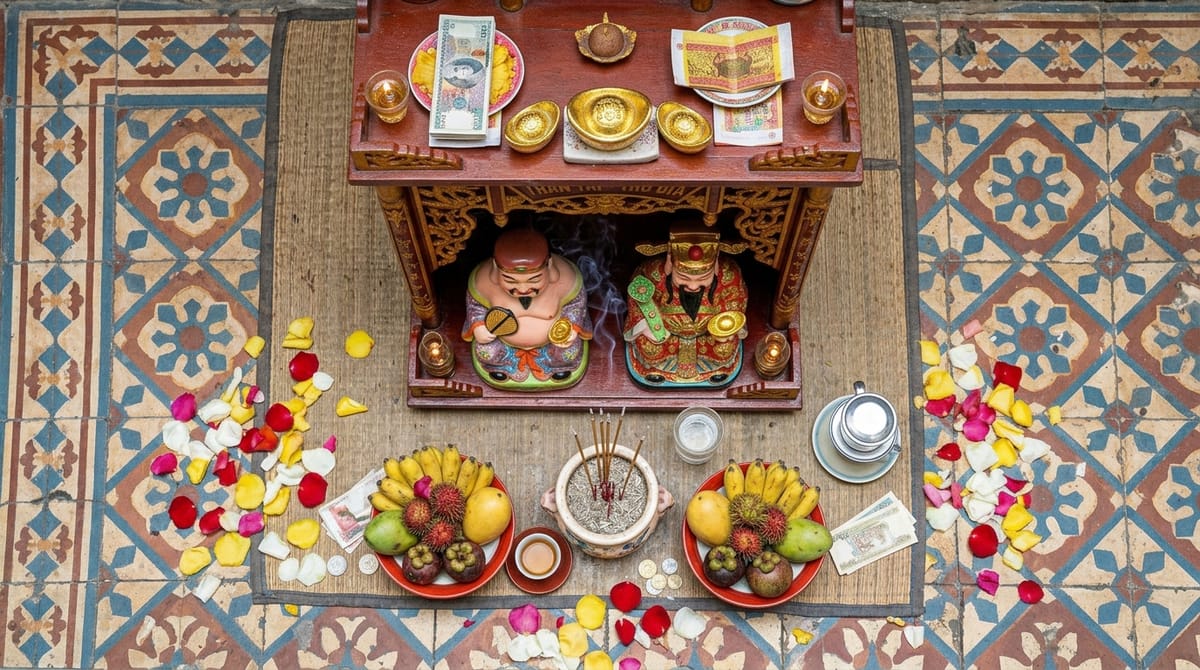
Walk into any restaurant, cafe, or street food stall in Vietnam and you'll likely spot something near the entrance: a small altar sitting on the ground, holding two statues, a few sticks of incense, and offerings that might include fruit, coffee, and even cigarettes.
If you're Chinese, Taiwanese, or from any other part of the Chinese cultural sphere, this looks wrong. Deities go up high. Altars sit on elevated tables, above head height, as a sign of respect. Placing a god on the floor? That would be borderline disrespectful.
In Vietnam, it's the correct way to do it. And the reasoning makes perfect sense.
▍ Who Are the Two Figures?
The pair on the ground are Ong Dia, the Earth God, and Than Tai, the God of Wealth. They're almost always worshipped together.
Ong Dia is easy to recognize: a jolly, big-bellied man in simple clothes, holding a fan and grinning ear to ear. He looks almost identical to the Laughing Buddha, or Budai, that you see in Chinese Buddhist temples. That's no coincidence. Over centuries, Vietnamese folk religion merged the image of the Buddhist monk Budai with the local earth deity, creating a figure that's distinctly Vietnamese.
Than Tai sits next to him, looking more formal: white beard, serious expression, dressed in traditional robes. He handles the money side of things.
Together, they cover all the bases. Ong Dia protects the land and the space. Than Tai brings in customers and cash. Vietnamese business owners believe you need both for a shop to thrive.
▍ Why the Floor?
In Vietnamese homes, ancestor altars always go up high. But Ong Dia and Than Tai are different. Their altar must sit on the ground, near the front door, facing outward.
The logic is straightforward. Ong Dia is the god of the earth. His domain is the ground itself. Putting him up on a shelf would contradict what he represents. Vietnamese folk belief divides the spiritual world into heaven, earth, and the human realm. Ancestors belong to the heavenly tier. The Earth God belongs to the ground.
There's also a legend about Than Tai. The story goes that the God of Wealth once fell from heaven and wandered among the shops and market stalls of the mortal world. Wherever he sat down, business boomed. Because the story has him sitting on the ground, that's where his altar stays.
Feng shui plays a role too. Vietnamese believe that wealth energy enters through the front door. An altar placed low and facing the entrance can "catch" that energy as it flows in. Too high, and you miss it.
▍ Coffee and Cigarettes for the Gods
In Taiwan, people typically worship the Earth God on the 2nd and 16th of each lunar month. At home, daily worship is mostly directed at ancestors.
Vietnam takes a very different approach. Shop owners pray to Ong Dia and Than Tai every single day: once before opening in the morning, once again when closing at night. The offerings are distinctly Vietnamese too. Beyond the usual fruit and flowers, you'll often see a cup of Vietnamese coffee and a lit cigarette placed on the altar.
Yes, people brew coffee and light cigarettes for their gods. It's one of those cultural details that tends to get a smile out of visitors.
On the 1st and 15th of each lunar month, the offerings get more elaborate. During Tet, the Lunar New Year, entire food spreads appear in front of the tiny ground-level shrine.
▍ Not Just for Businesses
Many visitors assume this is strictly a commercial practice. It's not. Regular Vietnamese households keep an Ong Dia and Than Tai altar too. The difference is frequency: business owners pray daily, while households might only do it on the 1st and 15th.
If you visit a Vietnamese home, look near the entrance at floor level. You'll probably spot a small shrine. Don't trip over it.
▍ Same Roots, Different Expressions
The earth god tradition in both Taiwan and Vietnam traces back to the same source: Tudigong worship from southern China. Both cultures believe the earth deity protects the local area and brings prosperity.
But after centuries of separate development, the two versions look nothing alike. Different appearance, different placement, different prayer schedules, different offerings. Same god, two completely different relationships.
Next time you're in Vietnam and spot that little altar on the floor of a restaurant, you'll know: it's not disrespect. It's a different kind of closeness. Vietnamese people keep their gods at arm's reach, greeting them every morning with incense, fruit, and a fresh cup of coffee.
There might be something to that. It feels more personal than a high shelf you only remember on holidays.
—
📢 A quick word from our sponsor
Ever feel like typing is too slow? I now write all my articles using Typeless — just speak, and the AI turns it into polished text. It even removes filler words like "um" and "you know" automatically.
It's 4x faster than typing in my experience, and it supports multiple languages. The free tier gives you 2,000 words per week, which is plenty.
👉 Sign up with my link for $5 in Pro credits: https://www.typeless.com/refer?code=XHRHHU5
(I use it every day — genuinely recommend it)