Vietnam Plans to Ban Binance and License Five Domestic Crypto Exchanges
Some 17 million Vietnamese trade crypto on offshore platforms like Binance, with annual volume topping USD 220 billion. The government is now moving to shut that door and open a domestic one.
[Vietnam Plans to Ban Binance and License Five Domestic Crypto Exchanges]
▍ USD 220 Billion, Almost All Offshore
Vietnam is the world's fourth-largest crypto market, behind India, the U.S., and Pakistan, according to Chainalysis's 2025 Global Crypto Adoption Index. On-chain transaction volume hit USD 220 billion between July 2024 and June 2025, up 55% year-on-year.
About 21.2 million Vietnamese adults have held or used crypto assets, according to Tiger Research. Around 17 million of them trade on offshore platforms — Binance, Bybit, OKX. And 88% of users are under 35.
These platforms operate outside Vietnamese jurisdiction. User data and transaction records sit on foreign servers. The government collects no tax, sees no data, and has no way to enforce anti-money laundering rules.
▍ Legislate, License, Then Ban
Vietnam is moving in three steps.
First, the legal foundation. In June 2025, the National Assembly passed the Law on Digital Technology Industry, recognizing "digital assets" as property under the Civil Code for the first time. The law took effect on January 1, 2026.
Second, licensing. The government issued Resolution 05/2025/NQ-CP on September 9, 2025, launching a five-year crypto trading pilot. The Ministry of Finance began accepting exchange license applications on January 20, 2026. A March 12 ministry document cited by Reuters shows five firms have passed initial review:
➤ TCEX — affiliate of Techcombank, one of Vietnam's largest private banks.
➤ CAEX — affiliate of VPBank, a publicly listed bank and the only one of the five to have met the VND 10 trillion capital threshold so far.
➤ LPEX — affiliate of LPBank (formerly LienVietPostBank), also a listed bank.
➤ VIX Securities — one of Vietnam's major brokerages.
➤ Sun Group (entity name: Vietnam Digital Assets JSC) — a large private conglomerate spanning real estate, tourism, and entertainment.
All five are major domestic financial institutions or corporate groups. That's by design — the VND 10 trillion capital floor and 65% institutional ownership requirement ensure only banks and big corporates can play.
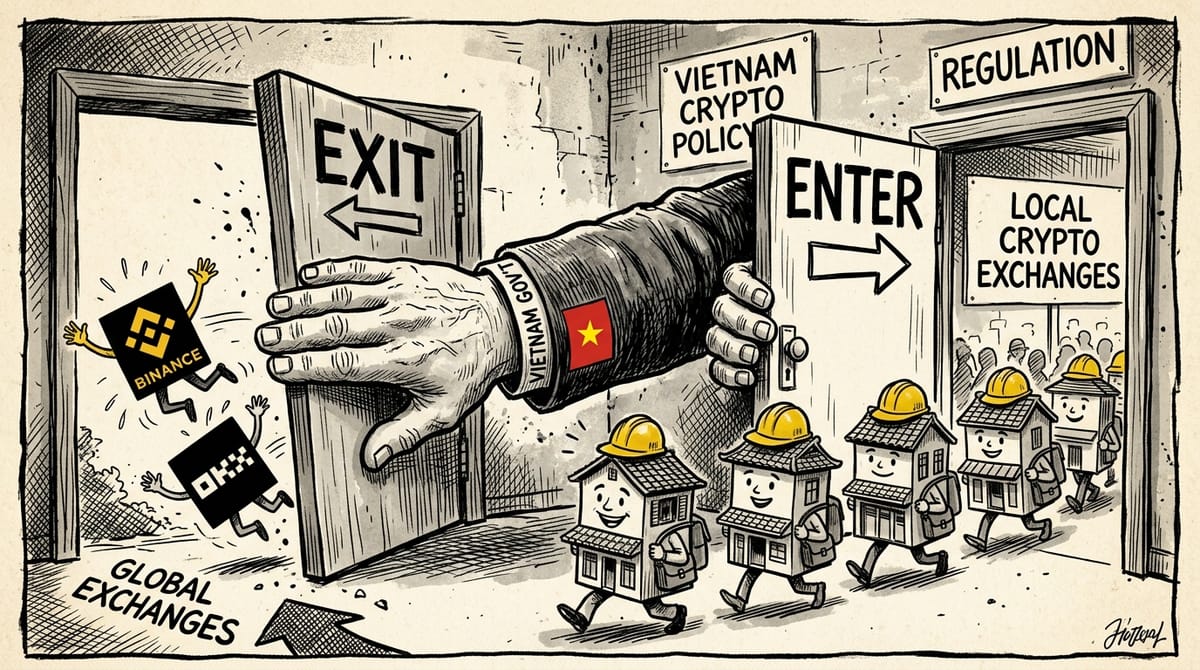
Third, the offshore ban. The Ministry of Finance is drafting rules that would prohibit Vietnamese citizens from trading on foreign exchanges like Binance, OKX, and Bybit — a full ban, not a partial restriction. The draft hasn't been enacted yet, but the direction is clear. Violators would face administrative fines, and serious cases could lead to criminal prosecution. Non-compliant offshore platforms may be blocked at the internet service provider level.
The ban targets trading activity on foreign platforms. Holding crypto in a personal wallet would not be prohibited.
A separate draft decree on penalties was released for public comment on November 18, 2025, and is still under review. It proposes fines of VND 10–30 million (roughly USD 400–1,200) for individuals trading on unlicensed platforms. Enforcement wouldn't begin immediately — there would be a six-month grace period after the first domestic exchange starts operating.
▍ The World's Highest Entry Barrier
Vietnam's capital requirement for a crypto exchange license is the highest in the world.
Minimum paid-up capital: VND 10 trillion, about USD 380 million. Singapore requires SGD 100,000–250,000. The EU has no fixed threshold. Vietnam's bar is 28 times Thailand's and 600 times Hong Kong's.
Ownership rules are strict too. At least 65% must come from institutional shareholders, with at least 35% contributed by two or more banks, securities firms, fund managers, insurers, or tech companies. Foreign ownership is capped at 49%. Only five licenses will be issued.
As of March 16, according to CafeF, only two companies have actually met the VND 10 trillion threshold: Vimexchange (which hit it when it was founded in June 2025) and CAEX (part of the VPBank ecosystem, which completed its capital increase in late February 2026). But Vimexchange is not among the five pilot applicants. The others are still raising capital.
▍ How Crypto Gets Taxed
The tax framework is already in effect. The Ministry of Finance's Circular 32/2026/TT-BTC took effect on March 27, 2026, and applies during the five-year pilot period.
Individual investors pay 0.1% on the transaction value of each trade — the same rate as Vietnam's stock trading tax. This is a turnover-based levy, not a capital gains tax. You pay it whether you made money or lost money.
Corporate investors pay 20% income tax on profits, calculated as selling price minus purchase cost and expenses.
Crypto transfers are exempt from VAT.
Until now, all of this tax revenue was lost to offshore platforms.
▍ Da Nang's Early Experiment
Before the five national exchanges go live, a smaller sandbox is already running in Da Nang.
In August 2025, the city government approved AlphaTrue Solutions to pilot a crypto-to-fiat conversion service called Basal Pay. It lets foreign tourists convert crypto directly into Vietnamese dong, at costs about 30% lower than traditional exchange methods. The system follows FATF Travel Rule standards, with identity verification and risk scoring on every transaction.
The pilot runs for 36 months across five phases: development, limited testing, scaling, evaluation, and full deployment. It's Vietnam's first government-authorized real-world use case for crypto assets.
▍ Ban the Platform, Hire the Expertise
Vietnam's stance toward offshore exchanges isn't purely adversarial.
On April 17, 2025, Finance Minister Nguyen Van Thang met with Bybit CEO Ben Zhou to discuss cooperation in the crypto space. Bybit's role isn't to operate an exchange in Vietnam — it's serving as a technical advisor, helping design the system architecture for domestic platforms, sharing AML and KYC expertise, and training Vietnamese financial regulators. The State Securities Commission was assigned to maintain ongoing technical discussions with Bybit. In September 2025, Bybit signed an MOU with the Da Nang People's Committee to support the city's development as an international financial center.
Bybit is also one of the offshore exchanges that Vietnamese citizens would be banned from using under the draft rules. The government is banning its platform while hiring its expertise.
▍ Why Not a Full Ban
China banned all crypto trading and mining in 2021. Chainalysis data shows over USD 50 billion in crypto flowed out of East Asian accounts between 2019 and 2020, much of it believed to be capital flight from China.
Vietnam is going a different route. Officials have stated that restricting offshore trading is meant to "curb capital outflows, reduce fraud risk, and strengthen supervision." But instead of China's blanket shutdown, Vietnam is closing the offshore channel while opening a domestic one.
Two facts intersect here: Vietnam enforces strict foreign exchange controls — all forex transactions must go through institutions authorized by the State Bank — and 17 million people are trading crypto on completely unregulated offshore platforms.
▍ What Happens Next
The five firms that passed initial review are preparing to launch. But the bar is high. Among the five, only CAEX has met the VND 10 trillion capital requirement so far. Whether the other four can raise USD 380 million within the pilot timeline remains to be seen.
Enforcement will be a challenge too. Seventeen million users are used to the trading experience and liquidity of offshore platforms. VPNs, decentralized wallets, and peer-to-peer trading are technically difficult to block completely.
Vietnam's five-year pilot is just getting started. The policy framework is in place: domestic licensed exchanges, the world's highest capital threshold, an offshore ban, and a stock-market-style tax. The question now is whether this system can actually pull 17 million users back onshore.
The Viet Media Monthly
A curated monthly digest of the most important political, economic, tech, and industry developments in Vietnam.
Designed for reading on desktop or tablet — no algorithm, no noise. Just the stories that matter.
Delivered before the 10th of each month. Cancel anytime.