Vietnam's National Assembly Convenes: The Biggest Power Reshuffle Since Doi Moi
Vietnam's new National Assembly convenes to elect a president, prime minister, and formalize Tô Lâm's sweeping government overhaul.
[Vietnam's National Assembly Convenes: The Biggest Power Reshuffle Since Doi Moi]
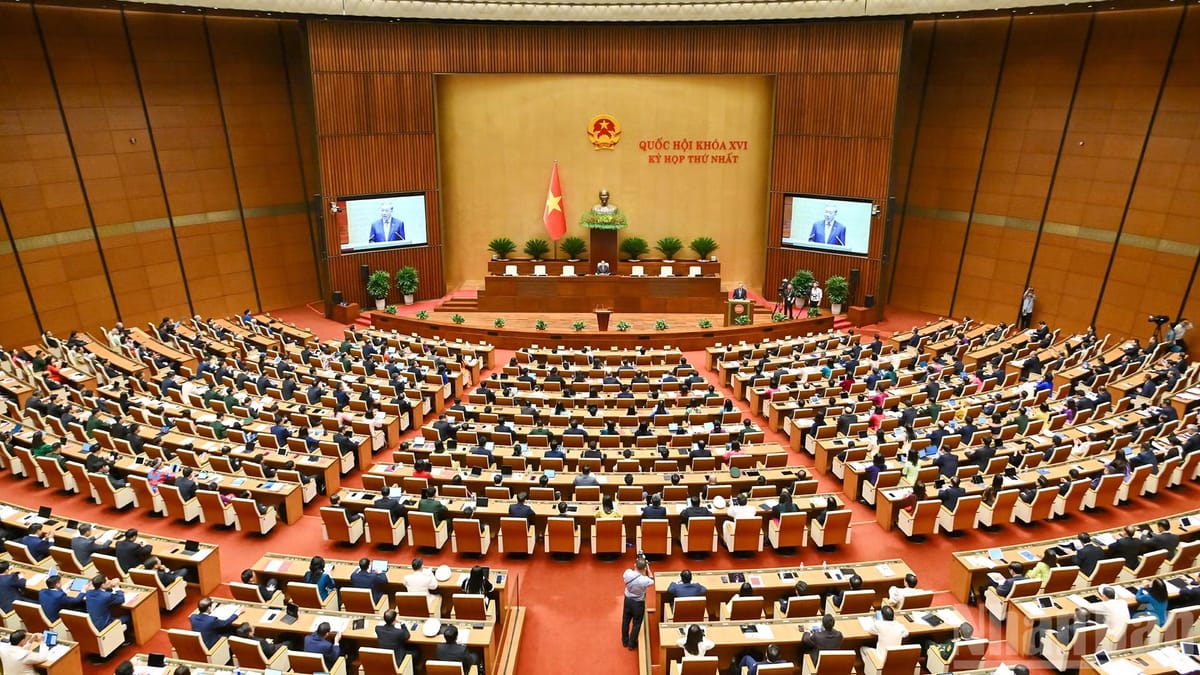
Vietnam's 16th National Assembly held its opening session in Hanoi on April 6. Over the next 11 days, lawmakers will elect a new president, prime minister, and National Assembly chair. But the real story isn't about who gets which title. It's about the structural overhaul happening underneath.
Government agencies have been cut from 30 to 22. Provinces have already been cut from 63 to 34. Up to 150,000 civil servants face redundancy. Under General Secretary Tô Lâm, Vietnam is undertaking its most sweeping power reorganization since the Doi Moi economic reforms of 1986. This Assembly session is where the new architecture officially goes live.
▍ 39 Leadership Positions, Decided This Week
The session runs in two phases. Phase one (April 6–12) covers personnel and organizational matters. Phase two (April 20–23) tackles legislation and economic planning.
Personnel dominates the agenda. In just two and a half working days, the Assembly will elect or approve 39 senior positions: the president, prime minister, NA chair, deputy prime ministers, cabinet ministers, the chief justice, the procurator general, and members of the National Defense and Security Council. The top three posts are expected to be filled by April 8.
Beyond personnel, lawmakers will review eight bills and the country's five-year plans for 2026–2030, covering socioeconomic development, national finances, and public investment. In effect, this session sets the roadmap for the next half-decade.
▍ Three Months From Party Congress to Parliament
To understand what's happening today, rewind to January.
On January 23, the Communist Party of Vietnam wrapped up its 14th National Congress. Tô Lâm was reelected as general secretary. A new 19-member Politburo was announced. The most telling detail: outgoing Prime Minister Phạm Minh Chính and President Lương Cường were not on the list. Both will step down during this Assembly session, making way for successors.
At the same congress, the party set a GDP growth target of over 10% annually from 2026 to 2030, with the goal of becoming a high-income country by 2045. Vietnam posted 8.02% growth in 2025, its best since 2011, but sustaining double-digit growth for five years is a different challenge entirely.
On March 15, voters went to the polls for the 16th National Assembly. Results came on March 21. Just two weeks later, the new legislature is already in session. The entire transition from party congress to seated parliament took less than three months.
▍ From Four Pillars to Five
Vietnam's political system has long been built on the "four pillars" (tứ trụ): the general secretary leads the party, the president handles diplomacy and state functions, the prime minister runs the government, and the NA chair oversees legislation. Power is split four ways. No single figure dominates. This structure kept Vietnam stable for decades after Doi Moi.
Tô Lâm is rewriting that arrangement.
After the 14th Congress, the top leadership expanded from four pillars to five (ngũ trụ). The new addition is the Standing Member of the Secretariat (Thường trực Ban Bí thư), currently held by Trần Cẩm Tú. This once-behind-the-scenes role has been elevated to equal standing with the other four.
Why add a fifth pillar? Because Tô Lâm is widely expected to permanently merge the general secretary and president roles into one. That would eliminate one of the original four pillars. Elevating the Standing Member of the Secretariat fills the gap and preserves the appearance of collective leadership. The model mirrors China and Laos, where the party chief also serves as head of state.
On paper, Vietnam still has collective leadership. In practice, power has tilted decisively toward the general secretary. Foreign Affairs has described this as a "power grab," arguing it comes at the cost of the institutional checks that gave Vietnam's system its unexpected durability.
▍ The Streamlining Revolution: 30 Agencies Down to 22
The reshuffle isn't limited to the top. Tô Lâm's "streamlining revolution" has already reshaped the entire government apparatus.
Last March, ten ministries were merged into five, bringing the total number of government bodies from 30 to 22 (14 ministries, 3 ministry-level agencies, and 5 government-affiliated agencies). The four biggest consolidations:
➤ Ministry of Planning and Investment + Ministry of Finance: economic planning and fiscal policy under one roof
➤ Ministry of Transport + Ministry of Construction: infrastructure and urban development unified
➤ Ministry of Natural Resources and Environment + Ministry of Agriculture and Rural Development: land, environment, and agriculture in a single agency
➤ Ministry of Labor, Invalids, and Social Affairs folded into the Ministry of Home Affairs: workforce and civil service management combined
The reforms are expected to eliminate 100,000 to 150,000 civil service positions. And it goes beyond Hanoi. Vietnam's 63 provinces and cities were already consolidated into 34 in July 2025.
This is the most ambitious administrative reorganization Vietnam has attempted in decades. The stated goal is to cut bureaucratic overlap and speed up policy execution. But how the transition period will work, where displaced civil servants will go, and whether local governance capacity will hold up are all open questions.
▍ What It Means for Business and Investors
These political changes have direct implications for anyone doing business in Vietnam.
The timing is notable. One day after the Assembly opened, on April 7, FTSE Russell will announce the results of its interim review. FTSE already reclassified Vietnam from Frontier to Secondary Emerging Market last October, but with a condition: the interim review must confirm sufficient progress in enabling access to global brokers before the upgrade officially takes effect in September. Vietnam also meets 17 of MSCI's 18 criteria for emerging market status. That said, foreign investors aren't all-in yet: they were net sellers of VND 1.122 trillion last week.
On the policy side, fewer ministries means fewer government touchpoints for businesses. Infrastructure projects that previously required sign-offs from both the Ministry of Construction and the Ministry of Transport now deal with a single merged agency. Investment approvals that involved both the Ministry of Planning and Investment and the Ministry of Finance will theoretically face less inter-ministry friction.
Long Thanh International Airport is targeting commercial operations in Q4 2026. The consolidation of 63 provinces into 34, completed last year, is already reshaping how local investment promotion works. For companies with long-term operations in Vietnam, now is the time to reassess government relationships and approval pathways.
The Viet Media Monthly
A curated monthly digest of the most important political, economic, tech, and industry developments in Vietnam.
Designed for reading on desktop or tablet — no algorithm, no noise. Just the stories that matter.
Delivered before the 10th of each month. Cancel anytime.