Why Is Saigon's Backpacker District Named After Phạm Ngũ Lão? A Mongol-Beating General and a Colonial Railway Station
Saigon's busiest tourist quarter is named after a man few visitors could identify: a basket weaver who became the general the Mongols could not beat. The street itself began as a nameless lane beside a colonial railway station.
[Why Is Saigon's Backpacker District Named After Phạm Ngũ Lão? A Mongol-Beating General and a Colonial Railway Station]
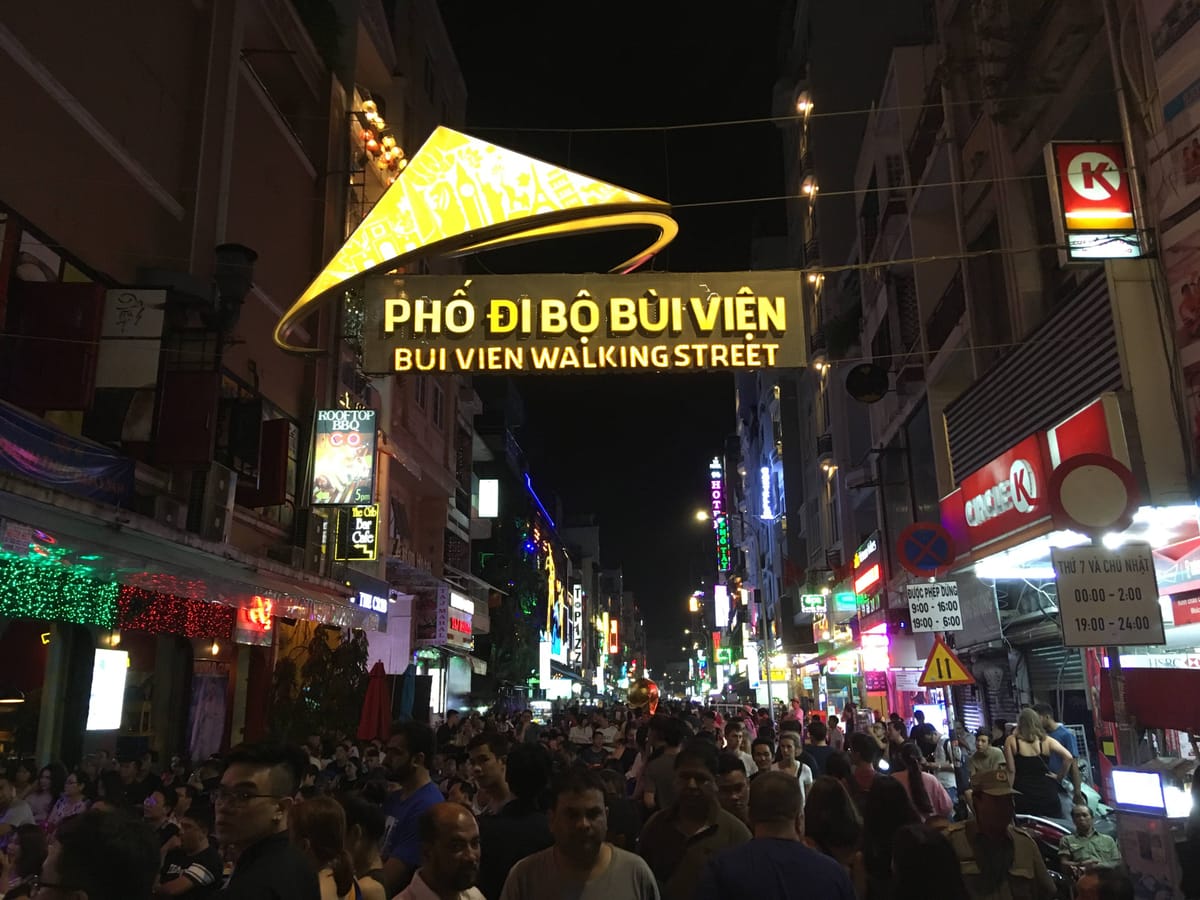
Almost every independent traveler passing through Ho Chi Minh City ends up in Pham Ngu Lao. On the map it is actually four streets — Phạm Ngũ Lão, Bùi Viện, Đề Thám and Đỗ Quang Đẩu — that together form Vietnam's most famous backpacker district. Locals call it "phố Tây ba lô," the Western backpacker quarter, and it draws constant comparisons to Bangkok's Khao San Road. Budget hostels, tour agencies and bars pack these few blocks, and the whole area goes by the name of one street: Phạm Ngũ Lão.
Business has rarely been better. In the first half of this year, Ho Chi Minh City received nearly 6.4 million international visitors — more than half its full-year target — with tourism revenue of about VND 214 trillion, roughly USD 8.1 billion. The Pham Ngu Lao quarter sits in the middle of that crowd. The nightlife, though, is not on Phạm Ngũ Lão street itself but on Bùi Viện, the street running parallel to it. Every weekend at 7pm, Bùi Viện closes to traffic and becomes a walking street: bars with speakers at full volume, plastic stools, tourists weaving through with beers in hand until 2am. Phạm Ngũ Lão street is where the hotels and travel agencies live.
Most travelers only know this one Phạm Ngũ Lão street. In fact, cities across Vietnam have one — in Hanoi, the National Museum of History sits at No. 1 Phạm Ngũ Lão Street. Yet on any of them, few people can tell you where the name comes from. Phạm Ngũ Lão lived more than seven centuries ago, and the most famous enemy of his life was the Mongol Empire.
According to the National Museum of History, Phạm Ngũ Lão was born in 1255 in Phù Ủng village, in what is now Hưng Yên province, to a poor family; he wove bamboo baskets to support his mother. A folk legend tells how he was discovered. Trần Hưng Đạo, the great general of the Trần dynasty, was marching through Phù Ủng when his advance guard found a young man sitting by the road, weaving a basket, so absorbed in thinking about military strategy that he ignored their shouts to move. A soldier drove a spear through his thigh. He did not flinch. Trần Hưng Đạo stopped to question him, found the farm boy fluent in the classics and the art of war, had his wound dressed and brought him to court — later marrying his adopted daughter, Princess Anh Nguyên, to him. In 1290 he was appointed a commander of the royal guard.
That mattered more than it may sound. Military power in Đại Việt was concentrated in the hands of the Trần royal clan, and Phạm Ngũ Lão was one of the very few commanders in the wars against the Yuan who did not carry the family name. When the Mongols launched their second invasion in late 1284, he fought the following year at Chương Dương, where Vietnamese forces all but destroyed the fleet of the Yuan general Sogetu. In the third invasion of 1287–88, after the Yuan navy was crushed at the Battle of Bạch Đằng, he ambushed Prince Toghan's retreating army and wiped out half of it. He rose to commander-in-chief of the army; his daughter became a royal concubine and his son received a mandarin post — honors normally reserved for the royal clan. Over the next three decades he kept winning: repelling Laotian incursions and campaigning against Champa, the old kingdom in central Vietnam.
He was not only a soldier. Phạm Ngũ Lão left behind a four-line poem, "Thuật hoài" ("Expressing My Feelings"): a warrior who has carried his spear across the rivers and mountains for years, whose army has the spirit of tigers — and who still feels ashamed to hear people speak of Zhuge Liang, the model strategist, because his own duty to the country feels unfinished. When he died in 1320 in Thăng Long, today's Hanoi, Emperor Trần Minh Tông suspended court for five days of mourning — a rare tribute for an official from outside the royal clan. The historian Ngô Sĩ Liên wrote in the Đại Việt sử ký toàn thư that in war he "won every battle, took every objective." In popular religion he was deified outright, revered as Đức Thánh Phạm — Saint Phạm.
The Saigon street, however, did not start out with his name. It exists because of a railway station. In 1885 the French opened Indochina's first railway line, from Saigon to Mỹ Tho, with the city's first station at the river end of today's Hàm Nghi boulevard. In 1915 a second station was completed next to Bến Thành Market, and a new road was cut along its southern side — so new it had no proper name, just "rue Latérale Sud de la Gare," the street on the south side of the station. When the station formally opened in 1917, the colonial government named the street rue Colonel Grimaud, after a French officer.
In 1955, the newly established South Vietnamese government swept away a batch of colonial street names, and the street was renamed for Phạm Ngũ Lão. It has kept the name ever since. During the South Vietnam era this was Saigon's press row, lined with newspapers, magazines, publishers and print shops; old Saigonese called the junction of Phạm Ngũ Lão, Đề Thám and Bùi Viện the "International Crossroads" (Ngã tư Quốc Tế).
The turning point came when the trains left. In 1983 the station moved further from the center to Hòa Hưng, where Saigon's railway station stands today. The vacated site became the nine-hectare September 23 Park in the 1980s, named for the day in 1945 when Saigon rose against the returning French. With the railway gone, cheap guesthouses and tour agencies gradually filled the surrounding blocks — today's backpacker district took shape from there. In 2017 the city's first underground food and shopping market (Sense Market, now Central Market) opened beneath the park, and on August 20 that year Bùi Viện officially became a weekend walking street. Bùi Viện himself, incidentally, was a reformist diplomat of the late 19th century — two parallel streets, named for men six hundred years apart.
The station is gone and the newspapers have closed, but the street name still hangs at the corner. Next time you find yourself in Pham Ngu Lao, somewhere between the bars and the neon, spare a thought for the general — and the poem he left behind.