In Hanoi's Winter, Early Morning Is the Wrong Time for a Run
Many people think early morning has the cleanest air, but during Hanoi's pollution season it is one of the dirtiest times of day.
[In Hanoi's Winter, Early Morning Is the Wrong Time for a Run]
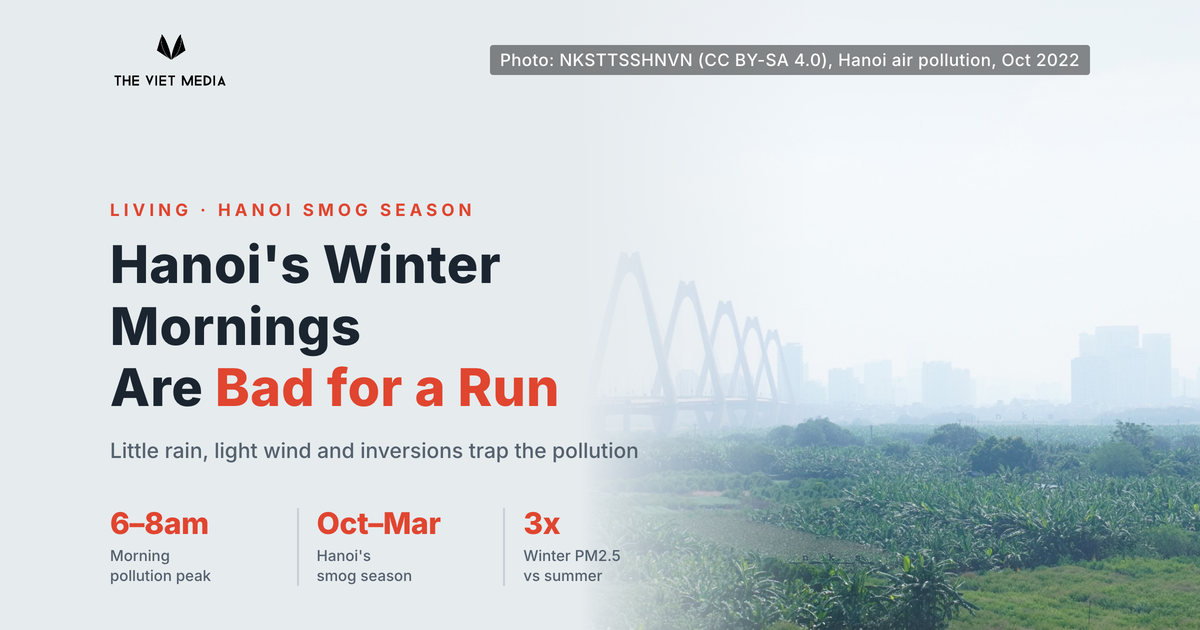
Plenty of people believe the air is freshest at dawn, so that is when they head out to exercise. In Hanoi's pollution season, the opposite is true. Hoàng Dương Tùng, a former deputy head of Vietnam's environment administration, says early morning is exactly when polluted air does the most harm. Vietnam's national environment officials say pollution tends to peak from 6 to 8am and again from 5 to 7pm, and it can also spike at night and around the arrival of cold fronts.
Last November the Ministry of Agriculture and Environment, which oversees environmental policy, told northern provinces to advise residents to cut back on outdoor activity and exercise in the early morning and at night. It singled out older people, children and anyone with respiratory illness.
Hanoi's air starts to get worse once the weather cools. The city's environment department treats October through March as its "pollution season." This year a wet run-up to autumn kept the air relatively clean for a while. By late October pollution had picked up again, and a monitoring point in the West Lake area went above 200, into the purple band.
Hoàng Dương Tùng points out that traffic and factories put out roughly the same emissions in winter as in summer. Autumn and winter are worse because the weather stops pollution from dispersing.
In summer, rain and strong wind keep the air moving, so fine particles get blown away or washed out. In autumn and winter there is less rain and less wind. Sometimes there is also a temperature inversion: the air near the ground is colder than the air above it. That warmer layer acts like a lid, holding the cold air and its pollutants close to the ground. A Vietnamese environment report says inversions are especially common in winter, when nights are long and cold air flows in from the north. Other research has found that vehicle exhaust in Hanoi rises during the morning and evening commutes, the same hours as the daily pollution peaks.
A study published in the journal Atmosphere sampled air at one Hanoi site for a month in summer and a month in winter. Winter PM2.5 levels came out at about three times the summer level. The researchers put this down to lower wind speeds in winter and less room for pollutants to rise and spread. Pollution carried in by northeasterly winds may also play a part.
Autumn adds another source. After the rice harvest, some farmers on the city's outskirts burn the straw in their fields, and the smoke drifts into town. A World Bank study also notes that Hanoi's pollution is not all homegrown. Some of it blows in from other provinces in the Red River Delta, and even from outside Vietnam.
On an air quality app, a higher AQI number means worse air. Vietnam's official scale has six levels, from green "good" to brown "hazardous." The purple readings that are common after autumn arrives count as "very poor," just one step below the worst. Different apps often show different numbers because they use different standards and different monitoring stations.
During the pollution season the air changes from day to day, so check the AQI before you head out in the morning. Don't stop once winter ends, either. Air quality in Hanoi dropped sharply in late May this year.
In October the city published its plan for tackling autumn and winter air pollution. When a pollution episode is forecast, authorities are supposed to issue a warning five to seven days ahead. During the season they will also step up checks on construction sites, factories, high-emission vehicles and open burning.
Families with school-age children will notice the changes at school first. The plan tells the education department to guide schools to cut or postpone outdoor activities and adjust teaching as air quality changes. Last December, Hanoi's city government also ordered that schools suspend in-person classes or rearrange their timetables once air quality reaches the brown "hazardous" level.
The Viet Media Pro: at least four in-depth articles a month, access to every paid article, building into a knowledge base on Vietnam's policy, industries, companies, and people.