The Toothpaste on a Paris Flight That Led to Vietnam's Biggest Drug Case
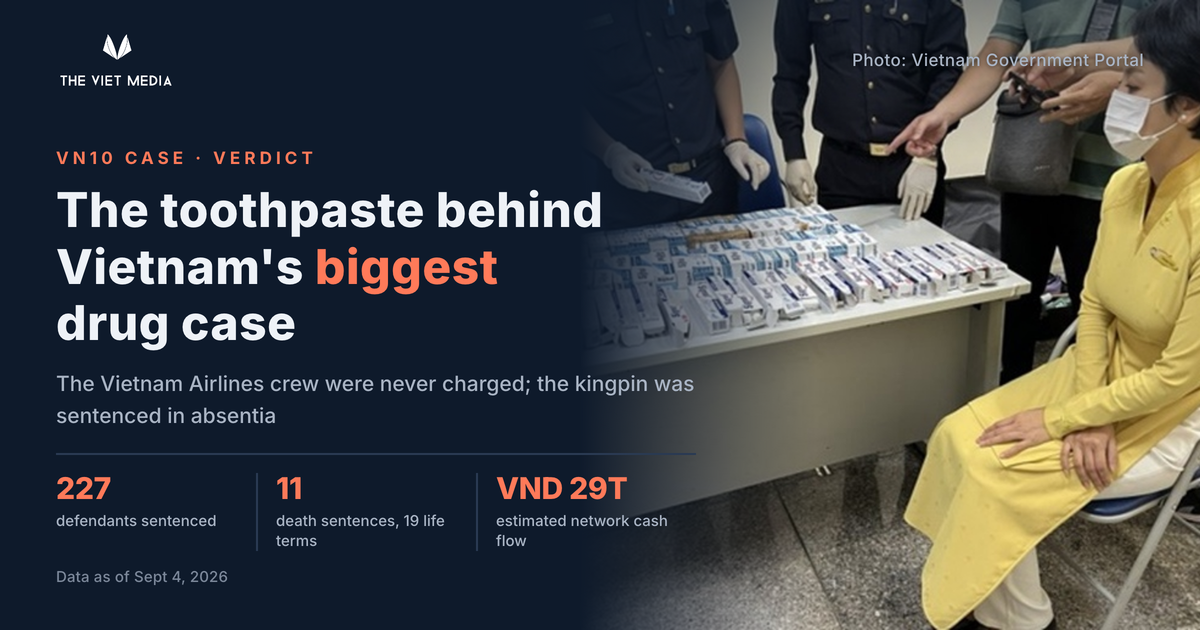
Four suitcases, 157 toothpaste tubes, and three years later a trial of 227 people. Police put the network's cash flow at nearly VND 29 trillion and call it the largest drug case in Vietnam's history.
[The Toothpaste on a Paris Flight That Led to Vietnam's Biggest Drug Case]
On September 3, the Ho Chi Minh City People's Court handed down sentences to 227 defendants: 11 death sentences, 19 life terms, and everything from an 18-month suspended sentence to nearly 30 years for the rest. With more than a hundred defense lawyers and too many defendants for one room, the court split the hearing between its main building and Chí Hòa detention center in the city, where jailed defendants watched the verdict by video link.
The case is known in Vietnam as VN10, after a flight number. In March 2023, customs officers stopped four flight attendants arriving on Vietnam Airlines flight VN10 from Paris. Three years later, the trafficking network traced back to their four suitcases is what police now call the largest drug case in the country's history.
The man at the top, Hà Danh Nậm, was not in court. The 52-year-old from Nghệ An province in central Vietnam ran the operation from France, has never been in custody, and is the subject of an international arrest warrant. He was sentenced to death in absentia, one of four fugitives tried without being present. The other ten people sentenced to death were traffickers at various levels of the network. One of them, Nguyễn Huy Hoàng, was found to have run a distribution branch selling the drugs Nậm supplied.
It started on the morning of March 16, 2023, at Tân Sơn Nhất airport. The luggage of four flight attendants, Trần Thị Thu Ngân, Võ Tú Quỳnh, Nguyễn Thanh Thủy and Đặng Phương Vân, showed something unusual on a routine scan. Inside were 327 sealed toothpaste tubes of assorted brands, each in its own box, plus more than a dozen bottles of mouthwash. Customs opened the tubes one by one. 157 of them contained ketamine and MDMA, more than 11 kilograms in total.
Police established early on that a Vietnamese man in Paris had asked the four to carry the goods home for his family, paying by weight at 6.5 euros per kilogram. Their bags weighed about 60 kilograms combined, so the whole job was worth under 400 euros. The indictment later identified the sender as Hà Danh Nậm, operating under an alias. Police held the four women for a week, then released them for lack of evidence and opened a case for illegal drug transport the same day. Three more years of investigation turned up nothing to charge them with. It was the first time the four had been rostered together on a Vietnam-France rotation, the indictment found, and they had no acquaintance, no communication and no money transfers with Nậm or any other defendant. They were never prosecuted.
Vietnam Airlines suspended the four from duty at the time. The civil aviation authority said it would handle them under its disciplinary rules for aviation staff, and that anyone who used their position to smuggle goods would be barred from working for any airline. Whatever happened to them afterward was never made public.
The toothpaste had been packed in France. According to the indictment, Nậm worked under several aliases, including Tiến Hoàng, Hữu Sơn and Tèo. He filled toothpaste tubes with drugs, marked them with the letter T, and packed them among laundry detergent, coffee, cocoa, chocolate, toothbrushes, mouthwash and shampoo so the shipment looked like a bag of household goods bound for relatives. Besides flight attendants, he recruited Vietnamese students and residents in France to carry the parcels, and sometimes simply used international courier services. From January 2023 he sent at least seven shipments. The first ones got through. The one on March 16 was the last.
In Vietnam, every shipment went to a single collection point in Đồng Nai province, where Hoàng Sỹ Thắng unpacked them. He picked out the tubes marked T, repacked the drugs in boxes and had his nephew-in-law, Bùi Văn Ánh, deliver them to buyers in Ho Chi Minh City and Bình Dương. Thắng was the hub of the line.
Ho Chi Minh City police worked outward from that collection point, and the list of names kept growing. They designated the investigation VN10 and kept expanding it over the next two years. By the time of the verdict it had produced 477 separate cases and more than 2,700 people charged. The 227 people sentenced this week are one of those cases. When police say "largest in history," they mean the whole VN10 operation, not just this trial. They estimate the network's transactions at nearly VND 29 trillion, about USD 1.1 billion, and that figure is the basis for the claim. The court found the network was deliberately built in layers to hide its leaders. Members used encrypted messaging apps, took payments through bank accounts opened in other people's names, and shipped drugs hidden among everyday goods.
At the far end of the network were a few names most Vietnamese would recognize. While chasing suppliers, police found people selling drugs to the circles around singer Chi Dân and model An Tây. Chi Dân was sentenced to seven years, the Spanish-born model An Tây to eight, and Trúc Phương, a social media personality known for charity work and nicknamed the "charity fairy," to six. All three were convicted of organizing drug use by others; An Tây was also convicted of possession. Trúc Phương's case involved a birthday party she threw for a friend at her home in March 2024, where she provided ketamine, ecstasy and laughing gas for guests.
The case also shows how Vietnam's sentencing scale works. Under Article 251 of the Penal Code, trafficking 3 kilograms or more of drugs such as MDMA or ketamine carries life imprisonment or death. The ecstasy in the four suitcases alone came to more than 8 kilograms, nearly three times the threshold. The indictment held Nậm responsible for that shipment and the earlier ones as trafficking, and that is what he was sentenced to death for.
Thắng, who received the shipments, and Ánh, who delivered them, got life instead, and the reason is in the statute book. A Penal Code amendment that took effect on July 1, 2025 removed the death penalty from several offenses, including illegal drug transport, which now carries a maximum of life imprisonment. The crimes were committed before the amendment, but the trial came after it, so death was no longer available for transport. Ten offenses still carry the death penalty after the amendment, and drug trafficking and drug production are both among them. Handling the same toothpaste, Nậm was convicted of trafficking and sentenced to death, while Thắng and Ánh were convicted of transport and sentenced to life.
The death penalty for trafficking itself is now up for debate. On August 20, the Minister of Public Security presented a new draft revision of the Penal Code to the National Assembly on behalf of the government. It would keep capital punishment for only four crimes, treason, murder, terrorism and drug production, and abolish it for drug trafficking. The government wants a vote at the October session, with the law taking effect in March 2027. The Assembly's law and justice committee supports narrowing the death penalty in principle, but several members urged caution about removing it for drug trafficking. Whether the draft passes, and what it would mean for cases already decided, remains open. This week's verdict is a first-instance ruling and the defendants can appeal. As for Hà Danh Nậm, he is still at large.
—
📢 A quick word from our sponsor
Heading to Vietnam and dreading the SIM card counter at the airport? I use Saily eSIM instead — buy it online before you fly, scan the QR code in the app, and your data connects automatically the moment you land.
Saily also lets you switch your virtual location in the app — traffic routes through a NordVPN server, so it works much like a VPN, though it doesn't encrypt data on the device — and it blocks malicious sites, ads, and trackers. Vietnam plans start at US$3.99 for 1GB/7 days, with 3GB/30 days at US$7.99 and 10GB/30 days at US$17.99. Unlimited plans are available too.
👉 Get your Saily eSIM → and use code Special10 for an extra 10% off