From 'Living to Give' to 'A Vietnamese Steve Jobs': A Decade of Vietnam's Exam Essay Questions
Vietnam's 2026 graduation exam asked students how the country can produce its own Steve Jobs, and the whole country started arguing. Line up the twelve essay questions asked since 2015 and you can see exactly where this one came from.
[From "Living to Give" to "A Vietnamese Steve Jobs": A Decade of Vietnam's Exam Essay Questions]
01 | One essay question, one day of arguing
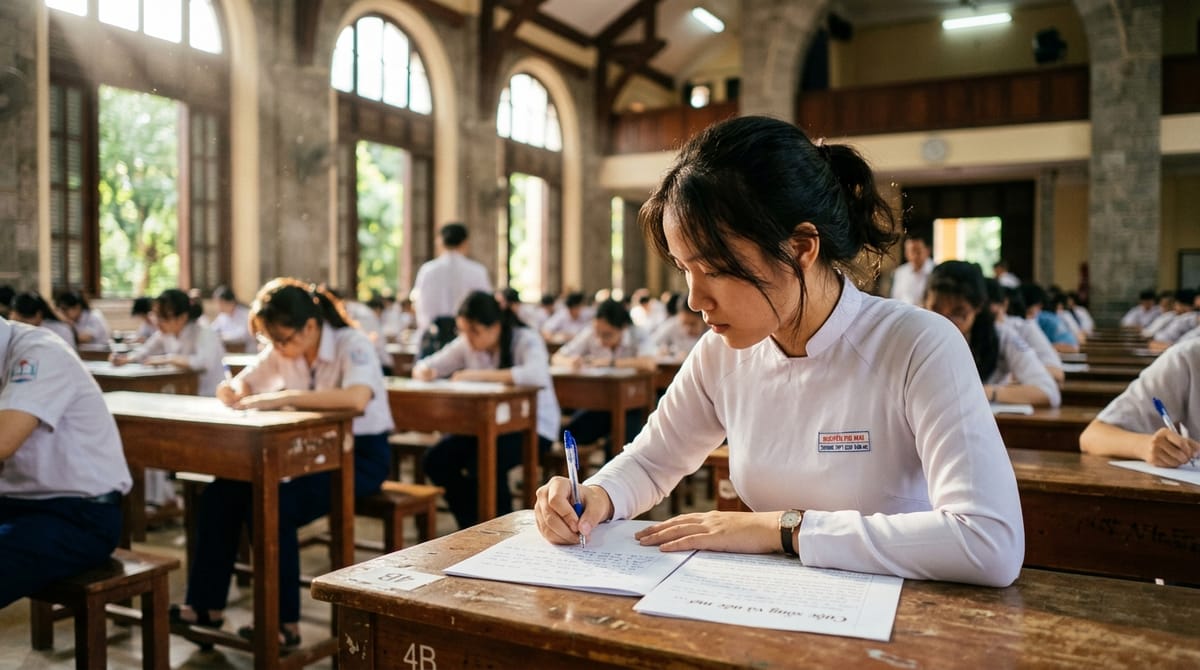
Vietnam's national high school graduation exam opened on the morning of June 11, with a record of more than 1.22 million registered candidates. What turned the exam into national news, though, was the essay question on the literature paper.
The question set up its premise first: America has Steve Jobs, Mark Zuckerberg and Elon Musk, people who changed the world with technology. Then it asked: how can there be a "Vietnamese Steve Jobs"?
The argument started the moment students walked out. Those who liked the question said innovation, startups and the role of young people are hardly strange topics. Those who didn't argued it drags a high schooler into policy, innovation ecosystems and national tech strategy — far too big, far too abstract. Worth noting: the required length was only about 200 words.
Dr. Phạm Ngọc Lan, a literature lecturer at Ho Chi Minh City University of Education, went further. Phrasing it this way, she argued, makes success sound like a personal matter and paints the American tech model in rosy colors. Every country has different historical, cultural and economic conditions, and building a tech sector was never just about producing a few star founders.
Vietnamese media offered a different reading. Thể thao & Văn hóa wrote that this is more than an essay prompt — behind it sits a whole country's aspiration to raise a generation capable of technological breakthroughs and world-class companies. Many also linked it to Politburo Resolution 57, the document that designates science, technology and innovation as the most important driver of national growth. All of this is media interpretation; the exam board never explained its intent.
One essay question caused this much noise because it looks nothing like any question that came before it. How different, exactly? Line them up and see.
02 | Twelve years of questions, in one line
Vietnam's social essay is set nationally — one question per year, for everyone. One question a year, twelve years, twelve questions. Put them side by side and you can watch what the society was thinking about, year by year:
➤ 2015: Training life skills matters as much as accumulating knowledge
➤ 2016: Cowardice makes you lose yourself; courage lets you be yourself
➤ 2017: The meaning of empathy (thấu cảm)
➤ 2018: Everyone's mission to awaken the country's potential
➤ 2019: The power of will
➤ 2020: Cherishing each day of life
➤ 2021: Living a life of dedication (sống cống hiến)
➤ 2022: The young generation carrying on from those before them
➤ 2023: Learning to balance your emotions
➤ 2024: Respecting individuality
➤ 2025: Every homeland sky is part of the Fatherland's sky
➤ 2026: How can there be a "Vietnamese Steve Jobs"?
The early years revolved around the individual: skills, courage, willpower, gratitude for life. The 2018 question on "awakening the country's potential" was the lone exception — in hindsight, a preview filed eight years early. In 2021 and 2022 the questions turned collective: dedication, generational duty. In 2023 and 2024 they swung back to the inner life — emotional balance, individuality — two topics that would sit comfortably on a Taiwanese exam paper.
A side note: the 2017 empathy question drew its reading passage from writer Đặng Hoàng Giang's book "Good, Evil and the Smartphone." The title has aged well.
The turn came in 2025, when two things happened at once. The format changed first: the social essay was promoted from a 200-word piece to the paper's main 600-word essay, its weight jumping from 2 points to 4 — the heaviest question on the paper. And the first topic under the new format was patriotism: "every homeland sky is part of the Fatherland's sky." A literature teacher in Hanoi read it this way: students who follow politics and society would write well, because "we are living through a historic period of the country." Some students did exactly that — one essay cited air force pilots guarding the skies over their hometowns.
After patriotism, what next? The 2026 answer is the question this story opened with: Steve Jobs.
03 | The exam turns to technology
The outlet Người Đưa Tin put it plainly: literature exams used to cycle through family, the environment, human kindness and role models overcoming hardship. This year's paper tests tech founders, along with AI, big data and digital transformation.
The whole paper reads that way. The reading section featured an essay on Gutenberg's printing press: before 1440, knowledge was an "imprisoned asset," locked in sheepskin manuscripts behind the iron gates of libraries, monasteries and castles; printing freed it, and only then did knowledge become the "fuel" of the Renaissance, the Scientific Revolution and the Industrial Revolution. The final reading question came back to the present, asking how young people should use AI to create "intellectual resonance" — the exam's own phrase, meaning roughly that AI should amplify your thinking.
For a dozen years, Vietnam's essay question has alternated between asking about the self and asking about the nation. In 2026, it asked: where is this country going?
Buying a Home in Vietnam: A Taiwanese Buyer's Full Playbook from Hanoi
Maggie of "Maggie's Lonely Planet" has lived in Vietnam since 2017 and traveled to more than 40 provinces. In this online talk she opens up the full ledger of buying her Hanoi apartment: location, pricing, cross-border transfers, renovation, and the legal rules for foreign buyers — all the hidden costs nobody warns you about.
Pure experience sharing, no sales pitch.
Time: Tuesday, June 23, 2026 — 9 pm Taiwan / 8 pm Vietnam