Starlink Goes on Sale in Vietnam, but the Real Story Is the Supply Chain
In a country where 5G already covers 92% of the population, Starlink is a backup service, not a challenger. The clue to its real ambitions is a job ad SpaceX posted in Hanoi two days before launch.
[Starlink Goes on Sale in Vietnam, but the Real Story Is the Supply Chain]
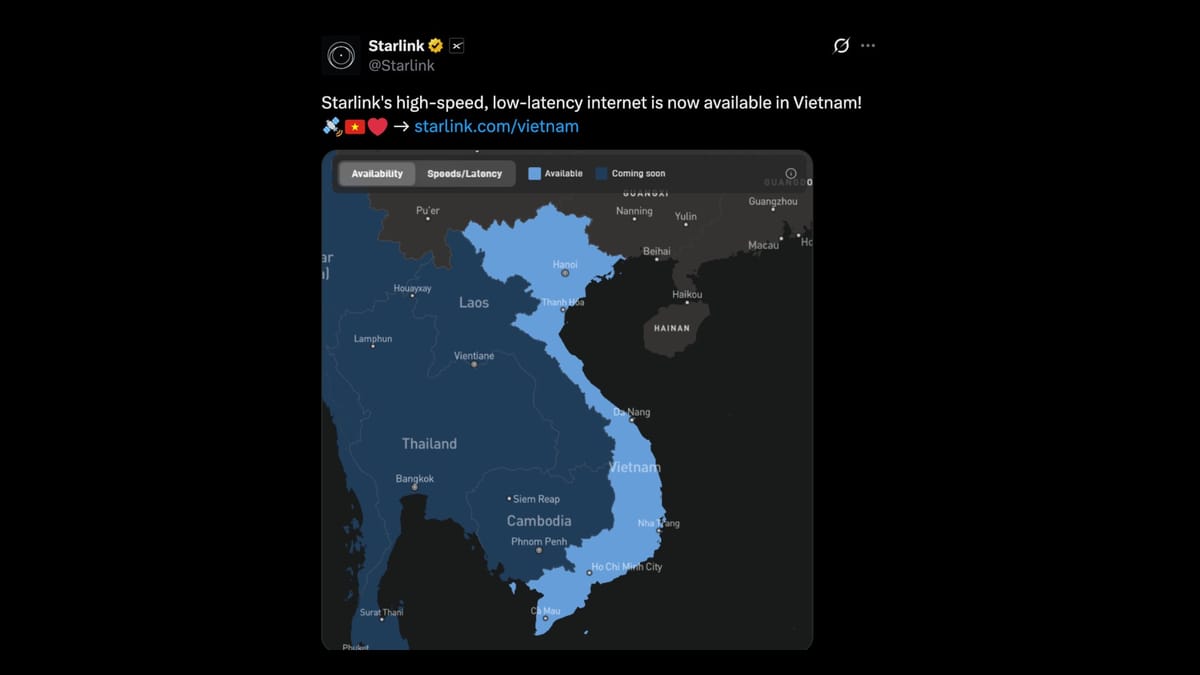
Early on the morning of August 13, Starlink's official X account posted a short announcement: Vietnam is live. That same morning, the country showed as "Available now" on the company's coverage map, and a Vietnamese-language ordering page was up. Enter an address, place an order. Counting from March 2025, when Vietnam's prime minister approved a pilot scheme, it took Elon Musk's satellite internet service nearly 17 months to reach this point.
The pricing comes in two tiers for households: about VND 1.13 million a month (roughly USD 43) for a plan capped at 100 Mbps, and about VND 1.71 million for the top-speed tier. How fast that top tier actually is remains fuzzy — the company's own marketing cites anywhere from 340 Mbps to over 400 Mbps, and real-world numbers will have to wait for actual users. Business plans are priced separately by data volume.
Then there is the hardware. The entry-level Mini kit, with antenna and router in one portable unit, costs about VND 8.66 million; the larger Standard 4X runs about VND 10.27 million and ships with a Wi-Fi 6 router. Getting started with Starlink in Vietnam therefore means paying close to VND 10 million upfront. The terms themselves are simple: no contract, a 30-day trial, delivery in one to two weeks, payment by card or the local e-wallet Zalopay. Signing up requires identity registration.
For context, local carriers sell long-term 5G plans for VND 135,000 to 280,000 a month. Starlink's cheapest plan costs four to eight times that, before hardware. In the cities, where fiber to the home is fast and cheap, satellite internet cannot compete on price.
It was never meant to. In late March 2025, the prime minister's Decision 659 allowed a controlled pilot of low-earth-orbit satellite telecom services, with an unusual concession: no cap on foreign ownership. That let SpaceX operate through a wholly owned local subsidiary, Starlink Services Vietnam, headquartered in Hanoi. On February 13, 2026, the Ministry of Science and Technology's radio frequency department issued the spectrum license. The pilot allows four ground gateway stations — the facilities that link satellites back to terrestrial networks — and a nationwide cap of 600,000 subscribers, running until January 1, 2031. FPT Telecom, Starlink's first local partner, helped build the gateway at its own data center.
A 600,000-subscriber ceiling is tiny for a market Vietnam's size, which tells you exactly where the government has placed Starlink: connectivity at sea, in the air, and in remote mountain areas, plus a backup channel when disasters knock out ground networks. Vietnam's telecom authority said in July that the country now has more than 40,000 5G base stations covering roughly 92% of the population. Demand-side data points the same way: in a VnExpress reader survey early this year, 74% of 8,500 respondents said they had no plans to use Starlink because existing networks already serve them well.
The more interesting signal came two days before launch. On August 11, SpaceX posted a Hanoi-based opening on LinkedIn for a Supplier Development Engineer — someone to build and manage suppliers producing Starlink terminal hardware, with half of each work week spent visiting suppliers inside Vietnam. In other words, SpaceX is hiring someone to plug Vietnamese factories into the Starlink hardware supply chain. Back in 2024, the company said it intended to invest USD 1.5 billion in Vietnam. The domestic market of 600,000 terminals may be small, but building equipment for Starlink users worldwide is a different proposition for a country already deeply embedded in global electronics manufacturing.
Vietnam's satellite play now runs on two parallel tracks: importing Starlink's service while capturing some of its manufacturing, and building its own constellation — Vingroup's VinSpace has bought launch services from SpaceX, with its first satellites slated for 2027, a deal we covered earlier this week. The retail launch is just the opening move. What comes next depends on the hiring and the factories.