How Vietnam's Stock Market Differs From Taiwan's: Listings, Trading Rules, Tax and Foreign Ownership
Vietnam's stock market looks a lot like Taiwan's, but you can't sell until the afternoon of T+2, you need cash up front, and short selling isn't allowed. A rule-by-rule comparison.
[How Vietnam's Stock Market Differs From Taiwan's: Listings, Trading Rules, Tax and Foreign Ownership]
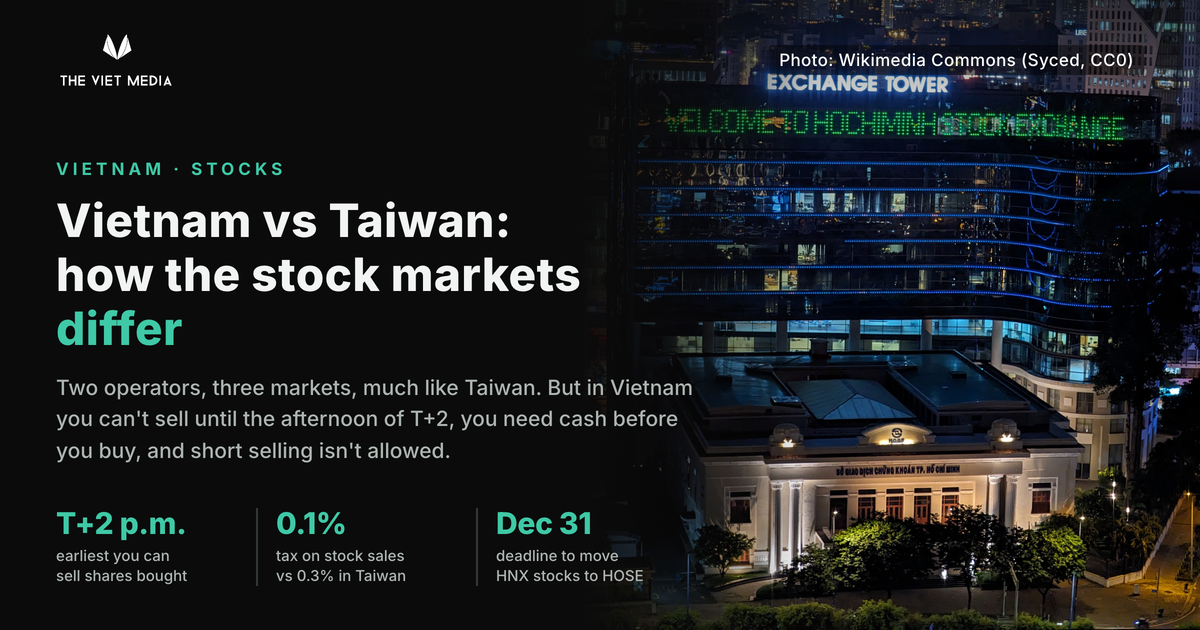
On paper, Vietnam's stock market is built much like Taiwan's: two operators running three main markets. In Taiwan, the Taiwan Stock Exchange runs the main board, while the Taipei Exchange runs both the OTC market and the Emerging Stock Board. In Vietnam, the Ho Chi Minh City Stock Exchange (HOSE) runs one listed market, and the Hanoi Stock Exchange (HNX) runs its own listed market plus UPCoM, the Unlisted Public Company Market, where public companies that have not listed yet trade their shares.
That setup is changing. HNX stopped accepting new listings in July 2025, and under Ministry of Finance rules, all of its listed stocks must move to HOSE by December 31, 2026. Meanwhile, FTSE Russell's upgrade of Vietnam from frontier to secondary emerging market took effect on September 21. MSCI has not followed.
The trading rules differ even more. In Taiwan, you can sell shares the same day you buy them, and ordinary shares are paid for two business days after the trade. In Vietnam, shares bought today can't be sold until the afternoon of T+2, retail investors need the full cash amount in their account before placing a buy order, and short selling is not allowed. The full article compares the two markets rule by rule, from listing thresholds and trading hours to price limits, payment, day trading, short selling, sales tax and foreign ownership caps, and lays out what Vietnam is set to change around year-end.