Vietnam's Sovereign AI Dream: Google's Ex-Chairman Is Sold, Viettel Has Its Own Model — but the Ceiling Is Electricity
Schmidt says Vietnam's treasure is its people. Vietnam is using a homegrown model, national labs and chips to push AI up to the level of national sovereignty. But the whole bet may come down to something far more basic: power.
[Vietnam's Sovereign AI Dream: Google's Ex-Chairman Is Sold, Viettel Has Its Own Model — but the Ceiling Is Electricity]
Hanoi, early June. Eric Schmidt — former CEO and chairman of Google, and former chair of the U.S. National Security Commission on Artificial Intelligence (NSCAI) — sat down at Vietnam's National Innovation Center (NIC) with a delegation of international AI experts. Earlier that same day, Party General Secretary and President Tô Lâm received the group in person.
A Silicon Valley heavyweight and a head of state, weighing in on the same thing on the same day — that doesn't happen often in Vietnam. And the line Schmidt dropped at the event got quoted again and again in the Vietnamese press: he said Vietnam has real potential to lead in AI, because it is sitting on a "treasure" no one else has.
That treasure isn't oil, and it isn't rare earths. It's people.
01 | Why Google's Ex-Chairman Says Vietnam's Treasure Is Its People
His reasoning was concrete: Vietnam consistently ranks near the top of the world at the International Mathematical Olympiad (IMO). In Schmidt's logic, a country that reliably produces top mathematical minds is already standing in a good spot for the AI race.
This wasn't just praise. Schmidt said he is working with Vietnamese partners on three projects: a national multi-platform model called Tapestry, a data-and-physical-production project called Data OS, and a plan to bring AI into basic education. In front of Tô Lâm, he also offered to help Vietnam set up a private AI investment fund, connect its companies and talent, and even provide scholarships for students.
The dialogue was co-hosted by NIC and U.S. AI company Aitomatic, and the room was a who's-who of Vietnam's tech sector: Viettel, FPT, Qualcomm, SmartOSC and CMC. NIC director Vũ Quốc Huy framed it bluntly — Vietnam is facing a "historic opportunity" to break through in AI and other strategic technologies. Tô Lâm put it inside a bigger national story: Vietnam wants to be a developed, high-income economy by 2045, with technology and digital transformation as the engine.
Stack these signals together and you see something larger than a celebrity visit. Vietnam is trying to move AI from an industry application up to the level of national sovereignty.
02 | What "Sovereign AI" Means, and Why Vietnam Insists on Building Its Own Model
"Sovereign AI" has been a buzzword for a couple of years, but it boils down to something simple: an AI system a country owns and controls itself, without relying on a foreign provider. Vietnam is taking it seriously. Viettel AI director Nguyễn Mạnh Quý put it well — AI is shifting from a helper tool into a layer of infrastructure, like power and water. Whoever controls the model, the data and the training capacity gets to build systems that serve their own needs.
In other words, the question is straightforward: do you hand this core capability over to a foreign company, or not?
Vietnam's answer is to build its own. Around the time of Schmidt's visit, Viettel unveiled a homegrown Vietnamese-language model called VT-Super-120B-A12B, with 120 billion parameters — parameters being, roughly, a model's "brain capacity," where more usually means more capable; this puts it in the mid-to-large tier among open models. It is built on NVIDIA's open Nemotron 3 Super base, trained and tuned for Vietnamese by a team of Vietnamese engineers. Officially, in testing it ranks among the most accurate models of its size, and strengthening its Vietnamese didn't drag down its original English performance.
This isn't a model built just to flex. Viettel is already developing an AI Agent platform for Vietnamese users on top of it, and one of the first applications is a "Legal AI Assistant" meant to analyze case files, compare regulations, pull data together and suggest next steps. Choosing law as the first use case says a lot about the sovereign-AI calculus: law, public administration and government work are exactly the kinds of highly local, highly sensitive areas a country least wants to outsource to a foreign model.
Even NVIDIA showed up to lend support. Shilpa Kolhatkar, NVIDIA's head of AI Nations, said Viettel's push into sovereign and domain-specific AI turns local language and data into value governments and businesses can actually use. Of course, that line needs a discount coming from a chip vendor — every time Vietnam expands its computing power, it mostly has to buy from NVIDIA first. And that's the awkward part of sovereign AI: to shake off dependence on foreign technology, the first step is a big purchase of foreign hardware.
03 | The National Team Steps In: 10 to 15 Labs and a Chip Push
A model is the soft part. What Vietnam lacks more is the hard part.
Tô Lâm was the most candid about this. At a meeting of the central steering committee on science, technology and digital transformation in late May, he named the gaps directly: Vietnam lacks top-tier research centers, modern labs, large databases, shared computing power, and long-term funding mechanisms for strong research teams. This wasn't outside criticism — it was the country's top leader auditing his own foundations.
The problem isn't new. Since 2000, Vietnam has built 16 national key labs across biotech, IT, materials, automation and other fields, at a total cost of nearly a trillion dong. But the Ministry of Science and Technology's own assessment was unsparing: the system never really became national strategic research infrastructure, and never produced the core technologies needed to lead strategic industries. The money was spent; the foundation wasn't built.
So Vietnam plans to start over, and bigger. The ministry's new "national key research center, testing and laboratory system" plan uses a three-tier structure, with the top tier being strategic national research centers and labs — roughly 10 to 15 of them, focused on AI and semiconductors. Deputy Minister Lê Xuân Định was clear at a workshop in early June: this is core infrastructure for national R&D capacity. Under the plan, 60 to 70 percent of early investment will go to priority fields — AI and big data, semiconductors, biotech, advanced materials and new energy.
On chips, Vietnam has already covered some ground. It has drawn more than 170 foreign-invested semiconductor projects; in chip design alone, over 60 firms are operating, supported by some 7,000 engineers. Viettel is building Vietnam's first wafer fab at the Hoa Lac Hi-Tech Park in Hanoi, and the broader semiconductor strategy runs to 2030 with a vision out to 2050. Down south, Ho Chi Minh City is courting AMD, NVIDIA and Qualcomm, and planning an international-grade research center and a shared lab at Vietnam National University–HCMC.
Put the soft and hard pieces together and Vietnam's sovereign-AI puzzle looks fairly complete: international backing and capital, a homegrown model, national labs and a chip push. But one piece is still missing — and it's the easiest one to overlook.
04 | The Real Bottleneck Is Power
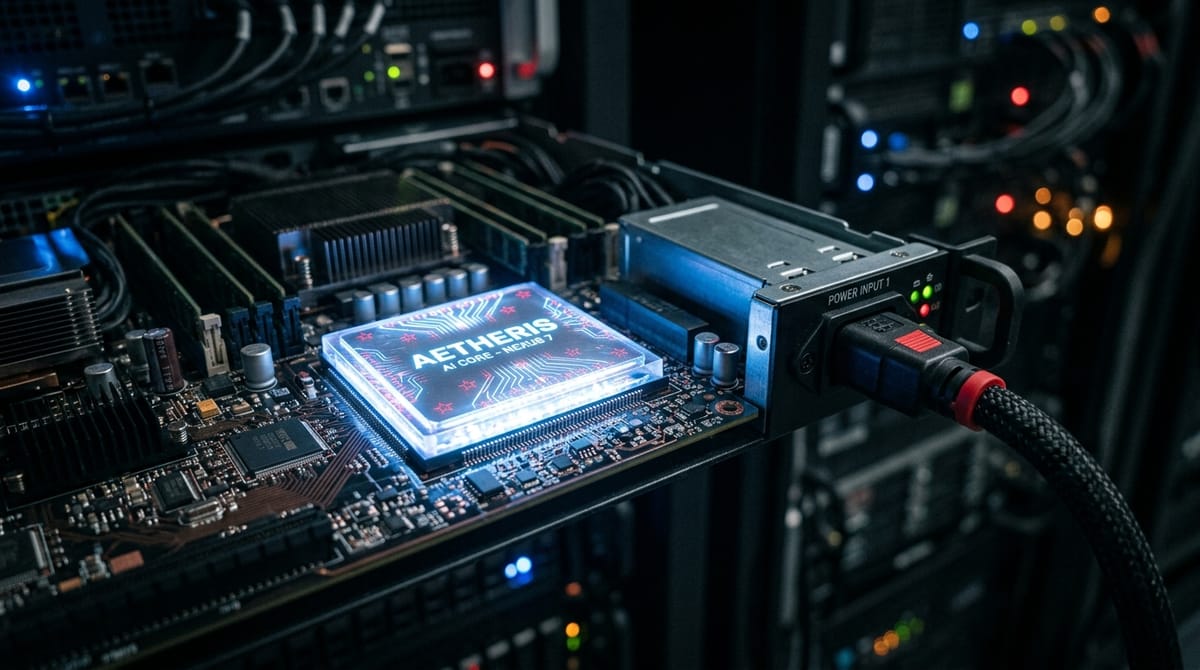
AI, data centers, semiconductor fabs — these things have one thing in common: they are extraordinarily hungry for electricity.
The numbers tell the story. Vietnam's energy demand is forecast to grow by nearly 80 percent by 2030. The problem is that Vietnam is already short on power. The worst case came in the summer of 2023, when a heat wave triggered massive blackouts in Bac Ninh and Bac Giang — home to major Samsung and Foxconn operations. The World Bank estimated the damage at up to $1.4 billion, about 0.3 percent of Vietnam's GDP that year.
That's the bind in Vietnam's AI ambition: the further it climbs toward high-value industries like semiconductors and AI, the more electricity each step demands — and it can't even reliably cover what it uses now.
The one filling the gap, for now, isn't Vietnam itself but international capital — and the clearest example is Korea's SK Group. On a stretch of white sand in Nghệ An province's Quỳnh Lập, a $2.3 billion liquefied natural gas (LNG) power project has just broken ground: a large power plant, plus a terminal and a dedicated port, covering an area equal to about 220 soccer fields. The project is expected to draw around $30 billion in direct and indirect investment, and once it begins commercial operation in 2030, the Vietnamese government will buy its electricity for the next 20 years.
SK isn't only selling power. It is offering a full package: SK Innovation supplies the energy, SK Telecom builds and runs the data centers, and the power plant and AI data centers sit in the same industrial cluster, wired together directly. Winning the deal also came down to relationships at the top — SK Group chairman Choi Tae-won met with Tô Lâm several times, and back in 2019 SK had already put $30 million into NIC, laying the groundwork.
So the whole thing loops back to where it started. Schmidt is right that Vietnam's treasure is its people, and Vietnam has indeed put a homegrown model on the table and drawn up its blueprints for labs and chips. But holding on to AI sovereignty takes more than clever minds and pretty blueprints — it takes enough electricity to feed them. Vietnam's most ambitious tech dream may, in the end, be decided not by its algorithms but by the timeline of a power plant.
The Viet Media Monthly
A curated monthly digest of the most important political, economic, tech, and industry developments in Vietnam.
Designed for reading on desktop or tablet — no algorithm, no noise. Just the stories that matter.
Delivered before the 10th of each month. Cancel anytime.