Vietnam Rewrites the Rules for Foreign Capital — and It's Screening for Technology, Not Dollars
Vietnam's Resolution 10 shifts FDI from quantity to quality. The capital target barely moved — what changed is the incentive logic: from granted on arrival to paid on performance, with clawbacks. An opening for tech-bearing investors, a warning for pure assembly.
[Vietnam Rewrites the Rules for Foreign Capital — and It's Screening for Technology, Not Dollars]
In early June 2026, Vietnam's Politburo issued Resolution 10 (formally 10-NQ/TW), signed personally by Party General Secretary and State President Tô Lâm. Its subject: the development of the foreign-invested sector. The Politburo rarely dedicates a standalone resolution to a single topic, which is why this one matters. It is not another round of investment sweeteners. It rewrites the logic that has governed how Vietnam takes in foreign money for the past three decades.
The headline most people grabbed first was "$300 billion." The resolution sets a 2026–2030 target of $200–300 billion in registered capital, with $150–200 billion actually disbursed. That works out to roughly $40–50 billion in registrations a year. The number is large. But anyone reading it as a doubling of Vietnam's investment ambitions has misread it.
Because the scale is not new. Back in 2019, the Politburo issued its first-ever FDI resolution, 50-NQ/TW, and it set a 2026–2030 target in the same neighborhood — around $300 billion, roughly $50 billion a year. In other words, how much money Vietnam wants is about the same line it drew seven years ago. What has changed is the conditions attached to letting that money in.
The resolution swaps out the yardstick. The old measure was how much capital arrived and how many jobs it created. The new one is what that capital brings with it. The targets are now full of conditions that would not have appeared before: by 2030, Vietnam wants 75% of incoming investment to come from advanced economies strong in technology, capital and governance; it wants the number of Fortune 500 firms investing in the country to rise by 30%; and it wants at least three world-leading tech corporations to base their headquarters and R&D centers there. None of these are questions of how much money. They are questions of whose money, and what it carries.
The kind of investor Vietnam wants is also spelled out more clearly than before. The priority sectors named in the resolution read like a list of the hottest hard-tech fields of the moment: electronics, semiconductors and digital devices; artificial intelligence, big data, the Internet of Things and blockchain; advanced biotechnology and biomedicine. Building a factory is no longer enough. The resolution wants localization rates in key industries pushed to 45–50%, and it wants around 10,000 domestic firms drawn deep into foreign supply chains by 2030. Vietnam doesn't just want foreign companies to set up shop — it wants them to pull local suppliers onto their parts lists.
Researchers who have assessed the resolution describe the shift bluntly. Dr. Bùi Quý Thuấn, head of general research at VIPFA, Vietnam's private-economy and FDI research institute, and a faculty member at Phenikaa University's School of Economics, told VnEconomy that the heart of Resolution 10 is a move from "expanding outward" to "developing inward." In plain terms: it's no longer about who lands the most factories, but about how deep and how strategic those factories are. For years, provincial governments competed for foreign investors by handing out land and incentives at almost any cost. The new resolution wants to replace that fragmented, every-province-for-itself scramble with a strategy organized around industry clusters and value chains — semiconductors with semiconductors, digital tech with digital tech — so that foreign and local firms buy from and supply each other within the same cluster.
But for Taiwanese companies actually operating in Vietnam, the part of this resolution to understand most is the shift in how incentives work.
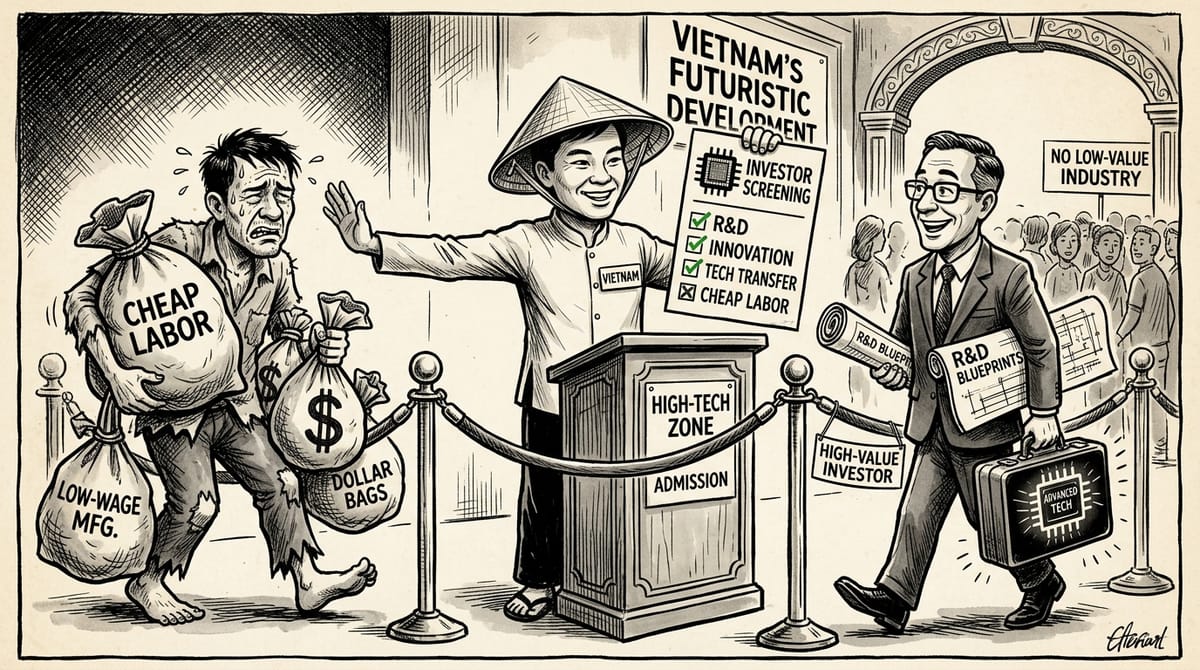
In the past, Vietnam's investment incentives were mostly "input-side" — granted up front. Once a project was approved and a plant was up, the tax breaks and land concessions followed; the reward was simply for showing up. Resolution 10 tears that down and rebuilds it as "support based on results." To earn top-tier incentives now, a foreign investor first has to hit concrete benchmarks: whether core technology was transferred, whether an R&D center was set up, whether localization targets were met, whether green transition was undertaken. And then comes the crucial line: the resolution also builds in mechanisms for post-audit review and clawback of incentives if commitments are broken. An incentive is no longer a one-time gift handed over at the door. It is a conditional payout tied to promises — collect it, and you're expected to deliver; fail to deliver, and it can be taken back.
This shift is not an isolated signal. Around the same time, Vietnam's Ministry of Science and Technology floated an even more aggressive incentive proposal. In mid-June, the Ministry of Justice published a draft decree implementing the High-Tech Law, in which the science ministry proposed waiving land rent for the entire lease term for "strategic-technology R&D centers, high-tech R&D centers and strategic-technology enterprises." For other land, the proposal offers a 15-year rent waiver followed by a 50% reduction for the remaining term. For manufacturers sensitive to land costs, that is about as generous as current incentives get.
Two things need to be kept separate here, though. The legal basis for this land-rent proposal is a different document — Resolution 57-NQ/TW, which deals with technological self-reliance — not the FDI-focused Resolution 10. And it is still only a draft out for comment, not in force. The two are separate policy tracks pointing the same way — both toward sweetening the deal for high-tech players — but the land-rent waiver cannot be treated as something Resolution 10 has already promised. When tracking Vietnamese policy, this gap between "the direction is right" and "it's actually in hand" is exactly where it's easiest to get the wrong idea.
Put these signals together, and the same resolution reads two ways for two kinds of Taiwanese company. For those that bring technology, are willing to set up R&D, and will pull local suppliers into their chains — especially in semiconductors, electronics and precision manufacturing, the sectors accelerating their move south — Vietnam is offering better terms than before. But for projects chasing cheap land and cheap labor to do assembly work with no tech transfer, the resolution sends a different message: what you offer is something Vietnam needs less and less, and is less and less inclined to retain with its best terms. And even once incentives are granted, a tail follows — you have to deliver, you'll be audited, and it can be clawed back.
The resolution anchors all of this to a 2045 vision: by then, the foreign-invested sector should account for about 25% of total social investment and contribute roughly 30% of GDP, helping carry Vietnam into the ranks of high-income developed nations. Seen from that endpoint, what Resolution 10 is trying to do is turn foreign capital from a simple source of money into a lasting force that brings technology and management capability into the domestic economy.
For Taiwanese businesses, what Vietnam wants is no longer what it used to be — which makes this a good moment to take fresh stock of the cards in your own hand.
(This article is an interpretation of policy developments and does not constitute investment, tax or legal advice. Actual eligibility for incentives and application conditions are subject to approval by the relevant Vietnamese authorities.)
Buying a Home in Vietnam: A Taiwanese Buyer's Full Playbook from Hanoi
Maggie of "Maggie's Lonely Planet" has lived in Vietnam since 2017 and traveled to more than 40 provinces. In this online talk she opens up the full ledger of buying her Hanoi apartment: location, pricing, cross-border transfers, renovation, and the legal rules for foreign buyers — all the hidden costs nobody warns you about.
Pure experience sharing, no sales pitch.
Time: Tuesday, June 23, 2026 — 9 pm Taiwan / 8 pm Vietnam