Vietnam's GDP Is Surging at 8%. So Why Are 1.6 Million Young People Opting Out?
Vietnam's booming economy is leaving behind a growing share of its youth, with 1.6 million young people now outside the workforce and education system.
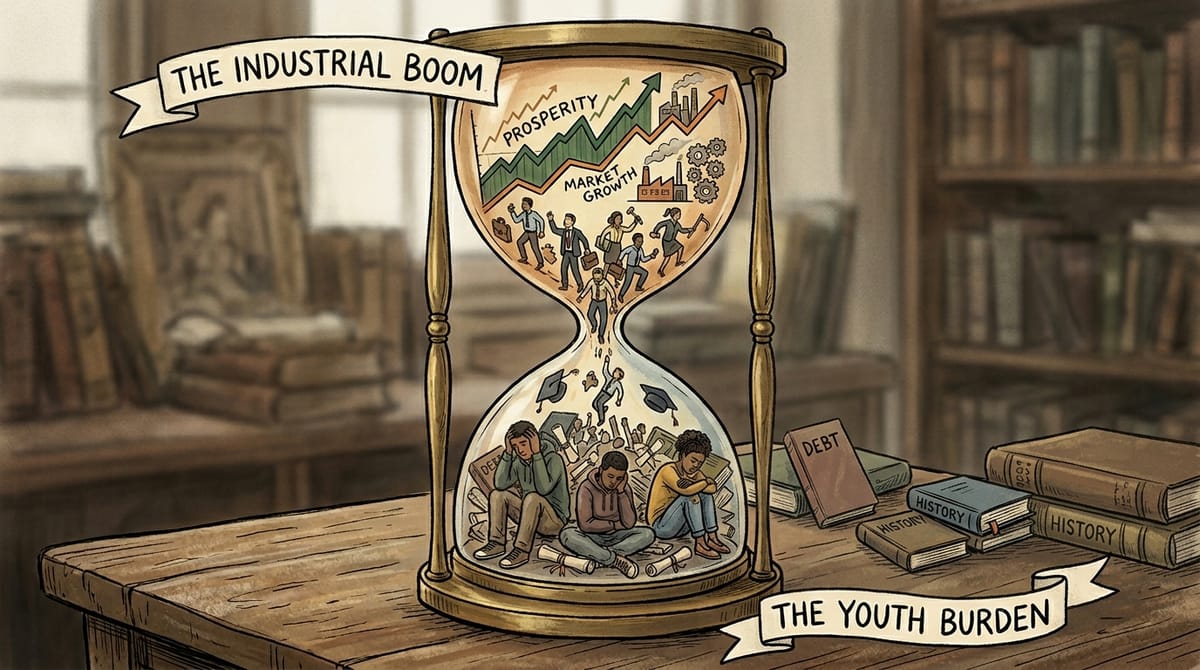
[Vietnam's GDP Is Surging at 8%. So Why Are 1.6 Million Young People Opting Out?]
Vietnam's Q1 2026 numbers look great on paper.
GDP grew 7.83%.
Registered FDI jumped over 40% year-on-year.
International tourist arrivals hit a record high.
But one number moved in the opposite direction: the count of 15-to-24-year-olds who are not working, not studying, and not in any form of training surged to nearly 1.6 million.
The Vietnamese call them "thanh niên ba không" — the "three nos" youth.
In labor statistics, they are classified as NEET: Not in Education, Employment, or Training.
These are not fresh graduates between jobs.
They have dropped out of the system entirely.
▍ The Numbers
Vietnam's General Statistics Office (GSO) released its Q1 2026 labor report in early April.
The headline: nearly 1.6 million people aged 15 to 24 fall into the NEET category, making up 11.4% of the youth population.
That is 173,000 more than the previous quarter and 212,500 more than the same period last year.
The breakdown tells a sharper story.
Rural areas have a NEET rate of 13%, compared to 8.9% in cities.
Women are at 12.8%, men at 10%.
Youth unemployment stands at 8.86%, four times the national average of 2.21%.
The trajectory is steep.
In Q4 2025, about 1.4 million young people were NEET, accounting for 10% of the cohort.
In just one quarter, the rate jumped 1.4 percentage points.
▍ Four Structural Cracks
On the surface, Vietnam has no shortage of jobs.
FDI keeps pouring in, factories are expanding, and services are booming.
So why are more young people falling through?
The first crack is between classrooms and the job market.
Vietnam's universities and vocational schools still lean heavily on theory, but employers in 2026 want hands-on digital skills and the ability to work alongside AI.
A recent HR market survey found that 47% of employers struggle to find experienced workers, and 42% say applicants lack even basic competencies.
Vocational training carries a deep stigma in Vietnamese society.
Parents and students would rather squeeze into a university for a degree the job market does not value than pursue a technical track.
The result: too many graduates, not enough skilled workers.
The second crack is job quality.
Vietnam's informal employment rate is 62.2%, meaning over six in ten workers have no formal contract, no social insurance, and no clear career path.
The national average monthly wage is 9 million VND (about 360 USD), but that includes experienced workers.
Starting pay for young people is far lower.
Faced with low-paying, long-hour, no-protection informal jobs, some young people simply walk away.
The third crack is inequality.
Rural NEET rates are more than four percentage points higher than urban ones, reflecting the concentration of decent jobs in HCMC, Hanoi, and a handful of other cities.
Women's NEET rates are nearly three points higher than men's.
Young women are disproportionately pulled out of the workforce by unpaid family care duties before they even start a career.
The fourth crack is disillusionment.
Vietnam's higher education system expanded massively over the past two decades.
But as more people earn degrees, each degree guarantees less.
The social contract — study hard, get a degree, land a good job — has broken down.
What replaces it, for many young people, is a fog: not knowing what to do, and not trusting that doing anything will matter.
▍ The Demographic Clock Is Ticking
Vietnam is in the middle of its "golden population structure," the stage when working-age people make up the largest share of the population.
The value of this window is straightforward: a large pool of young people enters the workforce, builds skills, and drives economic growth.
But that only works if they are actually working or training.
1.6 million NEET youth means the window is open, but a significant number of people are not walking through it.
This window has roughly 11 years left.
Once Vietnam's population begins to age, today's disconnected youth will become middle-aged workers with no accumulated skills, facing a heavier dependency burden at the same time.
Labor economists call it the "scarring effect": people who spend extended periods outside the workforce while young earn less and advance more slowly for the rest of their careers, even after they return.
In a regional context, Vietnam's 11.4% NEET rate is still below Southeast Asia's average of 16.3%.
But the speed of change stands out — a 1.4-percentage-point jump in a single quarter is significant.
Across the region, only 42% of workers aged 15 to 24 hold stable employment with a contract lasting at least one year, according to the ILO.
Vietnam's Q1 GDP growth of 7.83% and its 1.6 million NEET youth exist side by side.
Economic growth does not automatically fix employment.
If the gains flow mainly into capital-intensive FDI manufacturing and urban services, while the education system fails to equip young people with relevant skills, faster growth could mean more people left behind — not fewer.
The government has taken some steps.
This year it launched a program to attract overseas scholars back to teach in Vietnamese universities, aiming to improve education quality at the source.
Whether these efforts are large enough and fast enough to reach 1.6 million young people who have already disconnected from the system remains an open question.
The demographic dividend has an expiration date.
The demographic dividend has an expiration date.
The Viet Media Monthly
A curated monthly digest of the most important political, economic, tech, and industry developments in Vietnam.
Designed for reading on desktop or tablet — no algorithm, no noise. Just the stories that matter.
Delivered before the 10th of each month. Cancel anytime.