Vietnam's Inflation Looks Tame. Households Are Finding It Harder to Save
Vietnam's headline inflation sits below target. But rent, food and school fees are rising much faster than the average, and some families now save almost nothing each month.
[Vietnam's Inflation Looks Tame. Households Are Finding It Harder to Save]
On paper, Vietnam's numbers look manageable. In the first five months of 2026, the consumer price index rose 4.31% year-on-year, according to the General Statistics Office — below the government's full-year target of 4.5%. Read that line alone, and inflation looks under control.
But averages mislead. Prices do not rise evenly, and the items families cannot avoid have climbed much faster than the headline figure. Over the same five months, housing, utilities, fuel and construction materials rose 6.64%, the steepest of any major category. Transport followed at 5.22%, driven by global oil prices. For someone who spends most of their salary on rent, utilities and getting to work, the inflation that actually bites is not 4.31% — it starts at 6% and climbs.
The trend is also speeding up. The average looks low partly because it is held down by a low base early in the year. The closer you get to mid-year, the higher the monthly figures run. CPI rose 5.46% year-on-year in April and 5.6% in May. Both monthly readings have already crossed the 4.5% full-year target line; the five-month average stays inside it only because the opening months were soft.
Turn the percentages into a household budget and the gap gets clearer. VnExpress reported on a salaried worker in Ho Chi Minh City who got a raise of about 3.5% this year, only to see their landlord push rent up by nearly 60%. After accounting for costlier food and utilities, the money left at month's end was half of what it had been a year earlier. Incomes are growing in single digits while rigid costs rise in double digits, and the difference comes straight out of monthly savings. For some lower-income families, a month now ends with almost nothing saved.
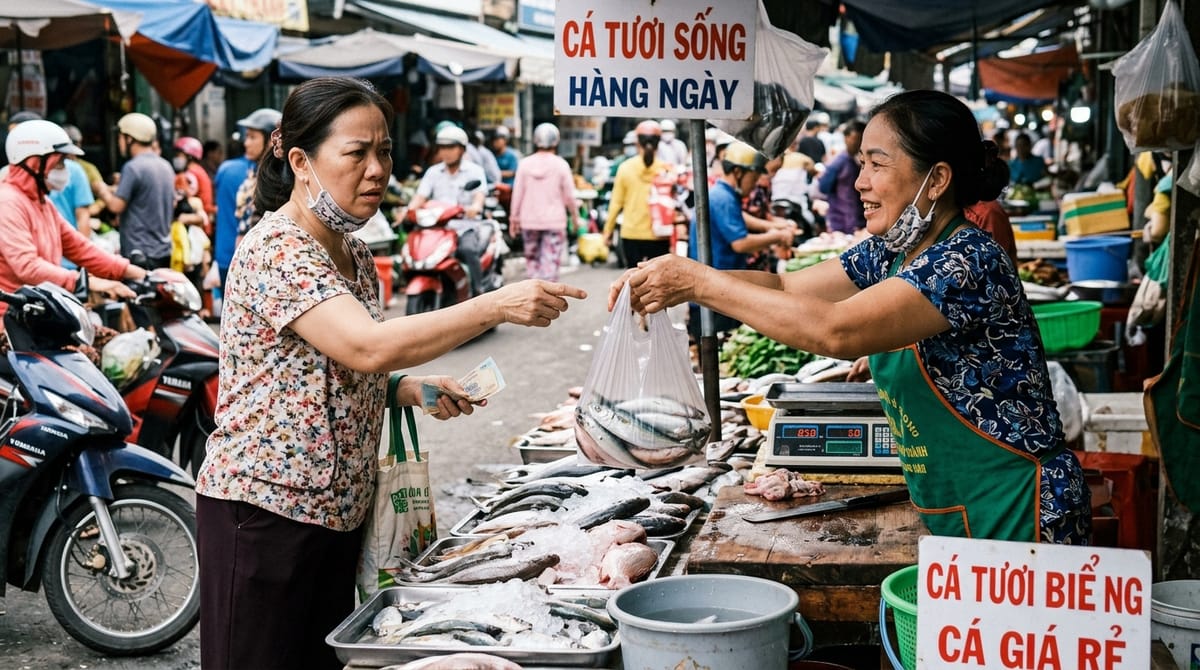
When families cannot save, they shop differently. Vendors at traditional markets in Ho Chi Minh City say customers have started buying half a kilo of fish instead of a full one, and walking between stalls to compare prices before committing. It is not their imagination: fish costs 15% to 30% more than a year ago, and beef is up about 10%.
Eating out is shrinking too. A survey by restaurant software provider iPOS and Nestlé Professional found that 34.5% of respondents plan to cut spending on dining out this year, up from 31.1%. The share who eat out daily fell to 13.76% from 17.4%. Restaurants are caught both ways: transport, packaging and ingredient costs are up 10% to 30%, so many have raised prices 5% to 20% — but higher prices drive customers away, and holding prices means absorbing the hit.
The clearest sign of how weak demand has become comes from suppliers. One large food maker in Ho Chi Minh City says production costs for its confectionery, drinks and seasonings are up 5% to 15%, yet it has held off raising prices, judging that any increase would sink demand. When a manufacturer would rather swallow the cost, there is usually little room left to raise prices. The pressure is broad: the Ho Chi Minh City Food and Foodstuff Association says 50% to 60% of production inputs have grown more expensive, traced back to the Middle East conflict pushing up gas and fertilizer prices, which in turn lifted plastic and aluminum packaging and farm commodities. Retailers read the same signal. Ho Thi Hong Dao, marketing director at supermarket chain Saigon Co.op, says shoppers are increasingly cautious about non-essentials, leaving stores to lean on promotions to keep sales moving.
Why does a conflict in the Middle East show up in Ho Chi Minh City fish prices a few months later? Le Dat Chi, head of finance at the University of Economics Ho Chi Minh City, points to Vietnam's heavy reliance on imports: when global energy, logistics or exchange rates move, the effect reaches domestic prices fast. That is why Vietnam's inflation is so sensitive to outside shocks.
Put together, this is a set of signals worth reading for anyone selling to Vietnamese consumers. The country's most-cited selling point in recent years has been "consumption upgrade" — a young population, a growing middle class, rising domestic demand — and that trend has not gone away. But this round of inflation is a reminder of something often skipped over: when housing, food and education take the first cut of a family's budget, there is less left for what people want rather than need. Tolerance for price increases is lower than many assume, with even big local makers reluctant to pass costs on. The closer a product sits to "essential," the safer it is. And promotions work precisely because shoppers are growing more price-sensitive.
These observations come from individual interviews plus the structure of the CPI data, and should not be stretched into "all of Vietnam can't save." But they at least show that judging Vietnam's domestic demand takes more than population and GDP growth — it also takes a look at how much an ordinary household has left at the end of the month. Right now, the answer is: less and less.
Buying a Home in Vietnam: A Taiwanese Buyer's Full Playbook from Hanoi
Maggie of "Maggie's Lonely Planet" has lived in Vietnam since 2017 and traveled to more than 40 provinces. In this online talk she opens up the full ledger of buying her Hanoi apartment: location, pricing, cross-border transfers, renovation, and the legal rules for foreign buyers — all the hidden costs nobody warns you about.
Pure experience sharing, no sales pitch.
Time: Tuesday, June 23, 2026 — 9 pm Taiwan / 8 pm Vietnam