Vietnam Ranks Among the World's Ten Least Affordable Housing Markets
Vietnam has climbed into Numbeo's global top ten for unaffordable housing. Buying a home now takes over 30 years of income, and homes are drifting away from wages.
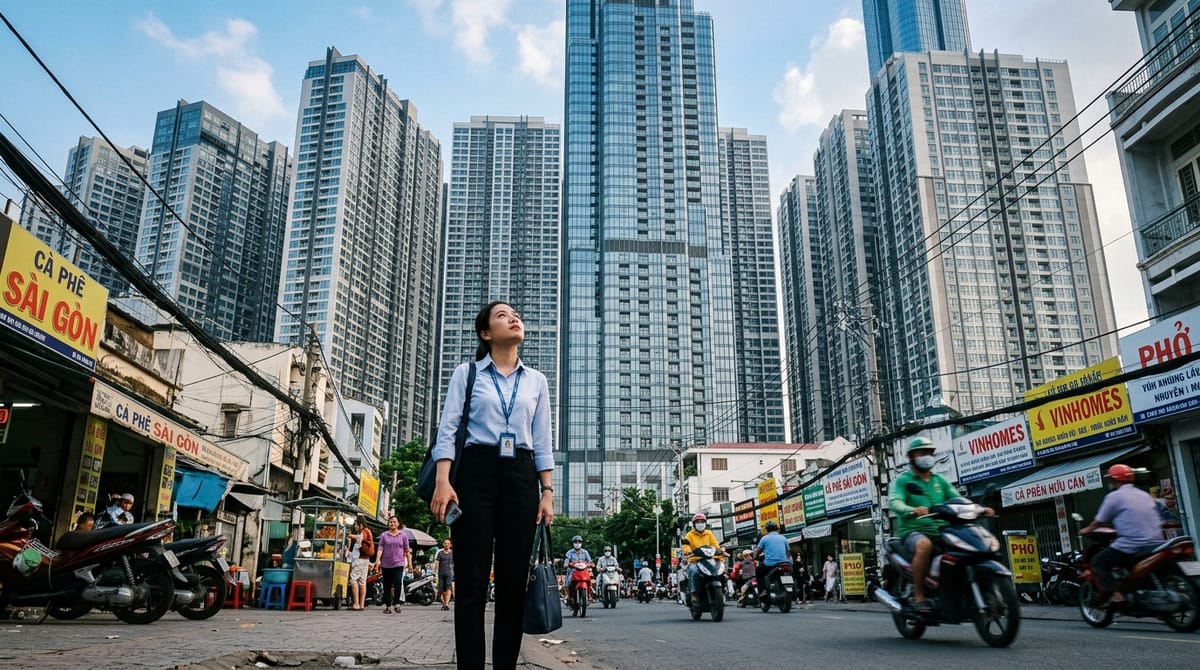
[Vietnam Ranks Among the World's Ten Least Affordable Housing Markets]
01 | A Ranking That Stings
Numbeo's latest price-to-income ratios place Vietnam in the world's top ten for unaffordable housing — in the same band as Nigeria, Sri Lanka and Cambodia. Three years ago Vietnam sat at 14th. It has since climbed to 10th, and it keeps getting worse.
Numbeo is crowdsourced, and no single ranking should be leaned on too hard. That's why the next section cross-checks it against Vietnam's own income figures and the "years needed to buy" trend, rather than betting on one indicator. Even with that caveat, 10th is a stark place to be — Vietnam's output per head is nowhere near that of the countries it now sits beside.
02 | How Many Years It Actually Takes
A multiple is abstract; time is not. Vietnamese media, citing Numbeo's method, lay it out like this: around 2023–24, a household saving every dong and spending nothing needed about 23 years to buy a home. Last year it was 26. This year it is over 30 — roughly double the global average.
Set that 30 years next to actual pay. The General Statistics Office puts the average worker's monthly income for full-year 2025 at about 8.4 million VND. Younger workers do a little better, earning roughly 15–30 million VND a month — but a home in Ho Chi Minh City typically runs 4–9 billion VND. On one side, salaries counted in millions of VND; on the other, prices counted in billions. The gap is no longer something a few extra years of effort closes.
03 | How It Got Here
The causes are what matter, and there are two threads.
The first is income decoupling. Vietnamese wages haven't grown badly — around 8–9% a year — but prices have run faster. The worsening rank and the lengthening "years to buy" are themselves the result of incomes failing to keep up. One contrast cited by the English-language outlet The Vietnamese puts it bluntly: over the past decade, GDP per capita rose about 80%, while property prices roughly tripled to quadrupled.
The second is distorted supply. New construction is increasingly concentrated at the high end. In the first quarter of this year alone, Hanoi launched zero new mid-tier projects — not few, none. Affordable and social housing have been undersupplied for years; Vietnam's one-million-unit social housing target is only about 70% met. When demand softens, prices should ease. But in Vietnam the affordable tier was squeezed out long ago and almost everything being built is high-end, so even as buying cools, prices don't come down.
Put the two threads together and you can read it this way: when almost all new homes are high-end and prices won't respond to weakening demand, housing increasingly behaves less like a place to live and more like somewhere to park money.
04 | The Burden on a Younger Generation
Châu Đình Linh, an economist at the Banking University of Ho Chi Minh City, warns that as prices keep climbing, the dream of settling down recedes for young workers, and more corrosively, so does their drive to push forward. When someone can do the math and see they will never afford a home, their relationship with work and with long-term planning changes.
This is no longer private grumbling. At a National Assembly discussion in April, a delegate said it plainly: work flat out for 30 years and you still can't buy a home.
Even the big developers are pivoting. Vingroup, Sun Group and Tran Anh — companies built on the high end — have announced moves into social housing. That shouldn't be read as an investment signal. What it actually shows is the size of the problem: the affordable gap is wide enough that even they have to step in to fill it.
A hot market is not a healthy one. Vietnam's real problem is that homes have come unmoored from most people's incomes, and what that erodes is young people's belief that working hard is enough to buy one.
—
This article is an analysis of market structure and a social affordability trend. It does not constitute property or investment advice.
The Viet Media Monthly
A curated monthly digest of the most important political, economic, tech, and industry developments in Vietnam.
Designed for reading on desktop or tablet — no algorithm, no noise. Just the stories that matter.
Delivered before the 10th of each month. Cancel anytime.