Vietnam's First Successful BOT Project
Phu My 2.2 was Vietnam's first internationally tendered BOT project — $400 million invested, 20 years operated, now successfully transferred. A benchmark for Vietnam's PPP model.
[Vietnam's First Successful BOT Project]
When governments lack funds for major infrastructure, BOT (Build-Operate-Transfer) is a common solution. Taiwan's high-speed rail is a famous example. Private firms invest, run the asset for decades, then hand it back. The model is used worldwide.
▍ Phu My 2.2 Thermal Power Plant
The Phu My 2.2 plant sits in Ba Ria - Vung Tau province with an installed capacity of 715 MW — roughly equivalent to a mid-sized thermal plant in Taiwan.
It was Vietnam's first internationally tendered, fully foreign-funded BOT project. The $400 million investment was jointly operated by France's EDF, Japan's Sumitomo Corporation, and JERA.
After 20 years of operation, the plant was officially transferred to Vietnam Electricity (EVN) on February 4, 2025 — Vietnam's first completed BOT handover.
▍ Taiwan's Contrast: The Wenhu Line Lesson
Taiwan's first BOT — the Taipei Metro Wenhu Line (originally the Muzha Line) — went differently.
In 1989, Taipei's government brought in Siemens and Asia Engineering under a BOT model to solve the city's traffic problems.
The line opened in 1996 but was plagued by frequent system failures and grossly overestimated ridership. Severe financial losses forced the government to reclaim operations in 1999, ending the BOT partnership. Taipei Metro Corporation has managed the line ever since.
▍ Vietnam's PPP Road
BOT is one type of PPP (Public-Private Partnership). The broader PPP framework includes BOO (Build-Own-Operate), BLT (Build-Lease-Transfer), O&M (Operations & Maintenance), and ROT (Rehabilitate-Operate-Transfer), each for different project types.
By 2020, Vietnam had attracted roughly VND 71,300 billion (about $2.9 billion) through PPP infrastructure investment. Of 140 BOT projects, only 4 hit their profit targets.
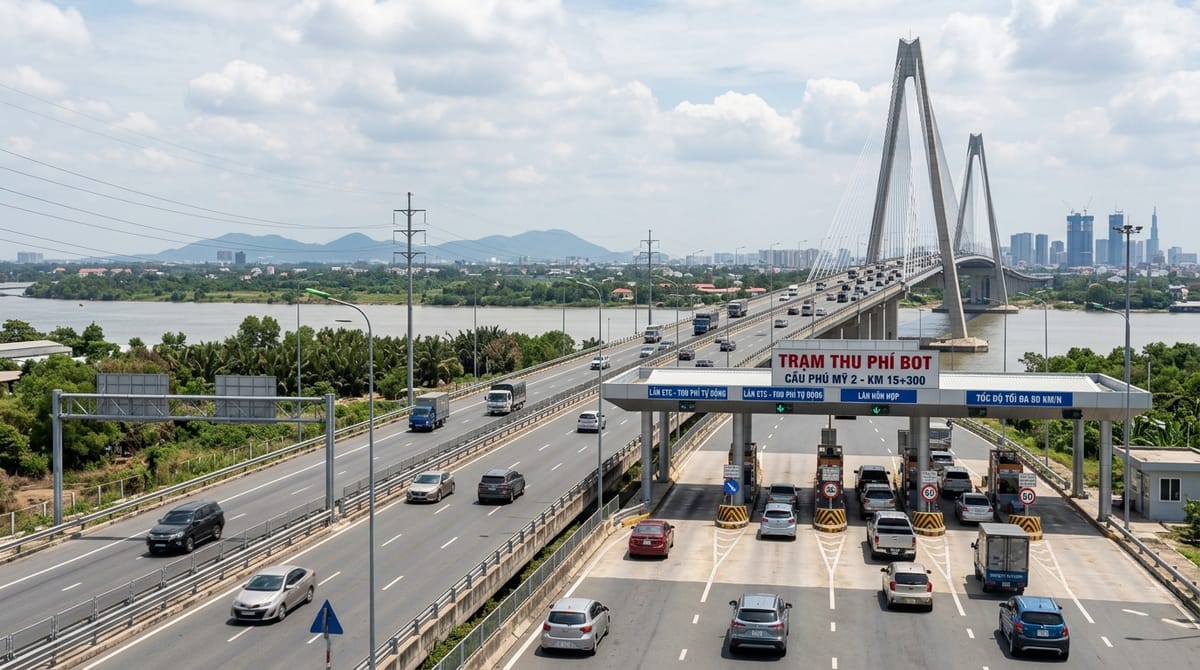
Failures include toll stations placed at wrong locations, yielding revenue far below projections, and BOT highways rendered pointless by changes in traffic planning.
Phu My 2.2 at least proves the BOT model can work in Vietnam. The question now is how to replicate that success.