Vietnam's Education System Explained: The 5-4-3 Structure, Pathways After Junior High, and Five Major 2026 Reforms

Vietnam's school system is shaped by French colonialism, Soviet planning, and post-reform modernization. In 2026, five sweeping reforms landed at once.
Vietnam's Education System Explained: The 5-4-3 Structure, Pathways After Junior High, and Five Major 2026 Reforms

[Vietnam's Education System Explained: From the 5-4-3 Structure to Soviet-Style Academies]

Most foreigners can talk about Vietnam's food, beaches, or booming economy. Ask how Vietnamese schools work, and you get blank stares.

One of our readers made a sharp observation: "I heard Vietnam's system was modeled after Russia's, with standalone academies instead of the multi-faculty universities you see in Taiwan or the U.S."

That observation is correct. But the full story involves three layers of history: French colonialism, Soviet-era central planning, and post-1986 market reforms. On top of that, Vietnam is now pushing through the most intensive wave of education reform in two decades.


▍ Same 12 Years, but Split Differently

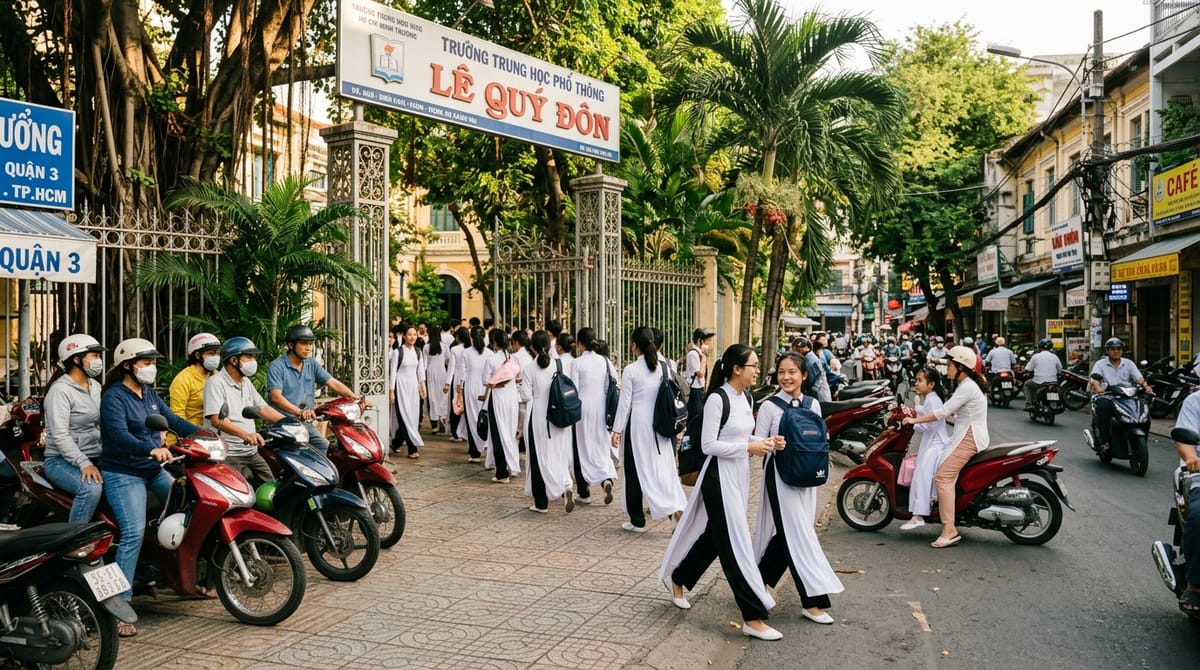
Vietnam's basic education follows a 5-4-3 structure: five years of primary school (tiểu học), four years of lower secondary (trung học cơ sở), and three years of upper secondary (trung học phổ thông). Students start at age six.

Taiwan uses a 6-3-3 split. The total is the same 12 years, but the dividing lines fall differently: Vietnam has one fewer year of primary school and one extra year of junior high.

That extra year matters. It makes junior high graduation a more significant branching point than it is in Taiwan, which we will get to shortly.

In September 2025, Vietnam launched 15 years of free compulsory education, covering everything from kindergarten through high school. The policy reaches roughly 23.2 million students and costs the government about 30 trillion VND (roughly $1.2 billion) a year. Of that total, 22.5 trillion VND was already being spent on tuition waivers for senior kindergarten, primary, and lower secondary students.

The national budget law requires that education spending account for at least 20% of total government expenditure, a ratio that ranks high globally.

Taiwan's compulsory education remains at nine years (primary and junior high). Senior high is non-compulsory but tuition-free. The two countries have taken different paths in how they structure the obligation.

▍ Four Paths After Junior High

In Taiwan, nearly all junior high graduates move on to senior high or vocational school. The path is relatively straightforward.

Vietnam is different. Junior high graduation is a genuine crossroads. Before 2026, there were three options. Starting in 2026, there is a fourth.

The first is the traditional academic track. Students pass an entrance exam to enter upper secondary school for three years, then sit for the National High School Graduation and University Entrance Exam (kỳ thi tốt nghiệp THPT), a single test that determines both graduation and university admission.

The second is intermediate vocational school (trung cấp). Students can enroll directly after junior high for a two-to-three-year program, or after high school graduation for just one year. These schools fall under Vietnam's vocational education system (giáo dục nghề nghiệp) and train students for immediate employment.

The third is junior college (cao đẳng), roughly equivalent to an associate degree. These programs run two to three years after high school or intermediate school, with hands-on training making up about 30% of the curriculum.

The fourth path is brand new in 2026: vocational high school (trung học nghề). For the first time, Vietnam has formally incorporated vocational high schools into its national education system. Their diplomas carry the same legal weight as those from regular high schools. Unlike intermediate vocational schools, vocational high schools combine the standard high school curriculum with vocational skills training, allowing graduates to apply directly to university programs in their field.

None of these paths is a dead end. Vietnam has a bridging system called liên thông that lets intermediate graduates advance to junior college, and junior college graduates advance to university. The jump from junior college to a bachelor's degree takes about 1.5 years.

▍ 30,000 Soviet-Trained Students Shaped Today's Universities

Most people are used to the model where a single university houses many faculties and each faculty contains many departments. National Taiwan University, National Cheng Kung University, and the University of California system all work this way.

In Vietnam, that kind of large comprehensive university is the exception, not the rule.

Vietnamese higher education institutions fall into four categories:

➤ Junior colleges (trường cao đẳng): associate-degree programs as described above
➤ Mono-disciplinary universities (đại học đơn ngành): focused on a single field, such as the Hanoi University of Architecture or Ho Chi Minh City University of Medicine and Pharmacy
➤ Multi-disciplinary universities (đại học đa ngành): the familiar model with multiple faculties, but relatively few in number
➤ Academies (học viện): specialized research and training institutions, such as the Diplomatic Academy or the Academy of Finance

Why so many small, single-specialty schools? The answer lies in the Cold War.

After the 1954 Geneva Accords, North Vietnam aligned fully with the Soviet bloc. Moscow did not just send economic aid. It exported its entire education model.

The Soviet approach was built around small, narrowly focused institutions. Each school trained specialists in one field. Teaching and research were kept separate, with universities handling instruction and dedicated institutes handling research.

Under this system, North Vietnam sent thousands of students to the Soviet Union and other socialist countries, which collectively trained over 30,000 undergraduates and 13,500 postgraduates. Between 1939 and 1964, Vietnam's university student population grew nearly 50-fold to 27,000, driven by the rapid expansion of Soviet-style specialized schools.

So our reader's observation was spot-on: Vietnam really is "academy-heavy," a direct legacy of Cold War-era Soviet educational exports.

After the 1986 Doi Moi reforms, Vietnam began modernizing its higher education. A 1998 education law opened the door to private universities. The rigid Soviet-era cohort system gave way to a credit-based system, and Vietnam started building a national qualifications framework aligned with ASEAN standards. But the institutional landscape, lots of small specialized schools, remains the defining feature of Vietnamese higher education today.

As for degree length, most bachelor's programs take four years, engineering takes five, and medicine or dentistry takes six.

▍ No Winter Break, Just One Week for Lunar New Year

Vietnam's academic year is split into two semesters. The first runs from September 5 (the national school opening day) through mid-January. The second runs from mid-January through the end of May, with a total of 35 instructional weeks per year.

Summer break stretches from late May to early September, about three months.

But there is no winter break.

Taiwanese students get three to four weeks off between late January and mid-February. Vietnamese students have no equivalent. The two semesters are bridged only by the Tet (Lunar New Year) holiday, which lasts about a week. In 2026, Tet fell on February 14 to 22.

One more thing: Vietnam's school calendar is not nationally standardized. The Ministry of Education sets a framework, but each province can adjust start and end dates based on local conditions.

▍ Five Reforms at Once: Vietnam's 2026 Education Overhaul

On December 10, 2025, Vietnam's National Assembly passed amendments to three laws at once: the Law on Education, the Law on Vocational Education, and the Law on Higher Education. All took effect on January 1, 2026.

Combined with the earlier Teacher Law and the free education policy, 2026 brought five major reforms running in parallel.

First, junior high diplomas are gone. As of January 1, 2026, Vietnam no longer issues lower secondary graduation certificates (bang tot nghiep THCS). Instead, school principals confirm course completion directly in the student's academic record.

Second, one national textbook. Starting with the 2026-2027 school year, all schools nationwide will use the "Ket noi tri thuc voi cuoc song" (Connecting Knowledge to Life) series published by Vietnam Education Publishing House, ending the previous system where three different textbook sets coexisted. Free textbooks are planned for the 2029-2030 school year, costing over 4,036 billion VND annually, distributed through a shared library model where students borrow books each semester and return them at the end.

Third, 15 years of free education. Effective September 2025, tuition is eliminated from kindergarten through high school at all public institutions, with subsidies extended to private school students as well.

Fourth, vocational high schools. As described earlier, this creates a fourth pathway after junior high, with diplomas equivalent to regular high school credentials.

Fifth, teacher pay moves to the top of the public sector scale. Under the Teacher Law passed in 2025 (Luat Nha giao), teacher salaries are classified at the highest tier in the civil service pay scale. Base monthly pay rises by 2 to 7 million VND ($80 to $280). Professional preferential allowances for kindergarten and general education teachers increase to at least 70%, reaching 100% for those in remote and disadvantaged areas.

Beyond these five, the reforms also recognize digital diplomas as legally equivalent to paper versions, and the vocational education law eliminated 36% of its administrative procedures.

All five reforms point in the same direction: lower barriers, reduce inequality, and retain teachers. Whether they deliver on those goals will depend on local implementation and whether government budgets can sustain the cost.

` })