Bamboo Airways Shrank From 44 Aircraft to One. Why Three Years of Restructuring Have Not Fixed It
Bamboo Airways once flew 787s to London and Sydney. Today one Airbus A321 carries its entire schedule, and the gap between the airline's recovery plans and its actual fleet has never been wider.
[Bamboo Airways Shrank From 44 Aircraft to One. Why Three Years of Restructuring Have Not Fixed It]
At noon on September 3, Bamboo Airways flight QH9588 left Da Nang for Macau. The aircraft was VN-A227, an Airbus A321. It landed that afternoon, which settles one question: the airline was still flying that day. The Planespotters fleet register, at the same moment, listed exactly one aircraft. This one.
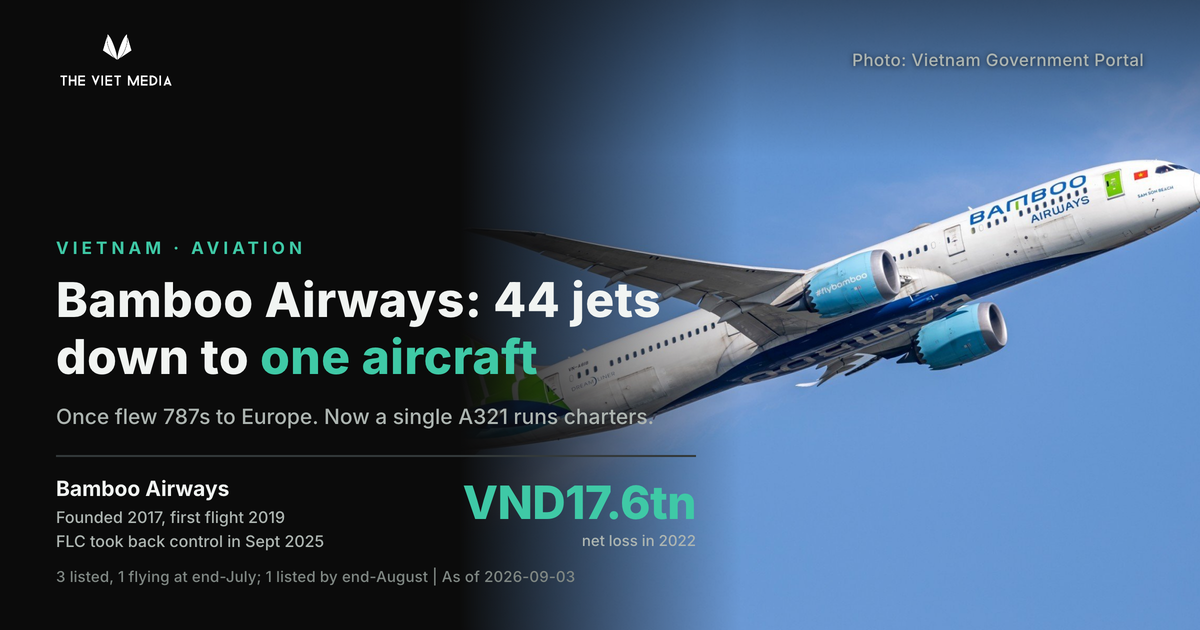
At its peak Bamboo Airways operated 44 aircraft: Airbus A319s, A320s and A321s, plus Boeing 787-9s for long-haul routes. By late July this year Planespotters still showed three aircraft on the books, but reporters found only VN-A227 actually flying. By late August the register had shrunk to one.
VN-A227 is not a paper entry. Flight records show it flew to Hanoi, Da Nang and Quy Nhơn in the second half of August, and it has kept running the Da Nang–Macau charter into September.
The website tells the other half of the story. In early August the booking engine returned no flights on the airline's core domestic routes: Hanoi–Ho Chi Minh City, Hanoi–Da Nang and HCMC–Da Nang. What remained were charters and a handful of scheduled services. Domestic flights appeared again in the records at the end of August, and the Macau service continued into September. Every verifiable flight in recent weeks traces back to the same A321.
This is a long way from the Bamboo Airways of a few years ago. The company was founded in 2017, flew its first commercial service in 2019 and quickly built a fleet of 44. Beyond the Airbus narrowbodies, it used 787-9s to reach the United Kingdom, Germany and Australia.
The turn became visible in 2022. Bamboo lost VND17.6 trillion that year. More than VND13.2 trillion of that came from provisions for bad debts and write-downs on investments in affiliated companies, so it was not purely the result of flying planes at a loss. Accumulated losses passed VND19.3 trillion by year-end and the company's equity went negative. The Civil Aviation Authority of Vietnam began monitoring whether the airline had the money to keep operating safely, maintain its aircraft and pay its suppliers.
The shareholders changed next. FLC Group exited in May 2023 and a new group of investors took over with a full restructuring plan. Low-demand, loss-making routes were cut. Capacity was concentrated on the trunk routes linking Hanoi, HCMC and Da Nang. The fleet was simplified to reduce fuel, maintenance and spare-parts costs. Long-haul services to the UK, Germany and Australia stopped one by one, and the fleet kept shrinking.
Bamboo reported net revenue of roughly VND12.4 trillion for 2023, up 6% on the year before. The plan it presented the following year called for nine narrowbody aircraft, rising to 12 by the end of 2024 if the market allowed, and 18 by the end of 2025. It did not happen. In 2025 the new shareholders acknowledged that two years of restructuring had fallen short and that continuing to run the airline was beyond their financial and management capacity. A shareholders' meeting in September agreed to hand control back to FLC, and the investors' restructuring plan was shelved.
Since taking the airline back, FLC has reopened talks with Boeing. The subjects include leasing 737 MAX narrowbodies and revisiting the earlier 787-9 programme. The company's own announcement mentions no signed lease and no delivery dates. Fleet expansion remains a plan.
For passengers, the reality has been cancelled and rescheduled flights and a wait for refunds. Bamboo apologised in late July and began accepting refund requests, and the volume stretched processing times. Because aircraft were still landing in early September, it is not accurate to call the airline grounded or bankrupt. It is accurate to say that third-party registers list one aircraft and that every recent verifiable flight was operated by VN-A227.
Three things are confirmed by the available records. The 2022 accounts left a very large financial hole. The investors who took over admitted they lacked the money and management capacity to fix it. And the plan to grow the fleet to 18 aircraft never materialised. FLC's new aircraft proposals, made after it regained control, are still announcements and negotiations.
What to watch next is simple: whether any new aircraft actually join the fleet, and whether the main routes go back on sale and stay flown. For passengers already affected, the company also needs to publish a verifiable refund timeline. Until those indicators move, the new fleet targets should be read as plans, not progress.
—
📢 A quick word from our sponsor
Heading to Vietnam and dreading the SIM card counter at the airport? I use Saily eSIM instead — buy it online before you fly, scan the QR code in the app, and your data connects automatically the moment you land.
Saily also lets you switch your virtual location in the app — traffic routes through a NordVPN server, so it works much like a VPN, though it doesn't encrypt data on the device — and it blocks malicious sites, ads, and trackers. Vietnam plans start at US$3.99 for 1GB/7 days, with 3GB/30 days at US$7.99 and 10GB/30 days at US$17.99. Unlimited plans are available too.
👉 Get your Saily eSIM → and use code Special10 for an extra 10% off