A London Court Froze Vietjet's Global Assets. Should Ticket Holders Worry?
Vietjet keeps flying and tickets remain valid. The real story is an airline worth nearly US$4 billion that has paid US$2 million of a US$250 million judgment, while Vietnamese courts refuse to recognise the English rulings.
[A London Court Froze Vietjet's Global Assets. Should Ticket Holders Worry?]
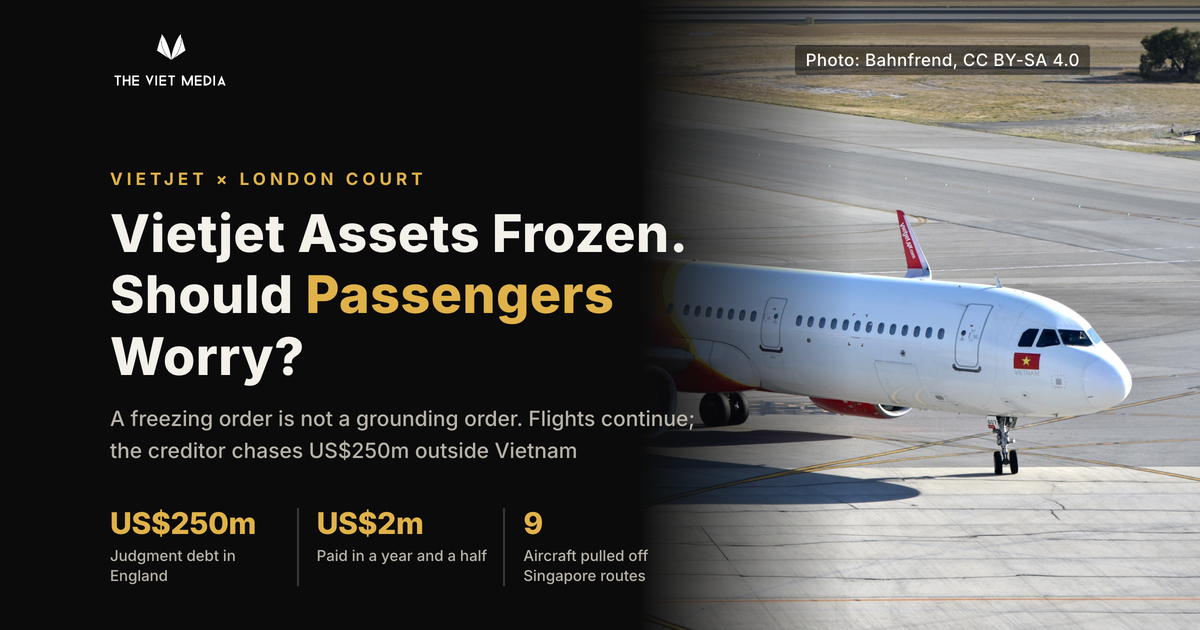
On 15 October, the Commercial Court in London granted a worldwide freezing order over the assets of Vietjet Aviation. Later the same month it formally appointed receivers to collect money and sell assets on Vietjet's behalf outside Vietnam. As the news spread, Vietnamese passengers asked online whether their December tickets to Singapore were still good. Vietjet answered with photos of passengers queuing to check in at Vietnamese airports and at Singapore's Changi, a note that its airports were crowded, and a fare promotion. It declined to comment on the ruling itself. The short answer is yes, the tickets are good. A freezing order is not a grounding order.
The order lets Vietjet deal with its assets in the ordinary course of business. Day-to-day spending and ticket sales continue. Only certain transactions involving aircraft orders, maintenance reserves and lease deposits held outside Vietnam now need the court's approval. Aviation lawyers read it the same way: passengers are unlikely to see any disruption, an English order has no direct effect in Singapore until a Singapore court recognises it, and Singapore's aviation regulator is unlikely to step into a commercial dispute unless safety or the ability to operate is at risk.
The judgment itself is blunt. The English courts first found Vietjet liable, then set the damages. Vietjet paid what the first stage ordered. Of the roughly US$250 million ordered in the second stage, it has paid US$2 million, and that payment was made the day before an appeal hearing, because without it there would have been no appeal. Vietjet has a market value of nearly US$4 billion and is still ordering new aircraft. Mr Justice Saini, who granted the freezing order, accepted the creditor's description of a "won't pay" debtor rather than a "can't pay" one. Why can't the creditor collect in Vietnam? What convinced the court that Vietjet was moving assets out of reach? And do the receivers have any claim on the fares Taiwanese passengers pay by card, or on the loan Taiwanese banks have just extended?