Hanoi's July Petrol Motorbike Ban Pilot: The Scope Shrank to 2% in 9 Months
Vietnam has 80 million motorbikes and Honda holds 80% of the market. A July 2025 prime ministerial directive ordered petrol motorbikes banned from Hanoi's inner ring by July 2026. Nine months later, the pilot covers just 11 streets — about 2% of the original scope.
[Hanoi's July Petrol Motorbike Ban Pilot: The Scope Shrank to 2% in 9 Months]
▍ The Ban's Scope Shrank to 2% of Its Original Version in 9 Months
Vietnam has roughly 80 million motorbikes — nearly one per person. Honda alone holds 80% of the market, the undisputed motorbike giant in the country.
In July 2025, Vietnam's Prime Minister signed a directive: starting July 1, 2026, all petrol motorbikes would be banned from Hanoi's entire inner ring.
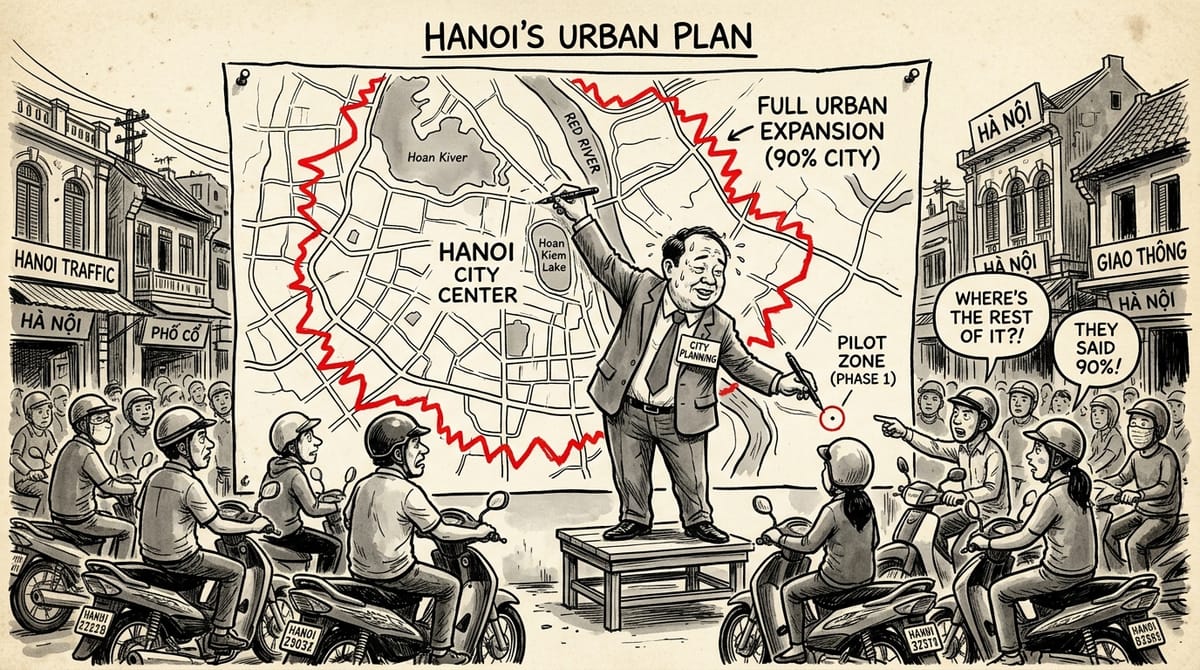
Nine months later, that directive has been rewritten into something much smaller: 11 streets, 0.5 square kilometers, weekends only — about 2% of the original scope.
What happened in those nine months? Honda's monthly sales dropped 22%. Japan's government filed protests twice. Grab said over 60% of its drivers weren't ready to switch to electric. And Vietnam's domestic electric motorbike industry couldn't supply even a fraction of the city's replacement demand. A directive that would have affected 620,000 residents has shrunk into a pilot that affects 20,000.
This is a story about policy ambition colliding with industry reality — and it's only beginning. The long-term timetable still says: 2028 full inner-ring ban, 2030 expansion to the outer ring, and by 2050, only pure-electric vehicles on the road anywhere in the city.
▍ The Government's Official Reason: Air Pollution
Hanoi's winter air really is among the worst in the world. Last year, the city's PM2.5 annual average was nine times the World Health Organization's recommended level, and in the past six months Hanoi has repeatedly been ranked among the world's ten most polluted cities.
Where does the pollution come from? According to Vietnamese government research, within Hanoi's own emissions, traffic accounts for 59%, construction and road dust 28%, and industry just 2%. The city's leadership has gone further, attributing 60% of Hanoi's air pollution to petrol motorbikes, and noting that roughly 70% of motorbikes on the road are older vehicles with hard-to-control emissions.
One caveat: this "motorbikes are the main cause" framing comes mainly from Vietnamese government research and official commentary. Independent third-party studies using the same methodology don't consistently reach the same conclusion. The pollution is real. But banning petrol motorbikes is a policy choice, not the only possible response.
Still, Hanoi has about 6.9 million motorbikes and 1.1 million cars — with roughly 450,000 motorbikes inside the inner ring alone. At that density, air quality is something the city government simply cannot ignore.
▍ Four Pressures That Forced the City to Rethink
The story begins in July 2025. That month, Vietnam's Prime Minister signed a directive requiring Hanoi to ban all petrol motorbikes from the inner ring one year later, with commitments to expand to the middle ring in 2028 and the outer ring in 2030. If the original version had gone through, it would have affected 620,000 residents and 450,000 motorbikes, every day, around the clock.
But over the next nine months, four things happened that forced the city to keep adjusting.
First: Honda opened its books. In the same month the directive was announced, Honda joined Yamaha and Suzuki in a joint letter to the Vietnamese government, warning of "bankruptcy risks" in the supply chain affecting hundreds of thousands of workers and thousands of dealers and suppliers. The following month, Honda's Vietnam sales plunged 22% month-on-month, and the double-digit declines continued through the fall.
Second: Japan's government stepped in. In September 2025, Japan's embassy in Hanoi sent a direct letter to the Vietnamese government, warning that a sudden ban would damage employment and demanding a "reasonable roadmap" with a buffer period. That same month, petrol car sales also fell 18% — dealers complained that customers were holding off due to policy uncertainty.
Third: Grab ran the numbers. Late in 2025, Grab Vietnam publicly told an official forum that over 60% of its drivers weren't ready to switch to electric. The reasons were practical: refueling takes two to three minutes, while charging takes 30 minutes or more. "You don't earn anything while you wait to charge."
Fourth: Even domestic electric makers said it was too fast. Even Selex Motors — a Vietnamese electric motorbike maker that should have been the policy's biggest beneficiary — had its CEO publicly declare "seven months isn't enough." His suggestion: restrict new petrol registrations first, ban petrol riding later, and phase in with "three years of incentives, two years of enforcement."
In those nine months, no public statement ever admitted the scope had been reduced. But by April 2026, what the city government put on the table was this: 11 streets, 0.5 square kilometers, weekends only.
▍ Honda, VinFast, Grab: Three Diverging Fates
This policy back-and-forth means completely different things to the three key players.
Honda is a special case in Vietnam: 80% market share, 2.6 million bikes sold per year, four factories in Vietnam, and Vietnam's entire USD 4.6 billion two-wheeler market is essentially Honda's turf. But its electrification has been slow — Honda offers only two electric models in Vietnam, and almost its entire production line still makes petrol motorbikes. Reuters has reported Honda internally discussed scaling back Vietnamese production; Honda has officially denied any plans to close factories.
VinFast is another story. It sold over 400,000 electric motorbikes in Vietnam last year — up nearly five times from the year before — and now holds 43% of the electric motorbike market, far ahead of the second player. Its battery-swap network is at about 4,500 stations now, with a long-term target of 150,000. If there is a designated winner in Vietnam's electric motorbike transition, right now it's VinFast.
Grab drivers are the most directly hit group. Under the pilot, petrol motorbikes on delivery and ride-hailing platforms are banned in those 11 streets around the clock; private riders can still use them Monday through Friday daytime. The problem is that most platform drivers ride older petrol motorbikes still on installment plans — switching to electric means another big upfront cost. And most of these drivers rent their homes, so installing chargers at home isn't an option.
▍ Subsidies Cover at Most 20%, the Rest Is on You
Hanoi's subsidy package looks like this: ordinary households switching to an electric motorbike get up to VND 3 million, near-poor households VND 4 million, and poor households VND 5 million (roughly USD 200). Registration and license-plate fees are waived through the end of 2030.
But there's a hidden condition: the new electric motorbike must cost at least VND 15 million to qualify. Do the math — an ordinary household's subsidy covers about 20% of the switching cost. The other 80% comes out of the buyer's pocket.
Charging infrastructure rules have also been spelled out: by the end of 2026, existing apartments, offices, and hospitals in Hanoi must have chargers at least 10% of parking spots; new projects must have 30%. But that's just on paper. In practice, multiple apartment complexes in Hanoi have been refusing electric motorbikes in the past year citing "fire safety concerns," and it's taken local government orders to force grudging compliance.
Production capacity is an even harder constraint. VinFast's 400,000 annual sales are nationwide figures spread across all of Vietnam; Selex produces just 20,000 a year. Replacing the 450,000 petrol motorbikes inside Hanoi's inner ring alone already exceeds a full year of domestic electric motorbike production. Swapping them all within three years isn't a problem VND 3 million in subsidies can solve.
▍ After Scaling Back, a Long-Term Plan Through 2050
This isn't Hanoi's first attempt to ban motorbikes. As far back as nine years ago, the city government had already drafted long-term plans to ban motorbikes from the inner ring, producing multiple versions over the years, none of which made it to implementation. The reasons were always similar: inadequate charging infrastructure, undefined subsidies, motorbike industry pushback, citizen opposition.
So why did the government this time push all the way to April 2026 before shrinking the plan to 11 streets, rather than shelving it again?
Compare with Amsterdam: the Dutch capital announced its roadmap in 2019, and the actual petrol motorbike ban only took effect in 2025 — a six-year phased rollout, with parallel investments in charging stations, purchase subsidies, and parking-fee reductions. Hanoi did the opposite sequence: issue the directive first, then revise. A July 2025 directive set a July 2026 deadline. Over the next year, the city faced Honda's sales drop, Japanese protests, platform pushback, and domestic manufacturer pressure — eventually scaling the scope from 26 square kilometers down to 0.5, and from 24/7 to weekends only.
What this outcome actually shows: a single directive can't resolve 6.9 million motorbikes' worth of historical weight in Vietnam, and Hanoi cannot ignore Honda's weight in Vietnamese employment and supply chains.
But scaling back the pilot doesn't mean the long-term direction has changed. The city's timetable still says: full inner-ring ban in 2028, expansion to the outer ring by 2030, and by 2050, only pure-electric vehicles on the road in the entire city (no hybrids either).
The 11 streets are just the beginning. What Hanoi wants to do is use the time between now and 2050 to transform an 8.8 million-person, 6.9 million-motorbike city from petrol to pure electric.
On July 1, Hanoi's Old Quarter will see new signage and surveillance cameras appearing. Patrol officers will have to remind residents riding old Honda bikes and delivery workers that their vehicle can't enter — at least not on weekends. How well this pilot executes will determine the next phase, those 14 streets in 2027, and how much credibility Hanoi's timetable all the way to 2050 still has.
The Viet Media Monthly
A curated monthly digest of the most important political, economic, tech, and industry developments in Vietnam.
Designed for reading on desktop or tablet — no algorithm, no noise. Just the stories that matter.
Delivered before the 10th of each month. Cancel anytime.