Vietnam's Airport Fast Track: An Unusual Service Most Countries Don't Sell, Now on Klook for $19
Klook's $19 Fast Track skips immigration queues at Vietnam's four international airports, but Vietnamese passport holders aren't eligible to buy it.
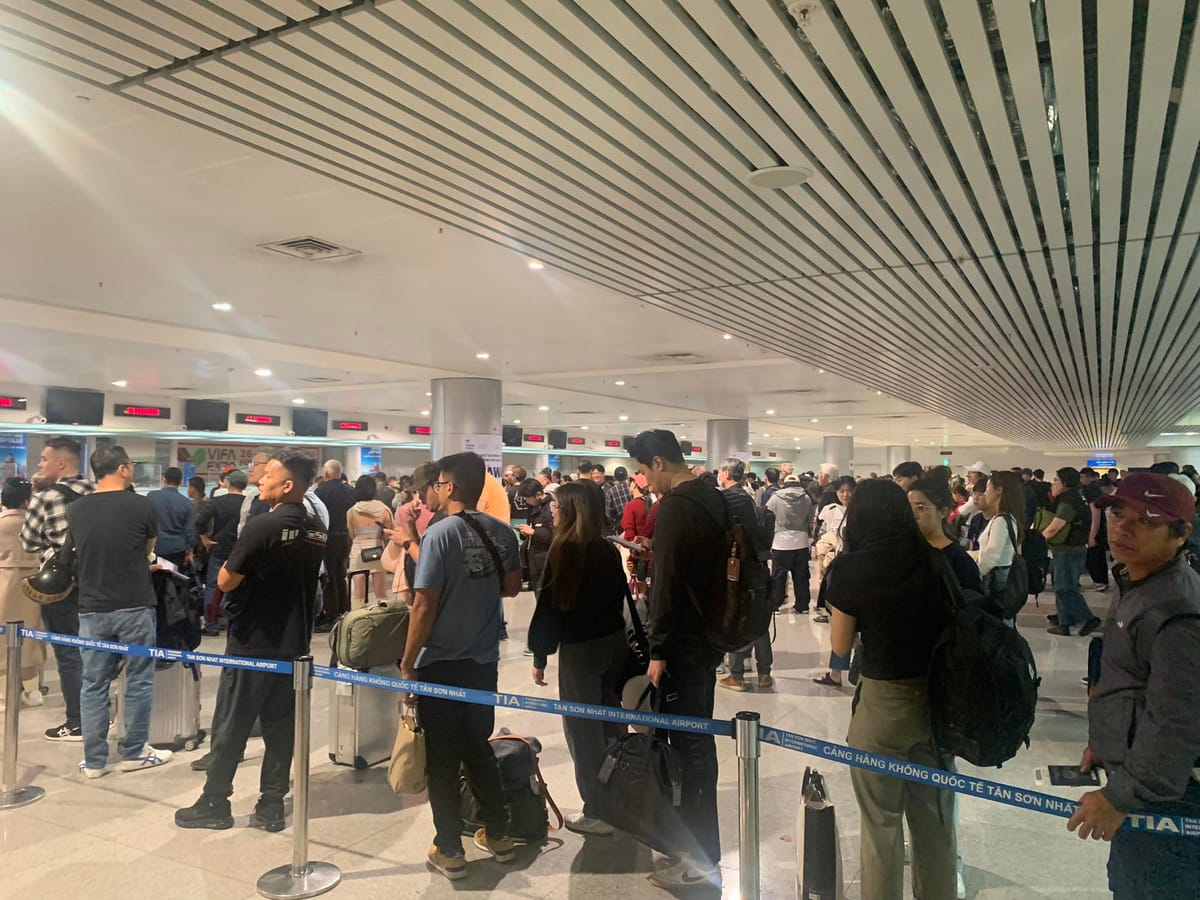
[Vietnam's Airport Fast Track: An Unusual Service Most Countries Don't Sell, Now on Klook for $19]
Open Klook. Search "Vietnam fast track."
The first result is "Tan Son Nhat International Airport Fast Track Service" — 4.0 stars, more than 4,300 reviews, over 100,000 bookings, starting at $19.05.
It looks like an ordinary travel product. Read on, and it becomes clear this product has almost no equivalent in the international airport-clearance landscape.
01 | What This Service Actually Is
Fast Track operates at four Vietnamese international airports: Tan Son Nhat (Ho Chi Minh City), Noi Bai (Hanoi), Da Nang, and Phu Quoc.
Operators claim the service cuts immigration time from the usual 1–3 hours down to 5–10 minutes. (That's how the Klook listing puts it.)
How it works in practice: you pay through Klook, GetYourGuide, KKday, or Viator before your flight. On arrival, a staff member meets you at the terminal with a name placard, walks you through a dedicated lane, helps with baggage and customs, and takes you to your car. No queues at any step.
The operators are private companies, not the airport authority. Klook's listing is run by Taseco, GetYourGuide's by Consortio Vietnam, and VietAIR sells its own version. Taseco is a publicly listed Vietnamese company (HOSE: AST) and a long-standing partner of the Airports Corporation of Vietnam (ACV).
VietAIR's own website breaks the service into five tiers, ranging from $18 at the cheapest level to $116 at the top end (depending on airport and add-ons).
The biggest difference between tiers isn't speed.
It's which lane the staff walks you down.
02 | $26 Buys Access to the Diplomat Lane
VietAIR's tier comparison spells this out plainly.
Three of the five tiers — VIP, Cao cấp Ưu tiên (Premium Priority), and Tiêu chuẩn Ưu tiên (Standard Priority) — share one feature in common: passengers go through the "Crew / Diplomat / APEC Priority Lane." The other two tiers (without the "Ưu tiên" suffix) take the regular Fast Track lane.
What is the "Crew / Diplomat / APEC" lane?
Crew refers to airline crew members. Diplomat refers to holders of diplomatic passports. APEC is the business-traveler card issued under the inter-government APEC Business Travel Card scheme.
All three categories require formal credentialing — professional status for crew, international convention for diplomats, government-by-government approval for APEC cards.
VietAIR's offer effectively says: pay a fee, and you can walk through any of those three lanes.
The cheapest entry point is at Hanoi's Noi Bai airport, where Tiêu chuẩn Ưu tiên — Standard Priority — costs 650,000 VND, about $26. That's three to four times cheaper than the VIP tier (1.95 to 2.8 million VND), but uses the same diplomat lane.
What VIP buys on top is one extra service called "Thay mặt khách làm thủ tục nhập cảnh" — "completing immigration on the customer's behalf." Hand over your passport and the operator clears you through; the traveler doesn't even walk to the booth.
The price sheet at first glance suggests the diplomat lane is a VIP-only privilege. Cross-checking it against Klook and GetYourGuide listings reveals the real dividing line is the word "Ưu tiên" (Priority). $26 is enough; $112 is not required.
A January 2026 verified review on GetYourGuide listing 694577, posted by an Australian traveler, puts it in plain language:
"Fantastic! The best way to travel. The immigration snake line was long and we went through diplomat..."
That review confirms VietAIR's tier description in the field. And the reviewer is a paying customer — not a diplomat, not an APEC cardholder, not airline crew.
03 | What Other Countries Do
Expedited immigration exists at major airports around the world, but in three patterns — none of which match Vietnam.
The first is government-run Trusted Traveler programs. The U.S. Global Entry, run by Customs and Border Protection (CBP), charges $120 for five years. The crucial line on the CBP website: "All applicants must undergo a background check," followed by an in-person interview for first-time applicants. India's Fast Track Immigration TTP is similar — Ministry of Home Affairs administered, but free. Taiwan's automated lanes, Hong Kong's e-Channel, Korea's SES, and Japan's autogates fall into this same category.
The logic of these programs: trade speed for vetting low-risk travelers.
The second pattern is universal biometric automation. Major hubs like Dubai and Singapore use smart gates and biometric verification that speed up everyone's clearance with no extra fee. The logic here treats clearance as infrastructure — efficiency gains accrue to all passengers.
The third is officially sanctioned private Fast Track. Malaysia's KLIA has a paid Fast Track service, and the Malaysian Immigration Department publishes coverage of it on its official website (imi.gov.my). The operation is private, but the official position is open.
Other Southeast Asian countries are actually closer to Vietnam than these three patterns. Thailand and Indonesia have private Fast Track services for sale, with operators in Bali and Jakarta listing on Klook and GetYourGuide at comparable prices. So "Vietnam alone has paid Fast Track" doesn't hold — this is a regional phenomenon.
What's unusual about Vietnam shows up in two different details.
First, Vietnamese operators put "borrowing the Crew / Diplomat / APEC lane" in writing on their tier sheets. Operators in Thailand and Indonesia mostly call it a "special immigration lane" without naming which lane.
Second, Vietnam's autogate system points the opposite way from Indonesia's. Indonesia's Soekarno-Hatta launched 78 autogates in January 2024, open to foreign tourists holding e-Visas or visa exemption — meaning ordinary tourists in Indonesia can use the autogate and skip Fast Track entirely. Vietnam launched 100% automation at Da Nang in March 2025, and all five major international airports (Hanoi, HCMC, Da Nang, Cam Ranh, Phu Quoc) now have autogates deployed. But Vietnam's autogates are closed to foreign tourists on e-Visas or visa exemptions. They're available only to three groups: Vietnamese citizens, foreign residents holding TRC or PRC cards, and foreign holders of APEC business cards. So tourists in Vietnam are left with two options: stand in the regular line, or pay for Fast Track.
ACV — the state-owned airport operator, founded in 2012 by the Ministry of Transport and listed on the Ho Chi Minh Stock Exchange, running 11 international and 12 domestic airports — does not offer an official Fast Track product on its website. The service is sold entirely by private third parties, who claim "legal, in cooperation with the airport," and on the ground airport staff do cooperate.
So the unusual part isn't that Vietnam has paid Fast Track. It's the transparency with which operators write the lane-borrowing into their price sheets, plus the autogate's deliberate exclusion of tourists, which preserves the market space for Fast Track.
04 | A Particular Clause in the Klook Listing
Tucked into the "Good to know" section of Klook listing 86247 — the same one with 100,000+ bookings — sits this line:
"The service is NOT available to holders of Vietnamese passports."
This isn't a Vietnamese government decree. It's a restriction Klook and the operator (Taseco) wrote into their own product terms.
Why exclude one's own nationals? The clause itself gives no reason, but the institutional context from section 03 explains it: Vietnamese citizens already have the autogate, which is fast enough that they don't need Fast Track. The dual track isn't an arbitrary operator choice — it reflects how Vietnam's actual entry system is segmented. Vietnamese citizens go through autogates. Foreign tourists either pay for Fast Track or wait in line.
From a passenger's view, the dual track looks like this: a Vietnamese citizen with a Vietnamese passport stands in the regular immigration line. A foreign tourist pays $19, clears in minutes, and quite possibly walks through the diplomat lane.
This isn't a Trusted Traveler program.
Trusted Traveler programs filter by "who has a clean background." Vietnam's Fast Track filters by "who holds a foreign passport."
05 | Back to MOLISA: Two Fates of "Bôi Trơn"
The phenomenon is hard to read without recalling the indictment of the former MOLISA deputy minister covered in our previous article.
That case turned on a structural finding by Vietnam's Supreme People's Procuracy: MOLISA designed an internal document called "Quy trình" (procedure) that forced labor-export companies to pay "lubrication fees" (bôi trơn) in exchange for E7 visa export licenses. Former deputy minister Nguyễn Bá Hoan personally took 16.3 billion VND, with 28 defendants total, indicted in May 2026.
In Vietnamese law and media, bôi trơn (a gray-zone payment to speed up a process) and hối lộ (bribery that changes a decision) are usually distinguished. But once a payment becomes the precondition for an approval — when "no payment, no clearance" is the rule — bôi trơn is reclassified as hối lộ, and the case turns criminal.
The structure of airport Fast Track is functionally the same: pay to speed up an administrative procedure, get faster handling than people who don't pay. The difference is only in how it's treated. The MOLISA case was indicted. Airport Fast Track went on Klook.
Why such different treatment? Three plausible explanations come to mind, though none is complete.
Foreign-traveler unfamiliarity: a tourist who pays $19 doesn't read the transaction as corruption — it reads as a convenience service. So no consumer-side backlash builds.
Cross-jurisdictional gap: services like this sit in a gray zone. They're legal locally, but when they show up on cross-border travel platforms, those platforms can only enforce the loosest standard — legal-locally-equals-listable. That standard pulls gray-zone products into the category of "commercial goods."
Social acceptance: for the inbound Fast Track aimed at foreign tourists, Vietnamese media has barely produced any critical coverage. That contrasts sharply with the MOLISA case, which VnExpress, VOV, and CAND covered for days.
But these three explanations don't answer the deeper question: where exactly is the dividing line?
Vietnam routes the same act — paying to speed things up — onto two separate tracks. One ends in indictment, the other in legitimate commerce. The dividing line isn't the act itself. It's whether the payment is presented to society as "a product."