AEON's Vietnam Triple Plan: From 12 Big Stores to 100
Japan's AEON announced a 2030 plan to triple its Vietnam scale: 100 large-format stores, 200 small supermarkets, and another $1.5 billion of investment — turning Vietnam into a second home market as Japan saturates.
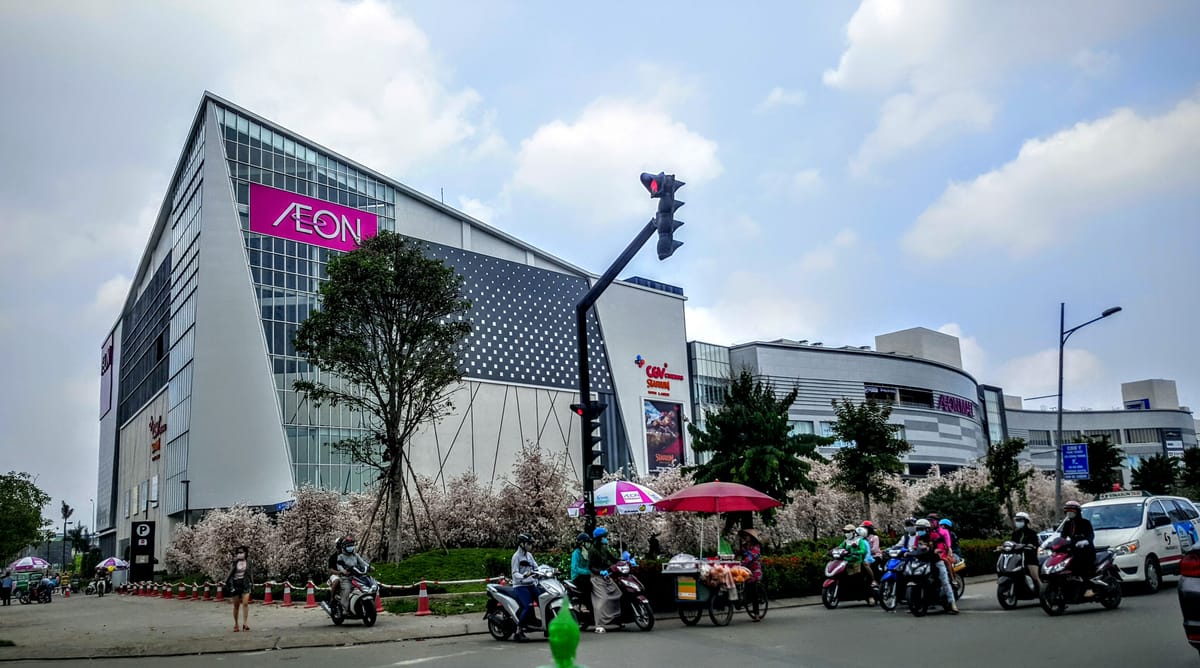
[AEON's Vietnam Triple Plan: From 12 Big Stores to 100]
▍ 2026: 37 New Stores in a Single Year
Most foreigners picture AEON Vietnam as eight big AEON Malls — the kind of all-day family shopping centers in Hanoi and Ho Chi Minh City.
But the headline number from AEON Group president Akio Yoshida's April 2026 annual strategy briefing was not about malls.
AEON will open 37 stores in Vietnam this fiscal year at a smaller format: general merchandise stores (GMS) plus mid-sized supermarkets. That is roughly one every ten days.
GMS and AEON Malls are different formats.
A Mall is real estate. AEON builds the venue and leases space to many brands: cinemas, fashion chains, restaurant rows.
A GMS is a single large store run entirely by AEON. It sells groceries, clothing, and household electronics under one roof, closer to Carrefour or Costco than to a department store.
That is just the start.
When AEON's Vietnam chief Daisuke Tezuka opened a new store in Hưng Yên province in October 2025, he told reporters Vietnam was AEON's most important market outside Japan.
For a Japanese retail group, naming any overseas market as "second only to Japan" is a strong statement. AEON saved that line for Vietnam because of what it is committing to here: a plan to triple the business by 2030.
▍ The Network Already in Place
By October 2025, AEON Vietnam ran 8 AEON Malls, 15 general merchandise stores, 45 mid-sized and small supermarkets, 182 convenience stores, and 29 specialty shops.
The spread is wide. From large suburban family malls down to street-corner mini-supermarkets, neighborhood convenience stores, and beauty and bicycle specialty outlets — AEON already touches nearly every retail format the country has.
Cumulative investment over the past decade comes to about $1.5 billion.
In 2024, Vietnam operations brought in ¥17.3 billion in revenue and ¥4.23 billion in operating profit.
AEON Vietnam has averaged about 30% annual revenue growth — well above the pace of the wider Vietnamese retail market.
▍ What "Triple" Actually Means
Triple sounds tidy. Broken down by format, the math is anything but even.
As of February 2025, AEON had 12 general merchandise stores in Vietnam — 3 of them at the larger super-supermarket scale — plus 36 food supermarkets including the Citimart chain it acquired earlier.
The 2030 targets:
➤ General merchandise stores and super-supermarkets combined: from 12 to 100. That is roughly 8x growth.
➤ Small-format food supermarkets: from 36 to 200. More than 5x.
Why the rush?
Yasuyuki Furusawa, who ran AEON Vietnam before being promoted to president of AEON Retail, put it bluntly: "To compete with companies like Central, we need to aim for 100 general merchandise stores and super-supermarkets by around 2030."
Central here is Thailand's Central Retail Corporation. Its flagship Big C — a household name in Vietnam for over 20 years, gradually rebranded to GO! and Tops Market starting in 2023 — runs more than 40 hypermarkets across the country.
Setting Central as the benchmark says something specific. AEON does not just want to be "the Japanese brand in Vietnam." It wants to fight for top-tier status in Vietnamese retail itself.
To pull off 12-to-100 in five years and triple the overall business, AEON estimates it needs to lift annual growth from the current ~20% to 40%.
The group also pledged another $1.5 billion of investment over the next decade — equal to everything it has put into Vietnam so far, all over again.
▍ Why Vietnam, Why Now
Strip the strategy back and the underlying bet is simple: Vietnam's modern retail market is still immature.
The total Vietnamese retail market is projected to reach about $309 billion in 2025 and $546 billion by 2030.
But organized modern retail — department stores, supermarkets, malls, convenience stores — accounts for only 13–15% of that. The remaining 80%-plus still flows through traditional wet markets, mom-and-pop shops, and street vendors.
Compare that to Japan, where modern retail penetration is so saturated AEON has to rebuild its core formats just to keep growing.
Vietnam is the opposite story. The population just crossed 100 million, urban middle-class households are expanding every year, and traditional channels are giving way to modern ones at an accelerating pace.
That is the window AEON is racing into. Lock down the "middle-class family weekend shopping" slot now, while penetration is still climbing from 15% toward something much higher. Once the market matures and the share gap closes, breaking in becomes a lot harder.
▍ The Strategy: Vertical Plus Horizontal
How does AEON actually plan to do this?
The company calls its approach "dual-track."
The vertical track is supply chain and product development.
AEON has been pouring resources into private brands in Vietnam — TopValu for food, Home Coordy for household goods — with the goal of running Vietnamese local supply all the way through to AEON-branded products on its own shelves.
The horizontal track is format mix and geography.
Beyond the existing strongholds of Hanoi and Ho Chi Minh City, AEON has put its expansion weight on three zones: the northern Red River Delta, the Mekong Delta, and central Vietnam (Hue, Da Nang).
What those three regions share: middle-class households with new spending power, but a retail scene still dominated by traditional channels. The window is widest there.
Two recent openings show how heavily AEON is willing to commit:
AEON Xuân Thủy in Hanoi, which opened in January 2025, devotes 1,620 square meters to prepared foods and seats 450 in its dining area. The retail floorspace is almost the side dish — the main attraction is "a place where the whole family eats lunch, picks up dinner, and lets the kids play."
AEON Tân An, which opened in late September 2025 in southern Vietnam, came with a single-store investment of VND 1 trillion (roughly $37.9 million). Tân An is not a major city. AEON is willing to put that kind of money into a provincial-level town because it is betting the local middle class will be large enough to fill a major store within a few years.
▍ A Country as a Second Home Market
AEON Group's full-year capex for FY2026 is ¥580 billion. Overseas accounts for just 16% of that — and Vietnam is where the bulk of the overseas allocation is going.
Twelve big stores becoming 100. Another $1.5 billion in. A jump from 20% to 40% growth. Taken together, this is no longer "open a few more malls." It points in one direction: turn Vietnam into a second home market for AEON now that Japan has plateaued.
Tezuka's "most important market outside Japan" line and Furusawa's Central-as-benchmark posture are two ways of saying the same thing.
Over the next several years, expect AEON to run both tracks at once. New AEON Malls are scheduled to open across provincial cities — Hạ Long, Ninh Bình, Hải Dương in the north, Thanh Hóa and Da Nang in the center, Mỹ Tho and Đồng Nai's Trần Biên in the south — between 2026 and 2027. Layered on top, the GMS-and-supermarket pace from the opening: roughly one every ten days.
If the triple plan lands, by 2030 AEON Vietnam will sit alongside Big C / GO! as one of the country's homegrown retail leaders.
Its headquarters just happens to be in Tokyo.