Vietnam's $500-Per-Worker Toll: How a Labor Ministry Turned Visa Approvals Into a Cash Machine
How Vietnam's Labor Ministry designed an approval process that workers paid for, $500 at a time.
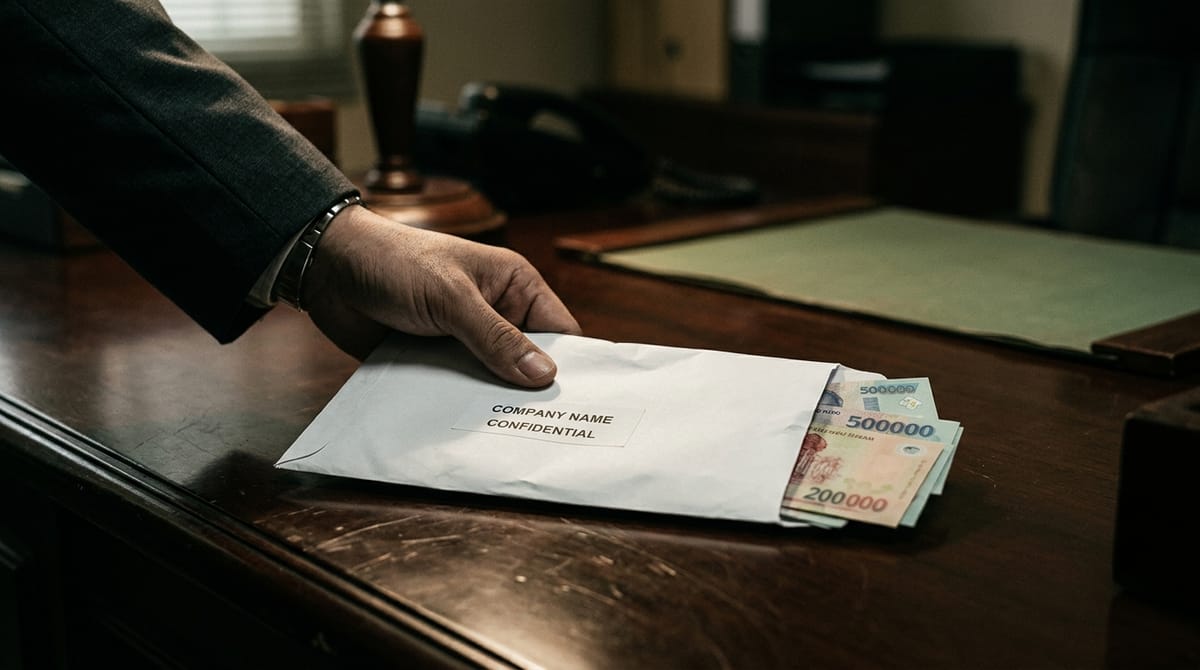
In Nguyen Ba Hoan's office, Vietnamese police found 25 envelopes — each one labeled with a different company name. Plus nearly 1 billion Vietnamese dong in cash, and $156,000 in U.S. bills.
That was the May 7, 2026 search of the former deputy labor minister's office. A day earlier, the Supreme People's Procuracy had indicted him along with 27 co-defendants — 28 people in total — and sent the case to the Hanoi People's Court.
The first question anyone asks is the obvious one: how much did he steal?
But that's not the striking part of the indictment. The real story is how they designed the system that produced those envelopes.
01 | The Indictment Is About More Than Personal Corruption
The charges fall into three categories: accepting bribes, brokering bribes, and accounting violations causing serious consequences.
Two figures sit at the center: Hoan as deputy minister, and Tong Hai Nam, former director of the Department of Overseas Labour Management. That department is the unit inside MOLISA (Ministry of Labour, Invalids and Social Affairs) that handles overseas worker export approvals. It's where the power in this case actually lived.
The remaining 26 defendants are mid-level MOLISA officials and executives at the bribe-paying firms.
The case spans nearly nine years, from 2017 to April 2025. Over that period, prosecutors say, MOLISA officials forced companies to pay over 30 billion dong (around $1.2 million) in what Vietnamese calls bôi trơn — "lubrication fees."
But this case isn't really about the total. It's about what was built underneath the total.
02 | "Quy trình": Turning Approval Into a Toll Gate
The most telling detail is in the indictment itself.
In October 2022, MOLISA officials internally drafted a procedure document — a quy trình — for processing applications under Korea's E7 specialized-skill visa. It took effect in February 2023.
The document required labor export companies to submit two specific items along with their applications: a formal recruitment letter from Korea's Ministry of Trade, Industry and Energy (MOTIE), and documentation of the Korean employer's foreign worker quota.
Neither was something a Vietnamese company could realistically obtain on its own.
In plain terms: companies couldn't get these papers from the Korean side. The only way forward was to pay a "lubrication fee" in exchange for someone "helping confirm the quota" and "expediting the application."
This is what makes the case different from ordinary corruption. One is a person being corrupt. The other is an entire approval process being engineered to extract fees. The quy trình was never built to review. It was built to charge — and reading the indictment any other way misses the point.
It's also why the formal charge is "accepting bribes" (hối lộ), not facilitation. In Vietnamese law and media, bôi trơn historically described small payments to grease bureaucracy — a gray area distinct from formal bribery. But once the quy trình tied payment directly to whether you got the export permit, companies had no real choice. When "speeding up a process" becomes "buying a right," it crosses from bôi trơn into hối lộ.
03 | The Going Rate Was $500 a Worker
The indictment also lays out the price.
Each E7 worker exported cost roughly $500 in lubrication money.
Between 2021 and April 2025, three Vietnamese labor export firms paid over 6.8 billion dong to MOLISA officials in exchange for export permits (Phiếu trả lời) covering 548 E7 workers. Do the math: about 12.5 million dong per worker, which lines up almost exactly with the $500 rate.
Put differently: every Vietnamese E7 worker was priced at $500 before he ever signed an employment contract.
The biggest corporate bribe-payer was Hoang Long CMS, a 20-plus-year-old mid-sized recruitment company whose main markets are Taiwan and Japan — not Korea. Hoang Long was effectively trying to push into Korea via E7, and every E7 export permit required a MOLISA stamp.
The case actually surfaced through Hoang Long's accounting irregularities first. In May 2025, the public security agency indicted the company's executives. Investigators followed the money upward, and the trail ended at the deputy minister's level.
04 | Why E7: A Built-In Vulnerability
E7 is Korea's specialized-skill visa. It covers jobs like shipbuilding welders and painters — exactly the work Korea has been desperate to fill.
But E7 has a structural difference from the more familiar E9 visa.
E9 runs through Korea's EPS system: a government-to-government agreement, administered directly by Korea's Ministry of Labor. Vietnamese discretion at the approval stage is limited.
E7 doesn't work that way. It's a company-by-company application process, and on the Vietnamese side, every export permit needs case-by-case sign-off from MOLISA.
That distinction matters. E9 is a pipeline. E7 is discretionary approval — and the ceiling on that discretion sat at the deputy minister.
Put case-by-case decision power into a single approval choke point, with no transparent oversight, and the structure itself becomes a rent-extraction trap. The indictment is what four years of that structure produced, starting in 2021.
05 | One Source of the "Modern Slavery" Problem
Pull the camera back from Hoan's office and look at the broader Vietnamese labor export market.
About 700,000 Vietnamese currently work abroad, remitting $4 billion home each year. In 2024, around 150,000 went overseas. In the first ten months of 2025, the number was already 121,000. The three biggest destinations are Japan, Taiwan, and Korea.
Taiwan sits downstream on this supply chain. As of March 2026, Taiwan hosted around 873,000 migrant workers, with Vietnamese making up 33.7% of them. As of January 2025, Vietnamese were also the largest group of undocumented migrants on the island — 57,611 people.
In 2020, the Reporter (《報導者》), a Taiwanese investigative outlet, ran a deep field investigation. Reporters Chien Yung-ta and Huang Yu-chen visited Cau Giay district in Hanoi — the city's so-called "labor street."
What they found: Vietnamese workers heading to Taiwan typically paid $6,000 to $8,000 in broker fees, around NT$200,000. To pay off the debt, workers spent their first two years on relentless overtime. International human rights groups have described this arrangement as "modern slavery."
Vietnam's legal cap is $4,000. In practice, workers paid $6,000 or more — well above the official ceiling.
For comparison: Vietnamese broker fees to Japan were around $3,600 in 2020, according to research by Lan Pei-chia, a sociology professor at National Taiwan University. But by 2023, an ILO report cited in a December 2024 East Asia Forum analysis put Japan-bound fees at about $7,700.
A doubling in three years is its own research question. It might reflect deregulation since Japan's "specified skilled worker" visa took effect, or different definitions of "broker fee" (the broker's actual cut versus all preparation costs including language training, health checks, and passport processing).
Wang Hong-zen, a sociology professor at National Sun Yat-sen University, interviewed nearly 20 brokers on both sides of the strait. His finding: the Taiwan side captures roughly 60% of the cross-border revenue split.
The Reporter laid out the framework explicitly. Rent-seeking, the article noted, is when groups lobby government for monopoly rights and extract surplus profit. Taiwan's migrant worker system — labor recruitment as a licensed industry, with only license-holders allowed to bring in workers — is a textbook case.
The Reporter described rent-seeking on Taiwan's end. The Hoan indictment reveals the same mechanism on Vietnam's end: MOLISA requires labor export firms to be licensed, and E7 visas require case-by-case Phiếu approval. One supply chain, two licensed-and-quota'd rent-extraction points at each end.
The sharper point: MOLISA leadership knew about the downstream problem.
The Reporter obtained an internal MOLISA document in 2020 — a market study by the Department of Overseas Labour Management (DOLAB) covering Japan, Korea, and Taiwan. The report identified high Taiwan-bound costs as a problem, and suggested that growing competition for Vietnamese labor in the region might eventually bring those costs down.
But DOLAB identified the problem in 2020.
The quy trình was drafted in October 2022.
The bribery period ran from 2021 through April 2025.
So: the high Taiwan broker fee problem was on MOLISA's desk by 2020. Over the following years, they added another toll gate on E7 visas — and charged another $500.
That's what makes this case "structural" rather than personal.
The full supply chain looks like this:
➤ Vietnam-side officials: $500 per worker at the MOLISA approval point (this indictment)
➤ Vietnam-side brokers: $6,000–$8,000 charged to workers (the Reporter)
➤ Vietnam's legal cap: $4,000 (exceeded by 1.5x or more)
➤ Taiwan–Vietnam broker chain: 60% of the split kept on the Taiwan side (Wang's research)
➤ The worker arrives in Taiwan already deep in debt
When Taiwan debates why Vietnamese migrant workers run away, why Vietnamese top the undocumented charts, this $500 export permit is one part of the answer. Taiwan-side brokers, Vietnam-side brokers, loan companies, and online "sponsors" all layer additional costs on top of that $500.
06 | What Happens After the Indictment
Sentencing isn't the focus here. Two other things matter more.
First: will MOLISA actually rewrite the quy trình that took effect in February 2023? The MOTIE letter and quota documentation requirements — the things companies couldn't realistically obtain — will those be removed in 2026?
Second: will DOLAB's 2026 labor export data, especially the E7 numbers, show unusual movement? But that figure alone can't tell you whether the system has changed. A sharp drop could mean the gate was sealed; it could equally mean Korean shipyard demand softened. Steady numbers could mean reform; they could also mean someone else has taken over the collecting. The data needs to be read alongside the first question — has the quy trình actually been rewritten — for it to mean anything.
An indictment exposes a structural problem. It doesn't reform it. This story will need to be tracked further.
—
If you found this article useful, feel free to share it with anyone interested in Vietnam.
Want regular updates on Vietnam? Visit our website to subscribe to our free newsletter.
Find our content valuable? Consider becoming a paid supporter to help us keep producing in-depth coverage. Paid supporters also get priority consideration for topic requests in our Reader's Wishlist. Details on our website.
We also have a LINE group for readers — join link is in our Facebook page bio. Come chat about all things Vietnam.