Hanoi Breaks Ground on Five Metro Lines at Once, Aiming for a 303km Network by 2030
Hanoi broke ground on five metro lines at once, more than 300km in total, due in four years. The number to watch isn't the budget — it's three changes in how it's being built.
[Hanoi Breaks Ground on Five Metro Lines at Once, Aiming for a 303km Network by 2030]
On the morning of June 22, Hanoi broke ground on five new metro lines simultaneously. Together they run about 303.5km, linking Nội Bài Airport, Hanoi Railway Station and several outer townships, with basic completion targeted for 2030. Prime Minister Lê Minh Hưng, Hanoi People's Committee Chairman Vũ Đại Thắng and Vingroup Chairman Phạm Nhật Vượng all attended the ceremony.
The scale is worth pausing on. Preliminary investment across the five lines tops VND1.3 quadrillion, or about US$49.4 billion — the largest single infrastructure investment in Hanoi's history. Officials laid out the role and price tag of each line:
➤ Line 1 is the most expensive at roughly VND390 trillion. It runs north to south, tying together Hanoi Railway Station, the national high-speed rail and Nội Bài Airport.
➤ Line 8, about VND317 trillion, runs east to west, connecting the Hòa Lạc tech park in the west to manufacturing and logistics clusters in the east.
➤ Line 2, about VND272 trillion, runs from Nội Bài Airport into the city center as an "international gateway" line.
➤ Line 10, about VND207 trillion, is a loop line stringing together new growth nodes on the city's edge.
➤ Line 14's Hanoi section runs to about VND130 trillion, linking new townships on the eastern and western flanks.
Add the five together and you get exactly the headline figure. But officials stress these are still "preliminary estimates" — routes, scope and cost will all be revised during planning and appraisal, so every number here can still move.
More than the money, what makes this moment notable is three changes in approach.
The first is the shift from building one line at a time to laying a whole network at once. Hanoi used to add metro lines one by one; this time, five started together. As Vũ Đại Thắng put it at the ceremony, the project marks a move "from building individual lines to forming a city-wide network." Once finished, the five lines will connect Nội Bài Airport, Hanoi Railway Station, Hòa Lạc and Gia Lâm, then tie into Lines 3 and 5 already under construction to form a single web. Rolling out five lines and weaving them into a network at the same time is a first for Hanoi.
The second change sits behind the word "metro" itself. Hanoi treats the rail network as the backbone of a "multi-polar, multi-center" city, developing the land around station nodes — what planners call transit-oriented development, or TOD. Put plainly: wherever a station goes, the surrounding land gets developed with it. Transport and real estate are tied together from the start.
The third change is who does the building. The owner of all five lines is the Hanoi Metropolitan Railway Management Board, funded with public investment — this is not Vingroup paying to build the metro. A consortium of Vingroup's Vinhomes and VinSpeed holds the EPC contract, handling design, equipment procurement and construction. In other words, the state pays and a private firm builds. What Hanoi liked about the consortium was its financial muscle, its experience running large projects and a roster of international infrastructure and rail partners behind it.
Bundling public investment, a private general contractor and TOD-driven land development is a new model Vietnam is testing. And the thing that model is betting against is Hanoi's own history.
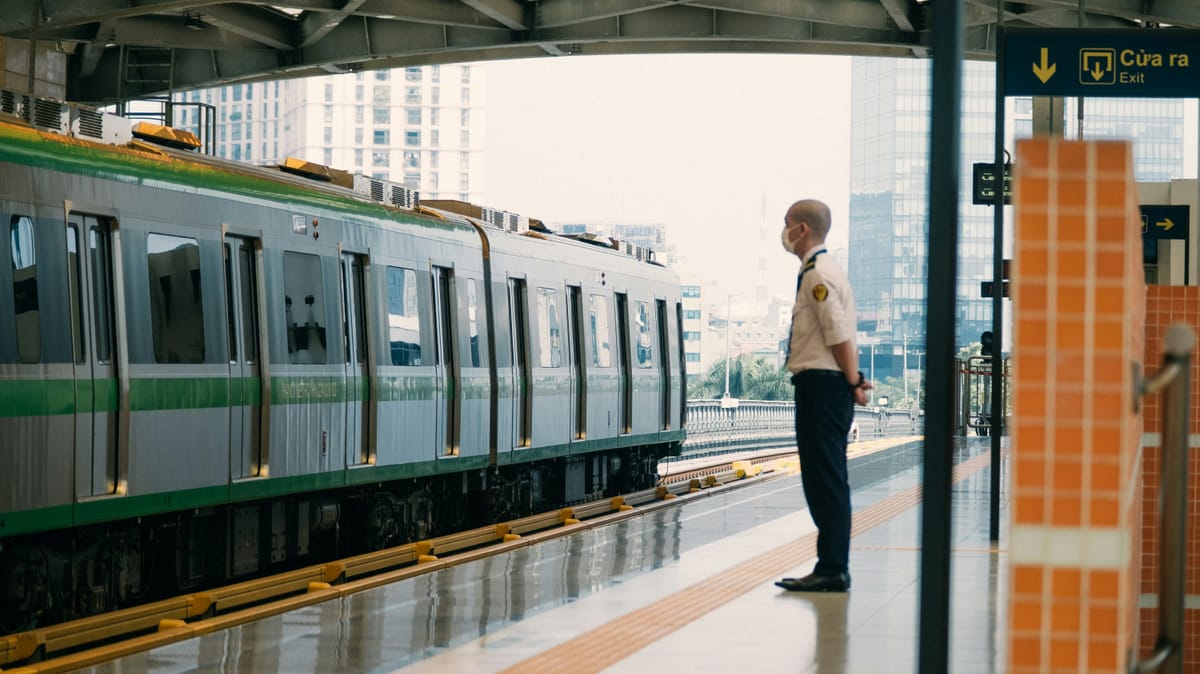
Right now the city runs just two metro lines: Cát Linh–Hà Đông, and the elevated stretch of the Nhổn–Hanoi Station line. Cát Linh–Hà Đông, Vietnam's first metro, was built by a Chinese contractor. Work began in 2011 with completion originally set for 2013; it slipped by about nine years and only opened in late 2021, running about 13km. The second line was rockier still — its opening date was rescheduled fourteen times, and the elevated section only partly opened in mid-2024. Between them, the two lines carry passengers along roughly 21km of track.
Set that record beside the 2030 target and the stakes come into focus. Over the past fifteen years, Hanoi has actually built and put into service about 21km of metro. Now it wants to bring 303km to "basic completion" in four years — in effect, to flip the curve that has so far meant every line ran late. The official bet is to hand the work to a well-capitalized, capable private firm and hope it breaks the spell of delays. For now that is still a hope, not a result — the nine years of Cát Linh–Hà Đông and the fourteen schedule changes on Nhổn are the cautionary tales sitting right in front of everyone.
VinSpeed, the firm taking on the contract, is no lightweight. It launched with VND6 trillion in registered capital, more than half of it held by Phạm Nhật Vượng personally, and within a year had raised that to VND45 trillion — clearly preparing in advance. Beyond Hanoi's five lines, it is also the owner of two high-speed rail projects: the Bến Thành–Cần Giờ line in Ho Chi Minh City and the Hanoi–Quảng Ninh line. Worth noting: on those two, VinSpeed is the project owner itself — a different model from the five Hanoi metro lines, where the state pays and the private firm builds. The two shouldn't be lumped together.
Coming back to the groundbreaking itself, the thing most worth noting is actually the route map. The points being strung together — Hòa Lạc, Gia Lâm — mark the direction of Hanoi's "multi-polar, multi-center" outward expansion; where the lines reach often says more about where the city will grow over the next decade than the ceremony does. As for the 2030 target, rather than take it at face value, watch two more concrete markers: which segments of each line actually start construction, and when the first stretch opens to passengers. Four years from now, how much of these 303km is really carrying people will be the true measure of this groundbreaking.
The Viet Media Monthly
A curated monthly digest of the most important political, economic, tech, and industry developments in Vietnam.
Designed for reading on desktop or tablet — no algorithm, no noise. Just the stories that matter.
Delivered before the 10th of each month. Cancel anytime.