Fansipan Cable Car: 800 Days on Vietnam's Highest Peak
A record-setting cable car on Vietnam's highest peak was built with picks, shovels and the backs of 400 to 500 Hmong and Thái workers.
[Fansipan Cable Car: 800 Days on Vietnam's Highest Peak]
Fansipan rises 3,143 metres, the highest point in Vietnam. Before 2016, reaching the top meant walking up from Sa Pa — two days if the weather held, longer if it didn't.
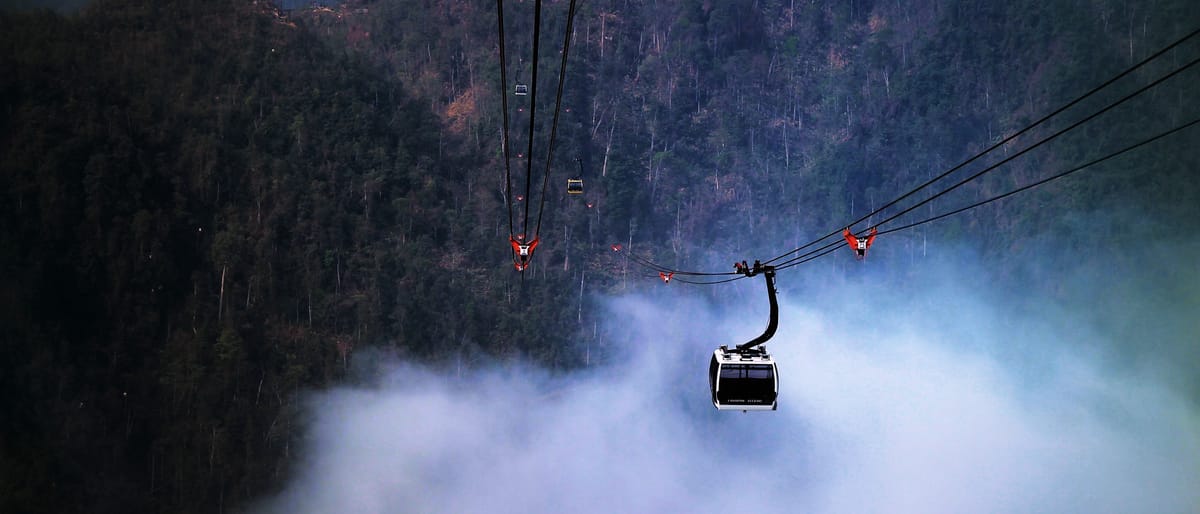
That climb now takes fifteen minutes. Thirty-three cabins circulate above the valley, thirty seated passengers each. The ride crosses the rice terraces and villages of Mường Hoa, then streams, then rhododendron forest, then spruce, before stopping at a platform near the summit. The route was chosen deliberately. One of the guiding principles was that a passenger should see all of Sa Pa's landscapes in a single trip.
The year it opened, the line took two Guinness World Records: the world's longest three-rope cable car, and the largest vertical gap between departure and arrival stations. Three-rope means the system runs on three steel cables rather than one, which holds up better against high-altitude wind. The length record fell in 2018 to a cable car on Phú Quốc island, about 1.7 kilometres longer. The vertical record still stands at Fansipan: 1,410 metres.
Where the line would start, which ridges it would cross, where it would end — the survey team worked that out by climbing the mountains one by one.
They had no GPS and no mobile phones. Radios were useless over those distances. The team climbed every peak within a five-kilometre radius and marked promising spots with white flags. Eventually they stopped measuring distance in kilometres and started counting slopes climbed and stretches of forest crossed.
They slept in shelters made of bent bamboo driven into the ground — you crawled in, and you worried it would collapse. Six months of this, and the route was set.
Construction began in November 2013. More than 300 engineers and workers walked in from Sa Pa town and set up camps at intervals along the mountain, the highest group all the way at the summit.
Only the base station at the bottom could be reached by truck. Above that, there was no road.
Doppelmayr's team had a straightforward proposal: cut trees, open a road, drive the materials up. Sun Group rejected it. The project's first principle was that the forest stayed intact. Balloons were tried. So were helicopters. Fansipan's weather and terrain defeated both.
With every other option gone, the only thing left was human labour.
Trần Đình Luật, an electrical engineer, remembers the stretch when they were installing the 35kV power line. One person could carry twenty to thirty kilos a day. At one point 400 to 500 Hmong and Thái people were brought in to speed things up — the Hmong from around Sa Pa, the Thái from neighbouring Lai Châu.
What went up included rocks weighing hundreds of kilos and coils of steel cable. Delivering one load of tools and equipment to the summit station took two to three days on foot. This went on for roughly a year.
Carrying things was not the hard part.
Nguyễn Xuân Hậu, from Quảng Nam province, had just returned from Australia and been hired as an interpreter for the foreign engineering team. He walked in behind those first 300. His memory of day one is that the path was terrifying: dense vegetation, near-vertical slopes. He fell behind at Red Slope, lay down halfway up the mountain and cried, wanting to go home.
Within a month of arriving, snow hit Sa Pa. Temperatures in the forest dropped far enough that drinking water froze one to two centimetres thick. Wind coming over from the Lai Châu side made it worse. Higher up, ice made the rock impossible to stand on. It was the harshest winter the northwest had seen in half a century.
Hậu describes the sensation as breathing air that had turned to ice water in his lungs. Over the 800-plus days of construction, he had five nights like that.
With temperatures below zero for long stretches, workers lived in several layers of jackets for a week at a time and gave up washing. The streams were too far. Water was carried back one canister at a time and froze on the surface before it could be poured out. Once pipes were run in, cold days came with an extra job: banging on the pipe to break up the ice so the water would move.
Food was worse than water. For the first few months, everything eaten on that mountain was carried in by local porters. Bad weather meant supplies took days to arrive, and by then the dried fish and pork had gone off.
One heavy rain cut the supply line entirely. No power, no food, a whole crew splitting a few packs of instant noodles. To keep working, they spread out to gather wild greens and eventually started catching mountain frog tadpoles. The cable riggers said they tasted good — a Fansipan speciality.
The living quarters were no better than during the survey. Bent bamboo pushed into the ground, plastic tarp for a roof, leaves for a bed. After a day's work, men crawled in still wearing their work clothes.
Snow and wind made the nights hardest. Wind driving up from the Lai Châu side flipped tents often enough that it stopped being remarkable, leaving a huddle of people gripping whatever they could reach. Má A Tông, a young Hmong man from the area, says hail and out-of-season snow came with it, collapsing the bamboo shelters onto whoever was lying underneath. The first time he went home from Fansipan, he still saw snow, ice and wind in his sleep.
Under those conditions, once materials reached a site, the digging started.
Each tower foundation went about four metres deep, roughly the volume of a small room, and the entire excavation was done with picks and shovels. Watching Vietnamese workers dig by hand, the foreign engineers estimated the project would take five years. At that point the construction cableway was nearly strung, but the summit station was still at the foundation stage.
In early 2015, that cableway carried its first successful load. Materials no longer had to go up on someone's back. By November, 33 electricity poles stood along the mountain path.
The cable car began carrying passengers in February 2016 — roughly 800 days from groundbreaking.
As the work wrapped up, Sigrist Reto, the Doppelmayr Garaventa foreman in charge of pulling the main rope, put it plainly. He had worked on hundreds of installations, but Fansipan was a monster: too hard, too punishing. After the rope was pulled, several of his colleagues told him straight out that they would not take another job like it.
—
Sources: Doppelmayr/Garaventa project records, VnExpress, Người Lao Động, Thương hiệu Công luận, Dân Trí, Guinness World Records
Cover image: Khoitran1957, 2016, via Wikimedia Commons, CC BY-SA 4.0
The Viet Media Monthly
A curated monthly digest of the most important political, economic, tech, and industry developments in Vietnam.
Designed for reading on desktop or tablet — no algorithm, no noise. Just the stories that matter.
Delivered before the 10th of each month. Cancel anytime.