Refusing to Fight Grab: How Japanese Startup Capichi Survives in Vietnam's Food Delivery Market

ShopeeFood and GrabFood have carved up Vietnam's food delivery market between them, while Baemin, Gojek and Loship have all exited. A small platform founded in Hanoi by a Japanese university dropout survives on a simple premise: nine out of ten of its users aren't Vietnamese.
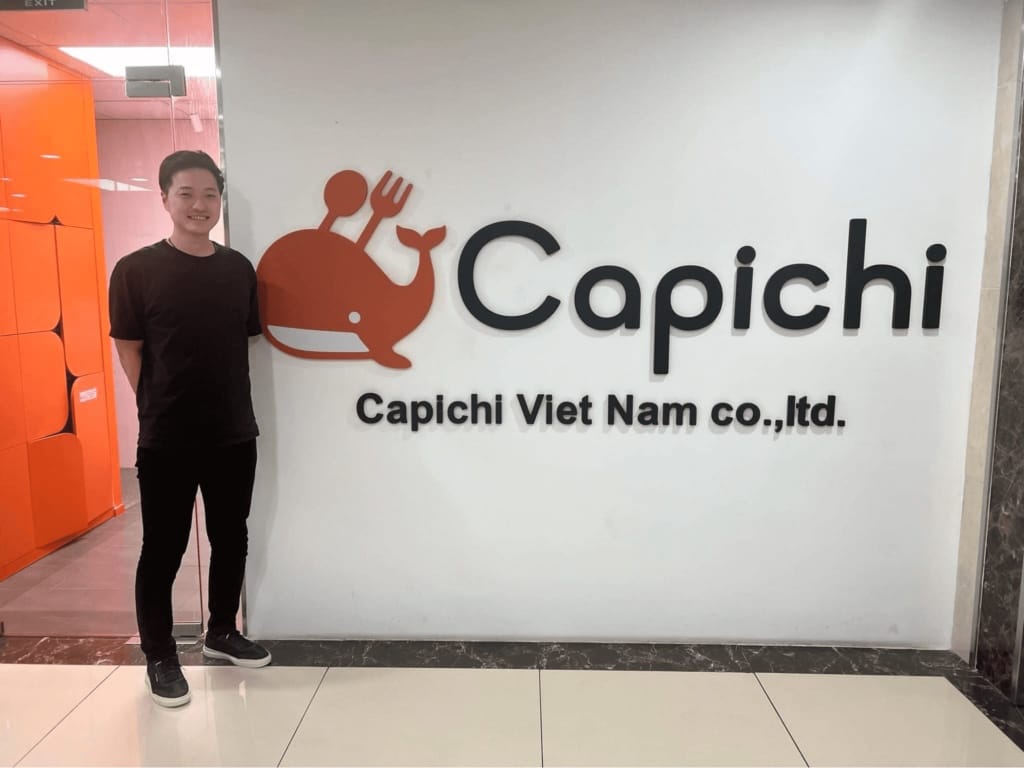

Capichi founder Mori Taiki standing next to the company's brand wall in the Hanoi office, with the orange whale logo and Capichi Viet Nam lettering

[Refusing to Fight Grab: How Japanese Startup Capichi Survives in Vietnam's Food Delivery Market]

Vietnam's food delivery market belongs to two companies. The market is worth more than USD 2 billion a year, and ShopeeFood and GrabFood take roughly half each, according to Singapore-based venture capital firm Momentum Works. The list of casualties is longer than the list of survivors: Korea's Baemin, Gojek's GoFood and local platform Loship have all exited in recent years.

Yet a Japanese-founded delivery platform, a fraction of the giants' size, has kept running since its launch in 2020 — and expanded to Bangkok in 2024.

The company is Capichi. Its founder, Mori Taiki, dropped out of Kobe University at 20 and moved to Hanoi alone, spending a year and a half in sales and project management at a local IT firm before starting his own company in 2019, at age 22.

Capichi didn't begin as a delivery service. It launched as a video-based restaurant discovery and booking app. Less than six months in, the pandemic gutted dine-in business and the company pivoted to delivery. The early days were rough: Mori suffered a serious motorbike accident that required emergency surgery and kept him off work for weeks, while the company was still losing money.

What kept Capichi standing was a decision not to compete with Grab for the same customers. The company disclosed its own user breakdown in a late-2021 funding announcement: half of its active users were Japanese, three in ten were Westerners, one in ten Korean — and only one in ten Vietnamese. By its own account, it listed more upscale and foreign-owned restaurants than any other delivery platform in Vietnam.

That positioning shows up in every part of the product. Before a restaurant can list, it has to send a test order to Capichi's team, which checks the packaging and how the food arrives. Mori has said in interviews that his team can't judge cooking, but it can judge what a customer experiences when a delivery lands in their hands. The interface supports seven languages — Japanese, Korean, English, French, Vietnamese, plus simplified and traditional Chinese — and the platform runs live customer support. It doesn't operate its own fleet; delivery is outsourced to Ahamove, a Vietnamese on-demand logistics company. Capichi even runs its own award, chosen on annual order volume and user ratings, as a marketing tool for partner restaurants. Everything points at the same customers: foreigners living in Vietnam who worry about the language barrier and will pay more for quality, plus higher-income locals.

Capichi's fundraising has been modest but steady, with backers including CRESCO, an IT company listed on the Tokyo Stock Exchange Prime market, and Vietnamese software firm Luvina Software, funding that carried it through the first tranche of its Series A. The company moved its headquarters to Singapore in 2023, set up a subsidiary in Thailand, and entered Bangkok the following year with about 100 curated restaurants, applying the same playbook to expats and higher-income Thai customers.

As of the end of 2023, Capichi had 160,000 cumulative users and 2,000 contracted restaurants. One caveat: those are the last operating figures the company has published in a press release, and it has not publicly confirmed whether the Series A closed as planned. Its ordering site is still live and taking orders in Hanoi and other cities.

Japan's Ministry of Foreign Affairs counts close to three thousand Japanese corporate sites in Vietnam. Capichi's origin looks nothing like the typical posting-from-headquarters setup: it's a company a student built from scratch on the ground, in a consumer-facing service business.

The ceiling is obvious. Vietnam is the smallest of the six Southeast Asian food delivery markets Momentum Works tracks, and the fastest-growing is Thailand — the market Capichi picked as its second. A niche won't produce a giant. But outside the subsidy war between the two big platforms, there is a real business: not many customers, but customers who can pay.


The Viet Media Monthly

A curated monthly digest of the most important political, economic, tech, and industry developments in Vietnam.

Designed for reading on desktop or tablet — no algorithm, no noise. Just the stories that matter.

Delivered before the 10th of each month. Cancel anytime.

Subscribe →

` })