Pham Nhat Vuong Surpasses Jack Ma: Net Worth Jumps $2.9B in One Day, World's 65th Richest
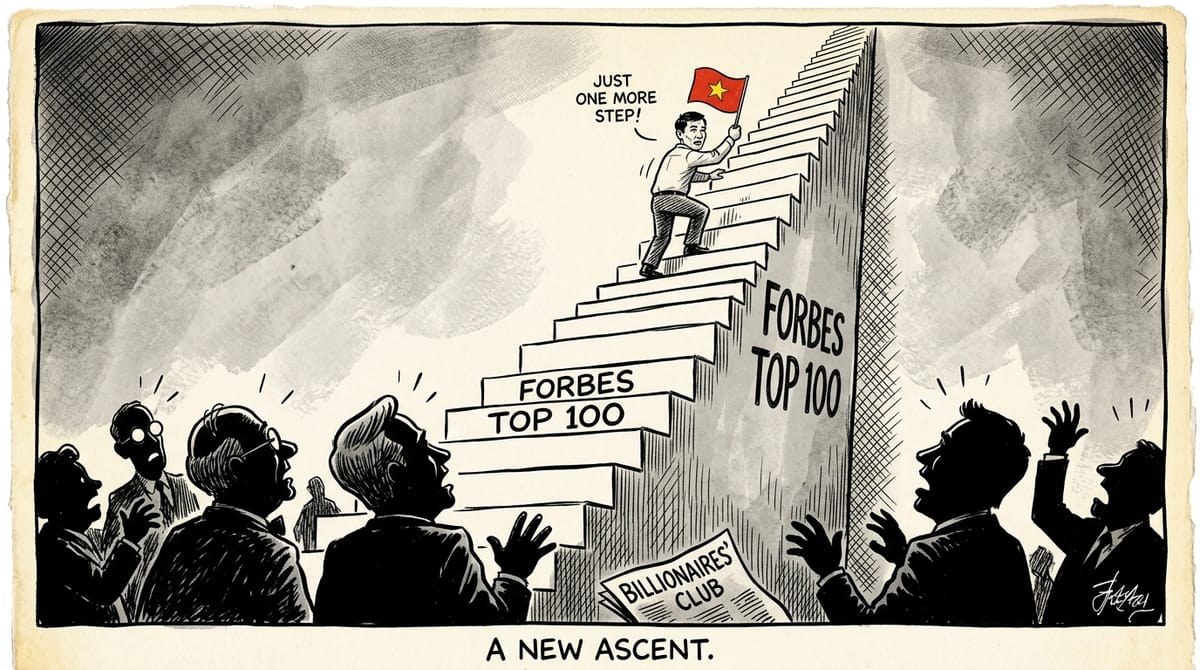
Phạm Nhật Vượng's net worth reached $34.9 billion in 2026, making him Southeast Asia's richest person and the world's 65th wealthiest, per Forbes.
[Pham Nhat Vuong Surpasses Jack Ma: Net Worth Jumps $2.9B in One Day, World's 65th Richest]
▍ The 65th Spot on Forbes' Real-Time List Just Changed Hands
At noon on April 23, the 65th spot on Forbes' real-time billionaires list changed hands.
The new name is Pham Nhat Vuong, founder and chairman of Vietnamese conglomerate Vingroup. His net worth stands at $34.9 billion, up $2.9 billion from the previous day. That's roughly US$900 million added to his wealth in less than a trading day.
Those ranked below him on the list now include Amazon founder Jeff Bezos' ex-wife MacKenzie Scott ($32.3B, 70th) and Alibaba founder Jack Ma ($28.4B, 87th).
That also makes Vuong the wealthiest person in Southeast Asia — he overtook Indonesian energy magnate Prajogo Pangestu earlier in April, who had held that position for years.
When Forbes first recognized Vuong as a billionaire in 2013, he was worth $1.5 billion and ranked 974th. Thirteen years later, his wealth has grown more than 20 times over.
▍ Who Is He? From Instant Noodles in Ukraine to Vietnam's Richest
Pham Nhat Vuong was born in Hanoi in 1968. His father served in the Vietnamese army; his mother ran a tea shop. At 18, he got into Hanoi University of Mining and Geology and won a scholarship to Moscow's Geological Prospecting Institute based on his math scores.
After graduating from Moscow in 1993, he didn't return home. He went to Ukraine instead.
There he founded Technocom and — surprisingly for someone who would later become Vietnam's richest person — started making instant noodles. The Mivina brand eventually became one of Ukraine's largest.
In 2002, Vuong wound down his Ukrainian operations and brought the money and experience back to Vietnam. His first projects were a resort (Vinpearl Nha Trang, opened 2003) and Vincom City Towers in central Hanoi. In 2007, he consolidated his businesses into Vingroup.
From there to today, Vingroup has expanded from real estate into retail, healthcare, education, and electric vehicles — and most recently into steel, electricity, rail, and ports.
▍ Why His Net Worth Is Surging Right Now
Vingroup's stock (VIC) has risen about 60% since mid-March. On April 22 alone, VIC hit its daily upper limit, pushing Vingroup's market cap to $60 billion (nearly NT$2 trillion).
Why such a strong rally? Several triggers hit the same timing:
First, VinFast's Q1 earnings looked solid. On April 22, VinFast reported nearly 60,000 electric vehicles delivered globally in Q1 (up 61% year-on-year), plus more than 140,000 electric scooters delivered (up 219% year-on-year). Domestically, VinFast holds 43% of Vietnam's electric motorbike market, well ahead of second place.
Second, Vingroup raised its 2026 targets. At its April 22 annual general meeting, the group announced a revenue target of around US$19 billion for 2026 (up 46% from 2025), with post-tax profit expected to reach nearly US$1.4 billion — roughly three times 2025's actual figure.
Third, Vietnam's electric-vehicle policy timing aligns neatly with VinFast. The prime minister signed a directive last July mandating that Hanoi's inner ring go petrol-motorbike-free starting July 2026, with the entire city restricted to pure-electric vehicles by 2050. It doesn't take much guessing to figure out which company catches that policy tailwind.
▍ How Big Is Vingroup, Really?
Net worth alone doesn't quite capture Vingroup's weight in Vietnam. A few data points help.
Vuong's family holds about 65% of Vingroup's shares combined, with Vuong himself directly holding around 10% — nearly 400 million VIC shares.
Vingroup's current market cap of roughly $60 billion makes it the single largest listed company on Vietnam's stock market. The entire Vietnamese stock market is worth about $350 billion, meaning Vingroup alone accounts for close to 20% of it. For comparison, TSMC has a market cap of about $2 trillion and accounts for over 40% of Taiwan's stock market. Vingroup's dominance over Vietnam isn't quite at TSMC-over-Taiwan levels, but it's impossible to ignore in Vietnam's market.
The business range is striking. Real estate (Vinhomes), retail, education, healthcare, electric vehicles (VinFast) — familiar names. But Vingroup's most recent expansion targets are: steel, electricity, rail, and ports. Almost every major industrial-and-infrastructure project Vietnam's government plans for the next decade now appears on the group's new-business roadmap.
▍ Jack Ma's Descent: From $60 Billion to $28.4 Billion
Another half of the reason Vuong can now sit at Forbes' 65th is that Jack Ma's net worth has been dropping for years.
In October 2020, Ma publicly criticized China's financial regulatory system at a Shanghai forum, saying it was too conservative and stifled innovation. Less than two weeks later, his Ant Group — at the time the world's largest planned IPO — was halted by Chinese regulators. Alibaba's market value has eroded systematically since then, with reports estimating cumulative losses of around $850 billion under continued regulatory pressure. Ma's personal wealth fell from a peak of more than $60 billion to today's $28.4 billion.
▍ Vingroup's Expansion Has Had Its Bumps Too
Vingroup's most recent controversial move was Vietnam's North-South high-speed rail project. In May 2025, Vingroup subsidiary VinSpeed submitted an investment proposal — with the condition that the government provide 80% of the capital as a 35-year zero-interest loan, leaving Vingroup to put up only 20%. Those terms drew domestic criticism in Vietnam. In December, Vingroup withdrew the bid, and VIC's stock dropped nearly 7% that day.
Before that, in October of last year, Vingroup established VinMetal and formally entered the steel industry. First-phase capacity is planned at 5 million tons per year, with the plant sited in Ha Tinh Province.
▍ Vietnam's First Globally-Ranked Billionaire
For Vietnam, Vuong making Forbes' 65th is a symbolic moment. He's also now Southeast Asia's richest person.
What to watch next is whether Vingroup can actually deliver the revenue and profit targets it set at its own AGM for 2026.
The Viet Media Monthly
A curated monthly digest of the most important political, economic, tech, and industry developments in Vietnam.
Designed for reading on desktop or tablet — no algorithm, no noise. Just the stories that matter.
Delivered before the 10th of each month. Cancel anytime.