Vietnam's 'Vingroup-ization': When One Conglomerate Makes Up 40% of the VN30
The VN-Index hit 1,900. But does that number still represent Vietnam's economy?
[Vietnam's "Vingroup-ization": When One Conglomerate Makes Up 40% of the VN30]
Vietnam's benchmark VN-Index broke through 1,900 points in early 2026.
On the surface, that looks like good news for Vietnam's economy.
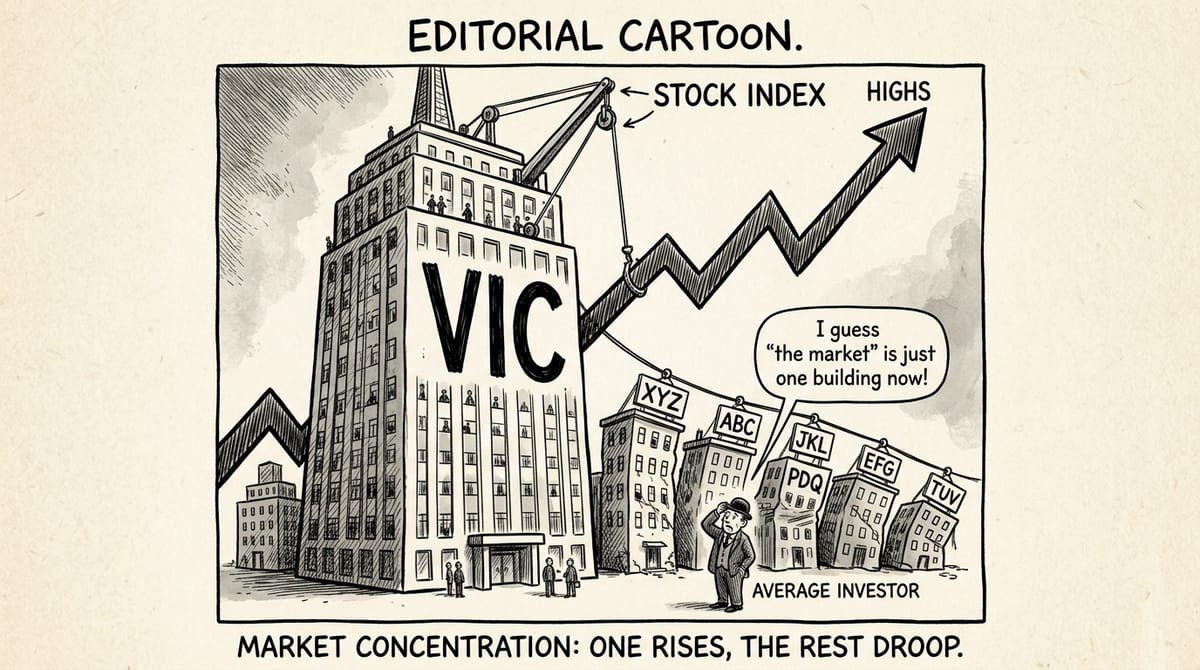
But the index now tells you less about Vietnam than it does about a single conglomerate.
You think you're looking at a country. You're actually looking at one company group.
01|Vingroup Alone Makes Up Nearly 40% of the VN30
Recent data shows that of the VN30 — Vietnam's benchmark index of its 30 largest listed companies — close to 40% of total market capitalization belongs to Vingroup-affiliated stocks.
That includes VIC (the parent), VHM (Vinhomes, real estate), VRE (Vincom Retail, commercial property) and VPL (Vinpearl, hospitality).
This means anyone passively tracking the VN-Index — through ETFs, foreign funds, or simply by reading the index as a barometer of Vietnam's economy — has a substantial slice of their exposure concentrated in one conglomerate.
02|The "Vingroup-ization" Only Took Shape in 2025
Before 2021, Vingroup had been Vietnam's largest listed company by market cap.
But for the next four years, the title belonged to Vietcombank, the country's largest bank by market value.
Vingroup only reclaimed the top spot in September 2025.
In 2025 alone, the combined market cap of Vingroup-affiliated stocks rose roughly 5.5x. VIC alone climbed 8.4x.
Taiwan's "TSMC concentration" and Korea's "Samsung dominance" took more than a decade to build. Vietnam's "Vingroup-ization" played out in the past twelve months — and it's still accelerating.
03|How Does Vietnam Stack Up Against Taiwan and Korea?
Per Taiwan's Futures Exchange disclosure dated April 30, TSMC alone accounts for roughly 44% of Taiwan's weighted index.
The number-two component, Delta Electronics, sits at just over 4.4% — nearly ten times smaller than TSMC.
Taiwanese investors have a phrase for this: "lift TSMC, lift the index. Sell TSMC, sink the index."
In Korea, Samsung Electronics and SK Hynix together make up close to 40% of the KOSPI.
Add in the rest of the Samsung Group and SK Group's listed firms, and that figure crossed 60% at the end of February 2026 — nearly doubling year-on-year.
For comparison: in the United States, the so-called "Magnificent 7" — Apple, Microsoft, Google, Nvidia, Amazon, Meta, and Tesla — together make up just over 30% of the S&P 500.
Seven companies versus Korea's two, versus Taiwan's one. That is the difference in concentration.
Vietnam's near-40% puts it in similar territory to Taiwan and Korea, far more concentrated than the U.S.
04|But There's One Key Difference
TSMC is the world's leading semiconductor foundry. Samsung and SK Hynix are the world's two largest memory chip makers.
The fact that Taiwan and Korea's indices are concentrated in these companies reflects something real: these firms are the export-side backbone of their respective economies.
What about Vingroup? Its market value comes from real estate (Vinhomes), retail and commercial property (Vincom Retail), and hospitality (Vinpearl).
The group does have VinFast in electric vehicle exports, but the bulk of its market cap remains in domestic-facing real estate and consumer assets.
When a manufacturing-and-export-driven economy has a stock market dominated by real estate and consumer conglomerates, the link between the index and the underlying economy becomes weaker than what you see in Taiwan or Korea.
Reading the VN-Index as a proxy for Vietnam's economy probably warrants a discount.
05|When a Single Stock Carries the Entire Index
On April 22, 2026, the day VIC hit its daily upper limit, 194 stocks on the Vietnamese exchange closed lower while only 111 closed higher.
Yet the VN-Index still rose.
Why? Because VIC alone added more than twenty index points — enough to overwhelm the broad decline.
For passive money tracking the index, that means holding a VN-Index ETF effectively concentrates a meaningful chunk of exposure in a single conglomerate.
For foreign observers using the VN-Index as a proxy for Vietnam's economy, the index's interpretive value is eroding fast.
The Viet Media Monthly
A curated monthly digest of the most important political, economic, tech, and industry developments in Vietnam.
Designed for reading on desktop or tablet — no algorithm, no noise. Just the stories that matter.
Delivered before the 10th of each month. Cancel anytime.