The Country That Celebrates Women's Day Twice a Year
Vietnam celebrates Women's Day twice a year. Flower prices triple, tens of thousands join an ao dai flash mob, and the scale of celebration is hard to find anywhere else.
March 8 is International Women's Day. In most of the world, it barely registers — a social media post here, maybe a corporate email there.
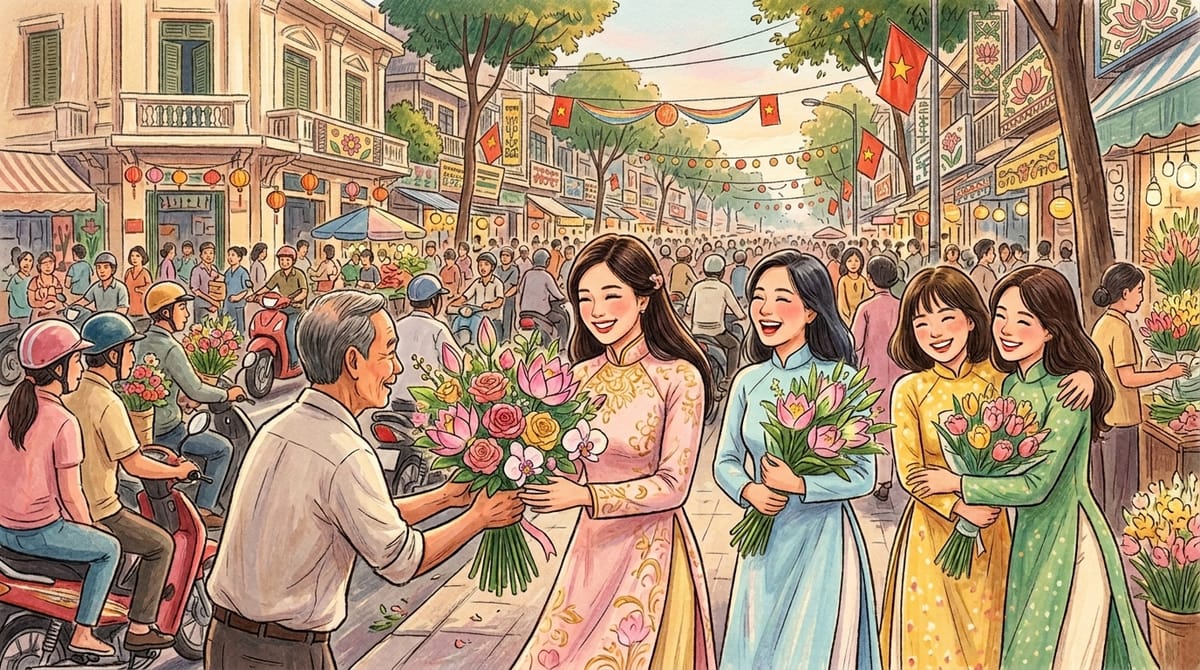
In Vietnam, it is a national event. Flower markets are jammed before sunrise. Offices organize dinners. People carry bouquets through the streets all day. And Vietnam does this not once, but twice a year — making it quite possibly the most enthusiastic Women's Day country on Earth.
Why Twice?
The first Women's Day, on March 8, is the same one the rest of the world observes.
The second, on October 20, belongs to Vietnam alone. The date marks the 1930 founding of the Vietnamese Women's Anti-Imperialist Association, which later became the Vietnam Women's Union. It honors women's role in the revolution and in building the nation. For many Vietnamese, October 20 actually feels more personal than March 8.
Neither day is an official public holiday — there's no day off — but the whole country celebrates anyway.
The Flower Frenzy
Flowers are the universal Women's Day gift in Vietnam. Vietnamese women keep fresh flowers at home as a matter of course, so giving flowers is the natural first move.
The supply chain, predictably, buckles under the pressure.
Vietnam's largest flower-growing region is Da Lat, where rose farms around Lang Biang cover roughly 600 hectares. On a normal day, a single Da Lat rose costs 20,000 to 40,000 VND. A bouquet runs 400,000 to 500,000 VND.
Two days before March 8, velvet roses jump three to four times in price. Bouquets hit 600,000 to 700,000 VND. Red roses run short. Imports from China can't fill the gap. Vendors start turning people away.
Hanoi's Quang An flower market fills up before dawn, with vendors taking orders past midnight. Ho Chi Minh City's Ho Thi Ky market is wall-to-wall people — some buyers give up on fresh flowers and grab silk arrangements instead, which look just as good and won't wilt.
This year, March 8 landed on a Sunday, so the buying rush started early. Markets were already buzzing by March 6.
Not Just for Partners
What sets Vietnam apart is how broadly the gift-giving extends. Mothers, sisters, female colleagues, classmates, even casual female friends — everyone is on the list.
In schools, students chip in to buy roses for every girl in class. Teachers and students pose together in ao dai. Some schools put on poetry readings and talent shows.
At workplaces, departments hand out small red envelopes to female employees, then head to a group lunch or dinner. Some companies hold award ceremonies for outstanding women. Others just give their female staff the afternoon off.
The commercial engine revs up days in advance. Flower stalls and heart-shaped balloon vendors appear on sidewalks. Restaurants push women-only set menus. Spas run half-price promotions. Department stores drape themselves in banners. The energy is something like Mother's Day elsewhere — but for all women.
This year, Vietnamese media spotted a shift in gift preferences. Flowers still lead, but beauty gadgets and "relaxation" gifts are gaining. Essential oil diffusers, Bluetooth speakers, sleep-aid lamps — search volumes for these items climbed noticeably on e-commerce platforms.
There's also a north-south divide. In the south — Ho Chi Minh City, the Mekong Delta — celebrations lean commercial, with themed promotions and date nights. In the north, the vibe is more traditional: family dinners and flowers.
50,000 People in Ao Dai
This year's March 8 came with a nationwide campaign: Ao Dai Week.
Launched in 2019 by the Vietnam Women's Union, Ao Dai Week runs from March 1 to 8. Female civil servants, teachers, and students are encouraged to wear the traditional ao dai throughout the week, with March 8 designated as the unified national wearing day.
The centerpiece this year was Nguyen Hue Walking Street in Ho Chi Minh City. An ao dai art performance kicked things off on March 6-7, followed by a folk dance flash mob with around 50,000 participants. The 12th Ao Dai Festival and the "Charming Ho Chi Minh City Ao Dai" beauty pageant finals ran alongside.
Organizers also launched a "Love Ao Dai" program, donating ao dai to women facing financial hardship.
Around the World
Vietnam isn't the only country that takes March 8 seriously.
In Russia, it's a national holiday — the whole country gets the day off. Flower sales top Valentine's Day, and vendors can make 15 times their normal weekly income. The traditional flower is mimosa, a holdover from Soviet times, though tulips are popular now too. Russian men give flowers to every woman in their orbit: colleagues, teachers, even the cashier at their regular shop.
Eastern European countries share similar customs — every woman in the family, from babies to grandmothers, receives flowers. In Italy, mimosa is the flower of choice; some regions just call the day "Mimosa Day."
The United States, by contrast, barely acknowledges March 8 at all.
What makes Vietnam unique is the doubling. March for the international version. October for its own. Two rounds of flowers, two rounds of gifts, two rounds of dinners.
No wonder the flower industry is booming.