Why Vietnam's City Universities Are Just a Few Buildings
Many universities in Hanoi and HCMC squeeze thousands of students into a handful of buildings. Here is why -- and what Vietnam is doing about it.
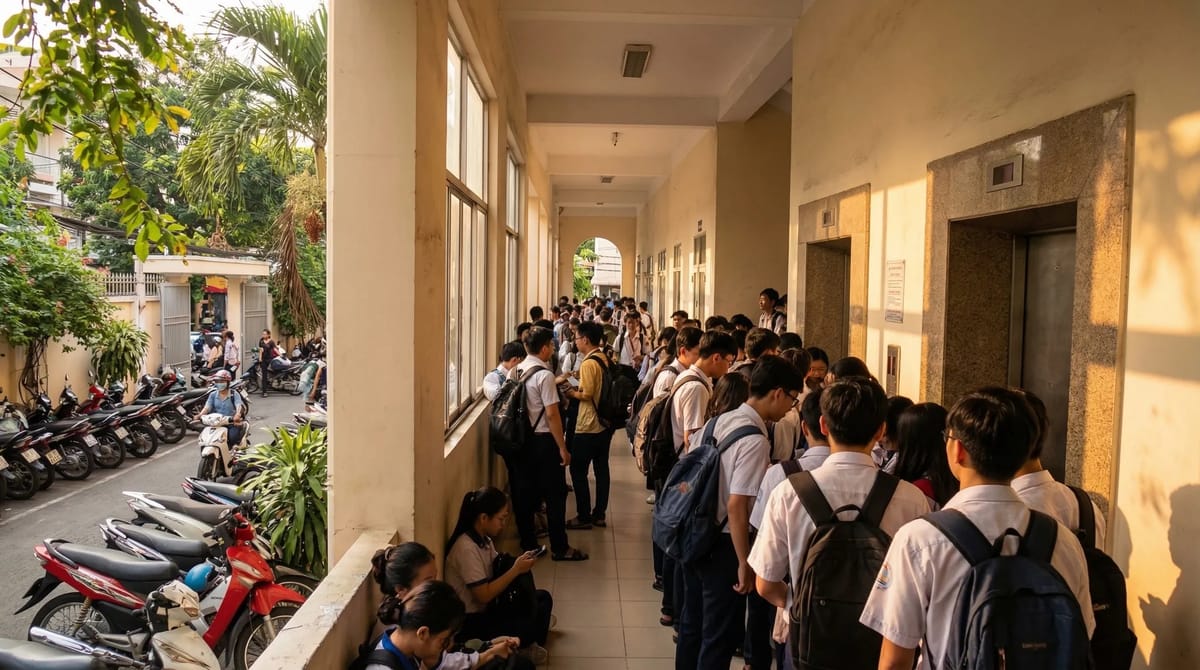
Walk into a university in central Ho Chi Minh City or Hanoi and the first thing you notice is how small it is. The entire school might be a few buildings — every department and thousands of students crammed inside. No lawns, no tree-lined walkways, no surface parking. Just concrete going straight up.
This isn't the case everywhere in Vietnam. But in the two biggest cities' downtown cores, it's the norm.
Half a soccer field for an entire university
The Foreign Trade University's Ho Chi Minh City campus occupies just 5,000 square meters — about half a soccer field — and serves thousands of students. The main Hanoi campus is better off, but still only 2.7 hectares, built around a single 12-story building with 32 classrooms packed inside.
The Ho Chi Minh City University of Architecture is another striking example. Its narrow plot left architects with no choice but to build up: one 8-story block, one 4-story block. Thousands of students shuffle between them daily, the elevators perpetually jammed.
These "vertical campuses" exist for one reason: there's simply no land.
Two to five square meters per student
Vietnam's Ministry of Education requires at least 10 square meters of campus space per student. That standard is already modest. Reality is worse. Surveys show many downtown universities provide just 2 to 5 square meters per student — barely enough room for a desk.
In Hanoi alone, 26 universities are packed into the urban core. Three of them occupy less than one hectare each. One stretch of road just one kilometer long reportedly has seven universities and colleges along it.
For comparison, National Taiwan University's main campus covers 106 hectares. The Foreign Trade University in Ho Chi Minh City has 0.5 hectares — a 200-fold difference.
The impact on learning is direct: not enough library seats, no sports facilities, labs that require booking weeks in advance, and nowhere to hold student activities.
How universities got stuck downtown
Many of Vietnam's top universities are decades or even a century old. When they were founded, they sat on the outskirts of the city. Today, they're surrounded by high-rises and traffic. Land is far too expensive to expand.
There's a structural reason too. Vietnam's higher education system was modeled on the Soviet Union's, emphasizing narrow specialization — one university trained experts in one field, so campuses didn't need to be big. But enrollment has since ballooned and interdisciplinary programs have grown, and the old footprints can't keep up.
Hanoi University of Science and Technology is the largest urban campus at 26 hectares. That sounds decent, but it serves 35,000 students — an average of about 7 square meters per person, still below the official standard.
Vietnam does have big campuses — just not downtown
Vietnam National University Hanoi's Hoa Lac campus spans over 1,100 hectares. Vietnam National University Ho Chi Minh City's campus covers 643 hectares. These are large by global standards.
Other sizable campuses include Da Lat University at 38 hectares, the Ho Chi Minh City University of Agriculture and Forestry at 120 hectares, and Vinh University at 270 hectares.
But they're all in suburbs or smaller cities. The prestigious, old downtown schools remain trapped in their original plots.
A 20-year relocation plan that barely moved
The Vietnamese government proposed moving downtown campuses to the outskirts back in 2007. The goal: every university should have at least 10 hectares. Schools with less than 2 hectares in city centers were slated for relocation.
Nearly two decades later, progress has been glacial.
The reasons are practical. New suburban campuses sit in areas with no dormitories, no restaurants, no convenience stores — students have nowhere to live. Faculty don't want two-hour commutes. And many schools fear that moving to the outskirts will hurt enrollment, because location still matters to students and parents.
The current compromise: keep graduate programs, research, and international partnerships at old campuses while gradually moving undergraduates to suburban branches. The Foreign Trade University is building a 33-hectare campus in Bac Ninh province, expected to open in 2026.
A slow transformation
Anyone used to sprawling university campuses elsewhere might be startled by Vietnam's urban schools. But these are products of a specific history, not a reflection of Vietnamese higher education as a whole.
Change is underway. Metro Line 5, connecting central Hanoi to the Hoa Lac area, is under construction. Vietnam National University Hanoi has already started moving into its massive new campus. The journey from overcrowded buildings to modern university towns has taken 20 years and may need another 10. But the next generation of Vietnamese students may finally get to experience what a real campus feels like.