Should You Visit Vietnam During Tết? An Honest Guide
Tết means closed shops, pricier hotels, and empty ATMs. But an empty Ho Chi Minh City might be something you'll only ever see once.
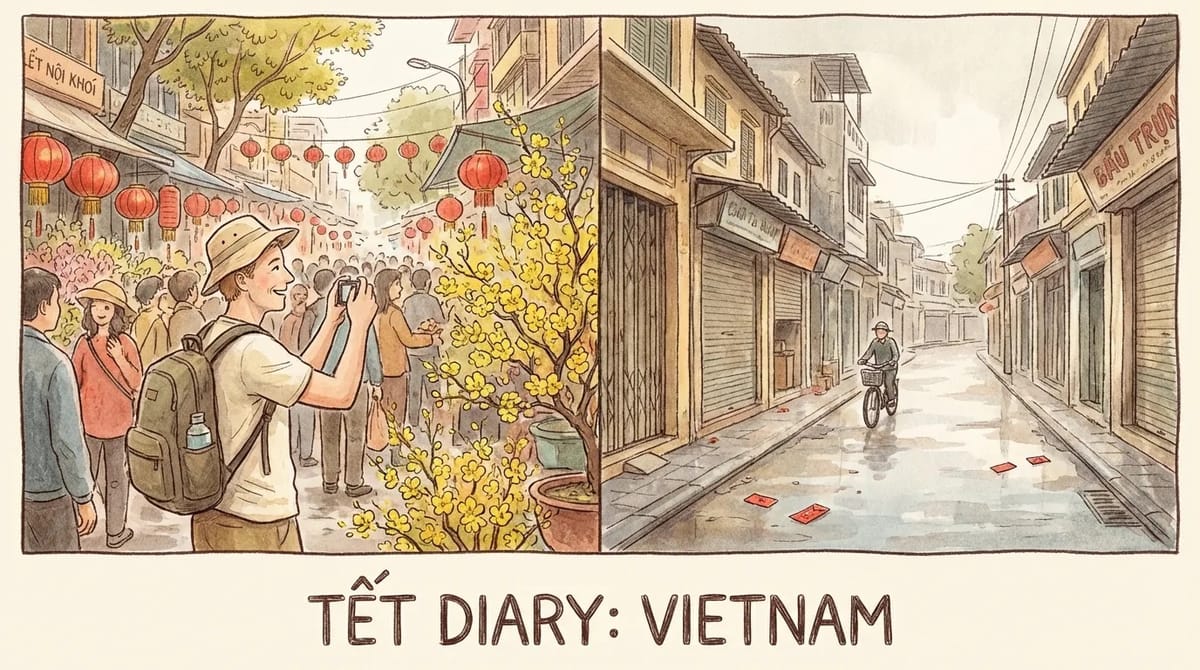
Vietnam celebrates the Lunar New Year — just like Taiwan, China, and Korea.
That might sound familiar and comforting, but for travelers, it means one thing: the country shuts down.
The Tết holiday runs about nine days.
During the first three days — the peak — 80 to 90 percent of restaurants, street food stalls, and shops close.
Convenience stores may run low on stock.
Finding a meal or doing any shopping becomes a real challenge.
So should you go? That depends on what kind of trip you want.
What You'll Deal With
Let's start with the practical stuff.
Flights and hotels get expensive, and they book up fast.
The earlier you reserve, the better.
Many hotels sell out months in advance.
ATMs run out of cash.
Banks are closed for the holiday, and restocking is slow — especially in tourist areas.
Exchange your money before you leave, or stock up on cash a few days before New Year's Eve.
Credit cards work at hotels and chain stores in major cities, but street vendors and small shops are cash-only.
Transportation gets messy.
In the days before Tết, airports and bus stations are packed with people heading home to their provinces.
Around the fifth and sixth day, the return wave hits.
During the first three days, taxis are nearly impossible to find.
Grab is just as bad — most drivers have gone home.
If you're traveling between cities, book tickets or arrange a private car two to three months ahead.
Which Days Are Worst, Which Are Fine
Not all nine days are the same.
Think of it in four phases:
Pre-Tết (February 14 to 16): About 60 percent of shops are still open.
Markets are actually buzzing with last-minute holiday shopping.
The streets are being decorated, flower vendors are everywhere, and families are stocking up on food.
This is when Vietnam feels most festive.
Day 1 to Day 3 (February 17 to 19): Ghost town.
Only about 20 percent of restaurants open.
Street food is gone.
Most museums and attractions are closed.
The upside? The roads are empty.
Ho Chi Minh City — normally gridlocked and deafening — feels like a completely different place.
Day 4 to Day 6 (February 20 to 22): Life slowly returns.
More than half of shops reopen, and attractions resume operations.
But some popular restaurants may still be closed.
Day 7 onward (February 23): Basically back to normal.
Why Some People Go Specifically for Tết
Despite all of this, international visitor numbers during Tết keep growing every year.
Tour packages sell out well before the holiday, even at inflated prices.
People are clearly choosing to come for this.
The reason is simple: Tết reveals a side of Vietnam you can't see any other time.
Hanoi's flower markets are the classic example.
In the week before Tết, the area around Hoàn Kiếm Lake fills with sprawling displays of peach blossoms and kumquat trees.
Northern Vietnam decorates with peach blossoms; the south uses yellow apricot blossoms.
This only happens during Tết.
Temples overflow with locals burning incense and praying for good fortune during the first three days.
For visitors, it's the easiest way to witness Vietnam's folk religious traditions up close.
And then there's the quiet.
Hanoi's Old Quarter is normally so packed you can barely move.
During Tết, you can stroll through the Thirty-Six Streets and actually see the old buildings.
Ho Chi Minh City's District 1, usually roaring with traffic, becomes so silent on New Year's Day that you can hear your own footsteps.
Some travelers come specifically for that.
How to Plan It Smart
If you're going during Tết, a few strategies can help you avoid the worst of it.
For food, hotel restaurants and chain stores like 7-Eleven typically stay open through the holiday.
Research which restaurants near your hotel will be operating — don't wait until you arrive.
Pack some snacks as backup.
Days 1 through 3 are genuinely tough for finding food.
For accommodation, go with large hotels or international chains.
Their service won't dip as much during the holiday.
Guesthouse and small hotel owners may have gone home themselves.
For destination, Đà Nẵng and Hội An recover faster than Hanoi or Ho Chi Minh City — tourism is a bigger share of their economy, so businesses close for fewer days.
Đà Lạt and Phú Quốc are where Vietnamese people themselves go for Tết holidays, so tourist infrastructure stays fully operational — good options for foreign visitors too.
Hạ Long Bay and Ninh Bình are nature destinations largely unaffected by the holiday — boat tours run as usual.
For timing, the smartest approach is to arrive before Tết and leave after.
Land around February 12 to catch the pre-holiday markets and flower fairs.
Spend Days 1 through 3 at nature spots or relaxing at your hotel.
From Day 4 on, the city comes back to life — that's when you hit the shops and restaurants.
If your only available dates are Days 1 through 3, go in with realistic expectations: limited dining, mostly closed attractions, and unreliable transportation.
You can still have a good trip — just build flexibility into your itinerary and have backup plans ready.