Vietnam Is Now America's Largest Single-Month Trade Deficit Source
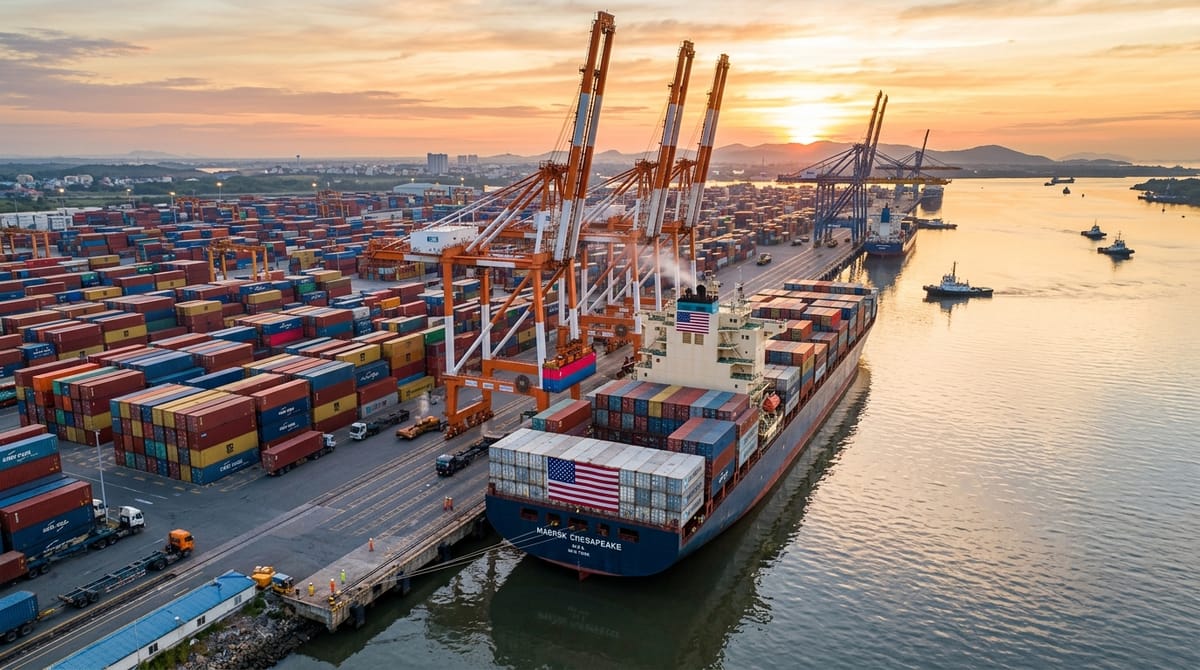
Vietnam's trade surplus with the US has grown from $38.3 billion in 2017 to $178.2 billion in 2025. In early 2026, it became the largest single-month source of America's trade deficit. But how much of that curve truly belongs to Vietnam?
[Vietnam Is Now America's Largest Single-Month Trade Deficit Source]
In early March, the US Department of Commerce released its trade data for January 2026.
Vietnam posted a $19 billion trade surplus with the US that month, the largest of any country. Taiwan came second at $16.8 billion. China was third at $12.7 billion. Mexico fourth at $10.9 billion.
Since late 2025, Vietnam has consistently held the top spot as America's largest single-month trade deficit source. A country with a per capita GDP that just crossed $5,000 is running a bigger monthly surplus with the US than China or Mexico.
That alone is worth unpacking.
▍ A Steep Curve
According to US Census Bureau data, Vietnam's annual trade surplus with the US has grown like this:
2017: $38.3 billion.
2019: $55.6 billion.
2021: $90.9 billion.
2023: $104.6 billion.
2025: $178.2 billion.
Nearly fivefold in eight years.
For 2025 as a whole, China still had the largest annual surplus with the US at $202.1 billion, followed by Mexico at $196.9 billion, Vietnam at $178.2 billion, and Taiwan at $146.8 billion. But on a monthly basis, Vietnam started overtaking the others in the second half of 2025 and reached the top in January 2026.
The question is: why?
Vietnam's manufacturing sector is dominated by assembly work for foreign brands. Most core components are imported. So where did $178.2 billion in surplus come from?
▍ The Detour
The answer goes back to 2018.
That year, the Trump administration slapped 25% tariffs on Chinese goods, triggering the largest supply chain migration in modern history. Contract manufacturers for Apple, Samsung component suppliers, Nike shoe factories — all started looking for alternatives outside China.
Vietnam was one of the biggest beneficiaries. It shares a border with China, labor is cheap (manufacturing wages average about $300 a month, roughly a third of China's), and it already had an industrial base. Samsung set up its first Vietnamese factory in 2009. By 2025, Vietnam was producing half of Samsung's smartphones worldwide.
But there's an important structural detail here.
Many factories that "moved to Vietnam" really only moved the final step: assembly. The components still come largely from China.
Chinese exports to Vietnam surged after 2018. In 2024, Chinese companies launched over 950 new investment projects in Vietnam, more than any other foreign investor. Luxshare, Goertek, BOE — Chinese companies in Apple's supply chain — all built assembly plants in Vietnam.
The global supply chain didn't leave China. It just took a detour on the map. Instead of "made in China, shipped to the US," it became "components made in China, assembled in Vietnam, shipped to the US."
Vietnam's export numbers soared as a result. But export figures reflect where goods are shipped from, not where value is created.
Harvard researchers estimate that 15% to 42% of Vietnam's exports to the US qualify as Chinese transshipments. White House trade adviser Peter Navarro puts it more bluntly: about a third.
▍ Tariffs Made the Winner
Washington noticed early on.
In April 2025, Trump launched "reciprocal tariffs" against dozens of countries. This wasn't aimed solely at Vietnam — it was a sweeping trade offensive. China's effective tariff rate was raised to about 38%. Vietnam was initially hit with 46%, but after negotiations the rate was brought down to 20% in July (40% for goods classified as transshipments), taking effect in August.
After the tariffs hit, Chinese exports to the US did shrink. But supply chains already established in Vietnam don't just pack up because tariffs went from zero to 20%. Factories have been built, equipment purchased, workers trained. The short-term cost of relocating far exceeds a 20% tariff. And with China facing 38% while Vietnam pays 20%, routing through Vietnam is still cheaper than shipping directly from China.
In 2024, Vietnam's trade surplus with the US was $123.5 billion. In 2025, the year tariffs took effect, it jumped to $178.2 billion — a 44% increase. Meanwhile, China's surplus with the US dropped from $295.5 billion in 2024 to $202.1 billion, a decline of about 30%.
Vietnam reaching the top of the rankings was, to a significant extent, a product of the tariff structure itself. Washington tried to use tariffs to block Chinese exports. The flow shifted toward Vietnam instead.
In March 2026, USTR launched a new Section 301 investigation covering 16 countries including Vietnam, citing "structural excess capacity in manufacturing sectors." It's the same legal tool previously used against China.
▍ The Transshipment Dilemma
Beyond the 301 investigation, Vietnam faces another thorny issue: how transshipment is defined.
Under the July 2025 US-Vietnam agreement, regular Vietnamese goods face a 20% tariff. Goods classified as transshipments face 40%. But "transshipment" has no clear definition. Traditionally, it hinges on whether goods undergo "substantial transformation" locally, usually requiring at least 30% domestic value added. Washington can choose to tighten that definition, reclassifying more Vietnamese exports as transshipments.
According to analysis by the Lowy Institute, most Vietnamese companies lack the detailed production records needed to prove their value-added ratios. That puts the power of classification almost entirely in American hands.
Cracking down on transshipment is also a dilemma for Vietnam itself. Cooperating with the US means restricting Chinese business activity in Vietnam. But China is Vietnam's largest trading partner and its biggest source of component imports. As Lowy's analysis points out, anti-transshipment enforcement for Vietnam is a geopolitical dilemma, not just a trade issue.
▍ The Question Behind the Curve
Vietnam's trade surplus with the US grew fivefold over eight years, reaching $178.2 billion in 2025. The numbers make Vietnam look like a major winner in global trade.
But one question remains unanswered: of that $178.2 billion, how much value actually stays in Vietnam?
Harvard's transshipment estimates range from 15% to 42% — a wide band that shows even academics don't have a clear answer. What's certain is that a significant share of the value in Vietnam's exports originates from Chinese-made components, and systematic data on Vietnam's actual domestic value added is scarce.
This won't stay an academic question for long. The Section 301 investigation is underway. Transshipment standards could tighten at any time. The bigger Vietnam's surplus numbers get, the more scrutiny they'll attract.
The Viet Media Monthly
A curated monthly digest of the most important political, economic, tech, and industry developments in Vietnam.
Designed for reading on desktop or tablet — no algorithm, no noise. Just the stories that matter.
Delivered before the 10th of each month. Cancel anytime.