73.5 Million Vietnamese Vote Tomorrow — How Elections Work Under One-Party Rule
Vietnam holds its once-every-five-years national election tomorrow, with 73.5 million voters choosing 500 National Assembly representatives — the first election after sweeping administrative reforms.
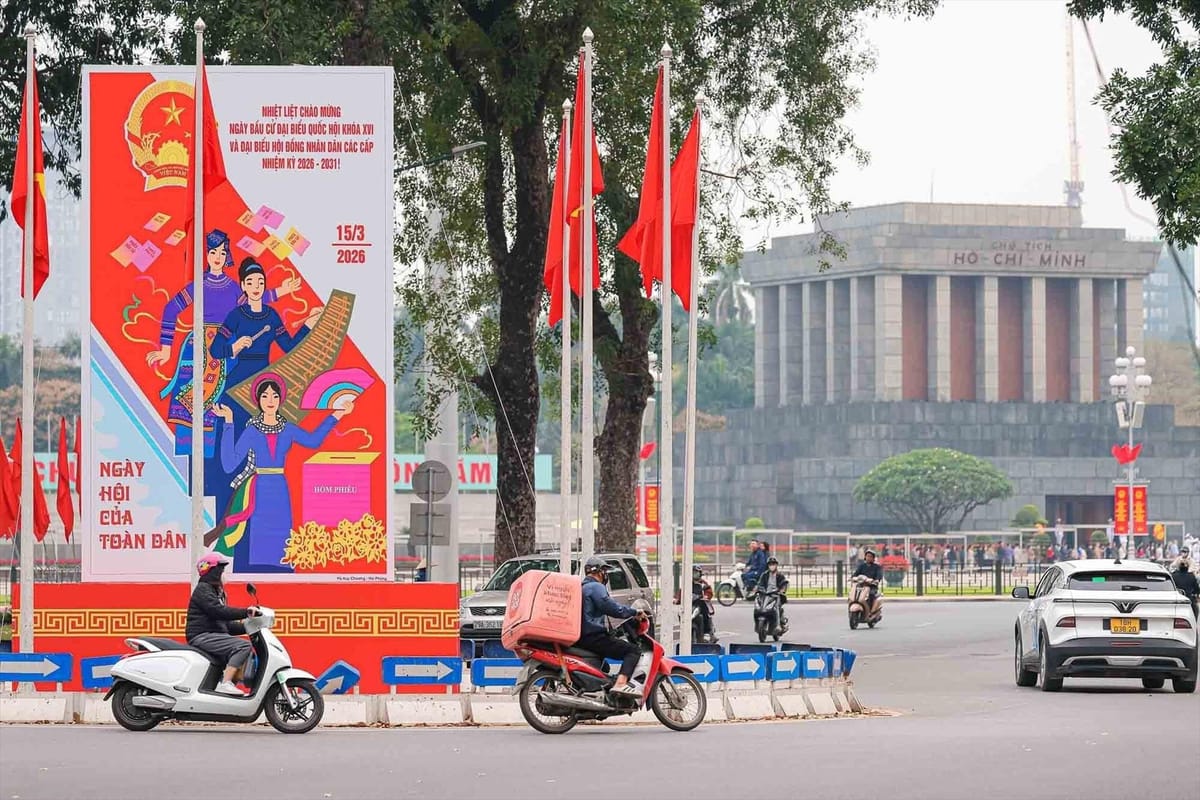
Tomorrow, March 15, Vietnam holds its once-every-five-years national election. Voters will choose 500 representatives for the 16th National Assembly (Quốc hội) and delegates for People's Councils (Hội đồng nhân dân) at all levels. The new term runs from 2026 to 2031.
About 73.5 million eligible voters will cast ballots across 182 electoral districts.
This election is unusual in several ways — and in the context of Vietnam's recent political reforms, it deserves close attention.
An Early Election, Timed to Political Reform
The 15th National Assembly's term wasn't supposed to end until July 2026. But last May, lawmakers voted unanimously — 449 to 0 — to cut the term short and hold early elections.
The reason ties to Vietnam's sweeping political overhaul.
In January, the Communist Party of Vietnam held its 14th National Congress, where General Secretary Tô Lâm was reconfirmed. The party's new leadership lineup was set. An early election lets the new National Assembly take office sooner, closing the gap between the party congress and the legislative changeover, and speeding up personnel decisions at the top.
The new National Assembly is expected to convene its first session on April 6, when it will formally elect the chairman of the National Assembly, the president, and the prime minister.
Vietnam's political system used to be described as having "Four Pillars" (Tứ Trụ) — general secretary, president, prime minister, and National Assembly chairman. Since 2025, the "Standing Secretary of the Secretariat" (Thường trực Ban Bí thư) has been elevated to a fifth core position, creating a "Five Pillars" (Ngũ Trụ) structure. This election is, in essence, the legal mechanism for formally installing the personnel decisions made at the party congress into state institutions.
The First Vote After Vietnam's Biggest Administrative Overhaul
This is also the first nationwide election since Vietnam launched what it calls the "streamlining revolution."
In July 2025, Vietnam implemented a massive administrative restructuring. The country's 63 provinces and cities were merged into 34 (28 provinces and 6 centrally governed cities). The district level was eliminated entirely, collapsing the old three-tier system (province-district-commune) into two tiers (province-commune).
Commune-level units were reduced from over 10,000 to about 3,321 — a nearly 70% cut.
Provincial and commune-level mergers alone are expected to eliminate over 130,000 civil service positions. Combined with central ministry streamlining, the reforms are projected to save about VND 190 trillion ($7.3 billion) in administrative spending between 2026 and 2030.
Because every administrative boundary was redrawn, electoral districts had to be redrawn too, and local councils needed full re-election. That's one reason this election is so large in scope.
864 Candidates for 500 Seats
According to the National Election Council, 864 candidates are running for 500 National Assembly seats — a ratio of about 1.73 candidates per seat.
The candidate composition is notable:
392 female candidates, or 45.37%.
188 ethnic minority candidates, or 21.76%.
65 non-Communist Party members, or 7.52%.
4 self-nominated candidates.
612 first-time candidates — more than 70% of the total.
Vietnam's election law requires that women make up at least 35% of the official candidate list and ethnic minorities at least 18%. Both thresholds are exceeded this time.
All candidates must pass three rounds of consultative conferences organized by the Vietnam Fatherland Front (Mặt trận Tổ quốc) to make it onto the final ballot. Non-party members and self-nominated candidates can run, but they go through the same screening process.
How Elections Work in a One-Party State
Vietnam is a one-party socialist state, but it holds direct national elections every five years.
Citizens 18 and older can vote. Those 21 and older can run for office. Voting is universal, equal, direct, and by secret ballot. Elections are required to be held on a Sunday.
Ballots list each candidate's Communist Party membership date. For non-members, that field is left blank. Voters cross out the names of candidates they do not support.
Soldiers and civilians on the Spratly Islands (known in Vietnam as Trường Sa) voted early on March 8. Election workers even brought ballot boxes to fishing boats so crew members at sea could participate.
This system is fundamentally different from multiparty competitive elections — the candidate selection process is party-led. But for Vietnam, the nationwide vote held every five years remains an important source of political legitimacy.
The Real Action Comes After the Vote
More than the election results themselves, the post-election personnel appointments and policy direction are what to watch.
The new National Assembly is expected to take office in April, formally electing the president, prime minister, and National Assembly chairman, and pushing through a batch of new legislation aligned with the administrative reforms. The merger from 63 to 34 provinces, the shift from three tiers to two — none of that truly takes hold without extensive supporting legislation.
Whether the new National Assembly can keep pace with the speed of reform will become clear in the months ahead.